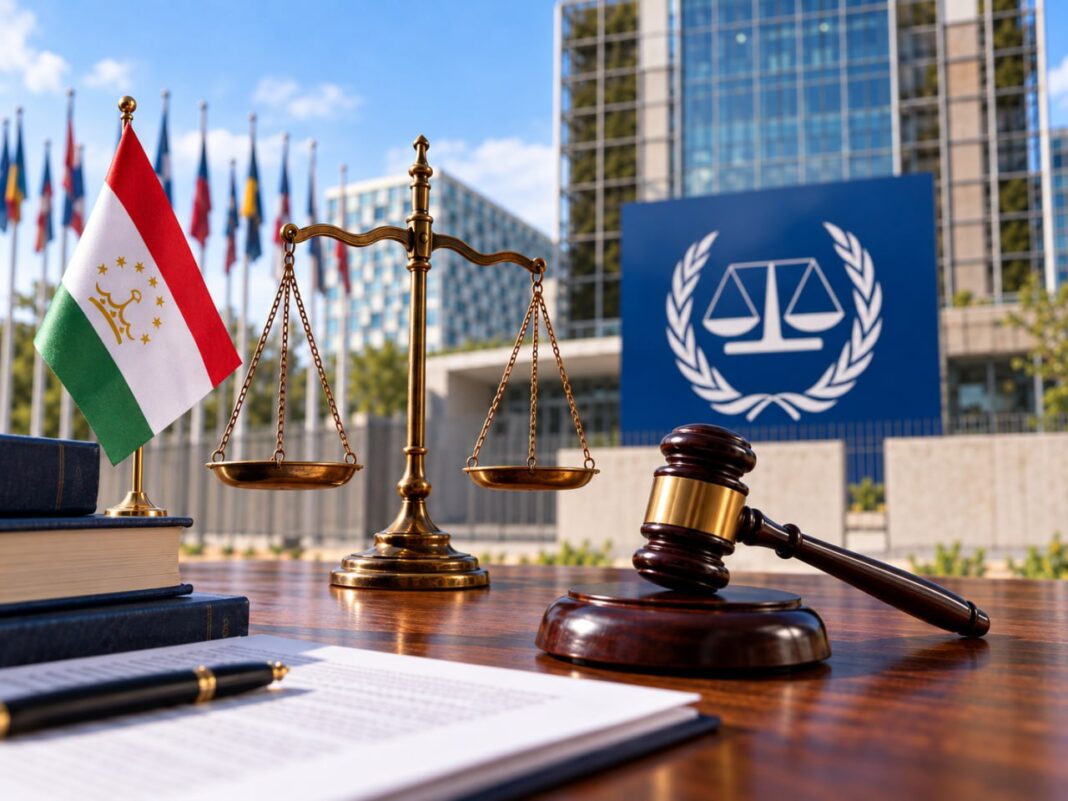
Tajikistan, a key Central Asian country,
has formally announced its withdrawal from the International Criminal Court
(ICC) and notified the United Nations of its decision. UN Secretary-General António Guterres has
confirmed Tajikistan’s decision to withdraw from the ICC. According to Russia’s
TASS news agency, Tajikistan formally notified the Secretary-General in writing
on November 20. Under Article 127 of the Rome Statute, the withdrawal will take
effect on November 20, 2027.
The announcement comes just days after the presidents
of the United States, Russia and China jointly challenged the jurisdiction of
the international court at a historic trilateral summit. With this
announcement, Tajikistan has become the seventh country to initiate the process
of withdrawing from the ICC in 2026. Niger, Burkina Faso, Mali, Chad, Venezuela
and Nauru had previously announced their withdrawal. It is worth noting that the Rome Statute is
the international treaty under which the International Criminal Court, based in
The Hague, Netherlands, was established. The treaty was adopted on July 17,
1998, during a United Nations diplomatic conference in Rome, the capital of
Italy, and officially entered into force on July 1, 2002.
Under the treaty, the ICC has the authority to
prosecute and punish individuals responsible for four of the most serious
international crimes: genocide, crimes against humanity, war crimes and the
crime of aggression. Countries that sign
and ratify the treaty are legally obligated to arrest and surrender individuals
to the court if the ICC issues arrest warrants against them and they enter
their territory. Pakistan, the United States, Russia, China, India and Israel
are not parties to the Rome Statute. Consequently, the ICC's jurisdiction does
not directly apply to these countries. Under Article 127 of the treaty, any
member state may withdraw by submitting written notification to the UN
Secretary-General. However, its membership remains in force for one year after
the notification is submitted.
Putin’s Arrest Warrant and His Visit to
Tajikistan
The circumstances surrounding Russian President
Vladimir Putin’s visit to Tajikistan in October 2025 are also significant in
the context of the country's decision to withdraw from the ICC. In March 2023, the ICC issued arrest warrants
for Russian President Vladimir Putin and Maria Lvova-Belova, Russia’s
Presidential Commissioner for Children's Rights, over allegations of the
unlawful deportation of Ukrainian children. However, Moscow refused to
recognise the court’s jurisdiction. Later,
in October 2025, Putin paid an official visit to Dushanbe, the capital of
Tajikistan. Despite being a member state of the ICC, the Tajik government did
not arrest him. The incident drew strong criticism from the European Union. In March 2026, ICC judges also formally ruled
that Tajikistan had violated its obligations under the Rome Statute and
referred the matter to the Assembly of States Parties for further action.
International Reaction to Tajikistan’s Decision
The ICC’s Assembly of States Parties and the
European Union have expressed serious regret over Tajikistan’s decision. They
have made it clear that withdrawal from the treaty does not release the country
from legal obligations incurred during its membership, including its failure to
cooperate in the case involving Putin. It
is worth noting that the International Criminal Court, established under the
1998 Rome Statute, is not part of the United Nations. Several major powers,
including the United States, Russia and China, do not recognize its
jurisdiction. During the recent Shenzhen
Summit, US President Donald Trump described the ICC as an "unaccountable
globalist organization", saying that the institution had become out of
control. China also joined the United States and Russia for the first time in
calling for reforms to the institution. Following
the receipt of Tajikistan’s withdrawal notification by the United Nations, the
one-year withdrawal period stipulated under the treaty has begun. Tajikistan’s
membership will formally end on November 20, 2027.