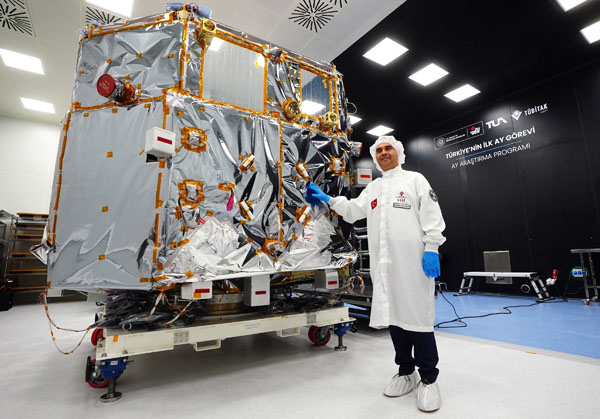
Türkiye has completed the
production and assembly of its first lunar spacecraft and handed over the
3.5-metric-ton spacecraft to Turkish Aerospace Industries (TAI) for
environmental testing. According to the Emirates News Agency (WAM), Minister of
Industry and Technology Mehmet Fatih Kacır said in a statement that the
spacecraft will be launched from the Kennedy Space Center in early 2027 and
will take approximately two months to reach a 100-kilometer (62.13-mile) high
polar orbit around the Moon.
The spacecraft will operate in lunar
orbit for three months, although its mission duration could potentially be
extended to up to one and a half years. During this period, locally developed
scientific instruments will be used to study solar winds, the formation of
water, magnetic fields, and surface radiation. Mehmet Fatih Kacır said these
efforts are aimed at establishing a “fully self-reliant Türkiye in critical
technologies,” following the same approach the country has adopted in its
defense industry.
The spacecraft incorporates
key communications and power systems developed for the previous İMECE and
Türksat 6A satellite projects and have a domestic production rate of 80
percent. Citing Anatole Agency, Kacır said further tests will verify the
spacecraft’s ability to withstand the harsh conditions encountered during
launch and in the space environment. After that, the spacecraft will be
transferred to the new clean-room facility of TÜBİTAK UZAY for final
inspections.
The spacecraft will use a
locally developed hybrid propulsion system for orbital insertion operations and
for the final controlled deceleration maneuver required to reach the lunar
surface after completing its primary scientific mission. The minister said that
so far, only eight countries have carried out lunar missions, and when Türkiye
completes its program, it will become the ninth country to do so. The development comes as Türkiye recently
joined the Artemis Accords, which aim to promote international cooperation in
the peaceful exploration of the Moon and beyond. Mehmet Fatih Kacır said
production of the Türksat 7A communications satellite has begun, while the
design phases for the İMECE-2 and İMECE-3 Earth-observation satellite
constellations are also underway.