In
most countries around the world, people tend to suffer from various health
problems as they grow older. However, in Japan, the number of people reaching
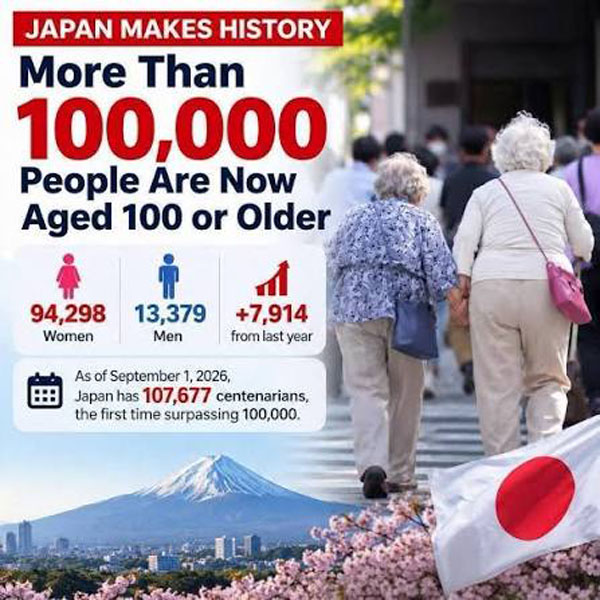
the age of 100 or older continues to rise. Notably, for the first time, the
number of centenarians in Japan has surpassed 100,000. As the elderly
population continues to grow, the country’s overall population is declining,
while the number of working-age people is also decreasing.
According
to a report by CNN, citing Japan’s Ministry of Health, Labor and Welfare, the
number of people aged 100 or older in the country rose to 107,677 in September.
This is approximately 8,000 more than the previous year. It marks the 56th
consecutive year that the number of people aged 100 or older has increased in
Japan.
It
is worth noting that women make up a significantly larger proportion of Japan’s
centenarian population. Of the total 107,677 people aged 100 or older, 94,298
are women, meaning that women account for approximately 88 percent of the
total. By contrast, the number of men in this age group is considerably lower.
These figures indicate that women in Japan are significantly ahead of men when
it comes to reaching an advanced age. Japan’s Health Minister Kenjiro Ueno
expressed his happiness over the figures, saying he was pleased that such a
large number of people are continuing to live active and healthy lives for so
many years.
Japan
is considered one of the countries where people live the longest. According to
World Bank data, Japan’s average life expectancy was approximately 84 years in
2024. By comparison, the figure in the United States was around 79 years.
Several factors are cited as contributing to Japan’s longevity. The traditional
Japanese diet includes plenty of fish, vegetables, and other well-balanced
foods. In addition, the country has a highly developed healthcare system.
Regular health checkups and improved medical facilities also help people live
longer lives.
Another
aspect of longevity that is frequently discussed in Japan is “Ikigai,”
which refers to a reason for living or an activity that gives person happiness
and a sense of fulfillment. Many Japanese people remain active in one way or
another even as they grow older. For them, family, society, work, hobbies, or
responsibilities can help maintain a sense of purpose in life. Although Japan
has faced criticism for its culture of working for long periods, particularly
in major cities, many people in the country continue to remain active even
after retirement.
It
is noteworthy that Japan is already grappling with the challenges posed by a
declining population. The country has a population of approximately 123
million, and it continues to decline. Its birth rate has fallen to a record
low. This is having a direct impact on the country’s working-age population:
the number of elderly people is increasing, while the number of young
working-age people is declining in comparison. As a result, government and
family spending on elderly care is increasing. At the same time, finding an
adequate number of workers is becoming a major challenge for companies and the
wider economy.