“European
colonial powers described the people of Asia and Africa as uncivilised,
ignorant and lazy in order to justify establishing colonies in these regions
and legitimise their political domination.”
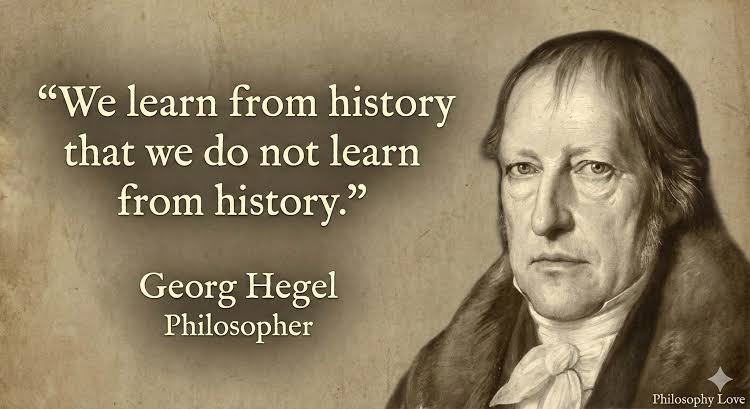
While delivering lectures on the philosophy of
history, the German philosopher Hegel (d. 1831) argued that only Europe had a
history, while the rest of the world was deprived of history, and Africa, in
particular, was a dark continent. Other European historians also endorsed this
view, including British historian Hugh Trevor-Roper, who repeated Hegel’s
theory.
This raises the question of whether European
historians were simply ignorant about Africa and, unable to acquire sufficient
knowledge of the continent, concealed their own ignorance by describing it as
“dark”. A second question concerns what European historians actually meant by
history. Did they define history in terms of military conquests, occupying
other countries, plundering their wealth and resources, and enslaving or
killing defeated populations? If that is their definition of history, then
Africa certainly does not fit the model. Does participating in the historical
process require adopting the European model? As the African leader Marcus
Garvey once suggested, the African continent could become great and powerful
only if it became imperialist it conquered other countries and exercised its
strength and power.
This so-called Dark Continent became the centre
of attention for European imperial powers when they developed an interest in
exploiting its natural resources. European explorers, adventurers, politicians
and intellectuals then set out to “discover” Africa and bring it out of
darkness into the light. Consequently, Portugal, France, Britain, Germany and
Belgium sent their armies to occupy different parts of the continent, ushering
in an era of exploitation and plunder.
The process initially began with the slave trade.
As colonial powers gradually expanded their control, they seized land,
displaced local populations and brought settlers from their own countries to
occupy the confiscated territories, providing them with the full support of
their imperial governments. Subsequently, research and exploration began in
almost every field. Mineral deposits were discovered, and the discovery of gold,
silver and diamonds enabled major European trading companies to establish
monopolies over these resources.
When labour shortages emerged in the colonies,
the British government sent poor and unemployed workers from India to its
African possessions as indentured labourers. This was essentially a form of
slavery. These workers were not allowed to form trade unions, their working
hours were extremely harsh, and they were required to live in the same places
where they worked. Indian labourers toiled in British colonies such as Kenya,
Nigeria, Uganda and Ghana. They had virtually no fundamental rights. Although
they were subjects of the British Crown, Britain provided them with no
meaningful protection.
France controlled several colonies in Africa,
while Belgium possessed the Congo. Portugal held colonies in Mozambique and
Guinea-Bissau. The Germans had occupied Tanzania and Namibia, while the Dutch
had established settlements in South Africa. Britain particularly sent
engineers, technicians and administrative officials from India to Africa.
Christian missionary groups also arrived from Europe to spread their religion.
As a result, European imperialists did bring an end to what they described as
Africa's darkness, but the light they introduced was not that of African
culture.
European colonial policies led to the decline of
Africa's indigenous civilisation and culture. Local religions were displaced or
transformed, while English, French, Portuguese and German became the languages
of power and administration. African history was ignored, and local customs and
traditions were treated with contempt. These policies were intended to prevent
any sense of nationalism from taking root among the indigenous populations. The
tragedy, therefore, was that the so-called Dark Continent enriched European
powers with its wealth and resources, while Africa itself remained
underdeveloped.
After the colonial era ended and African
countries gained independence, they faced the challenge of rediscovering their
identities. African historians and intellectuals began reconstructing their
history, while new forms of literature and art emerged. According to Frantz
Fanon (d. 1961), Africa needed to erase all traces of colonialism in order to
lay the foundations of a new culture. Although African countries achieved
political independence, colonialism had already created new states and drawn
their borders according to the political interests of the imperial powers.
Consequently, African countries have continued to experience mutual conflicts and
border disputes.
Following independence, many African countries
rejected European civilisation and adopted socialist ideology. However, they
encountered political difficulties because their own institutions had been
dismantled during the colonial period. They had little experience of
self-government, as colonial administrations regarded local political movements
as acts of rebellion and suppressed them harshly. Africa is now facing a
critical challenge. Its countries need to acquire modern education and
training, replace outdated cultural practices with new foundations for cultural
development, and reconstruct their histories. They must promote and standardize
their indigenous languages. Most importantly, ordinary people must be included
in nation-building, given equal social status and treated with the dignity and
respect they deserve.