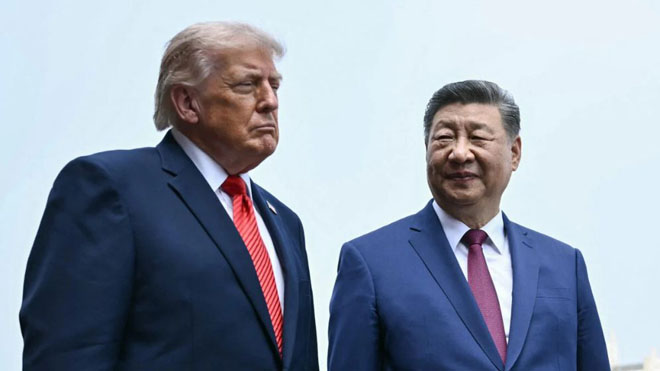
The
U.S. military honor guard is conducting rehearsals, and a new helipad at the
White House is ready. But will Xi Jinping and Donald Trump be able to make any
progress at their upcoming meeting? According to the French news agency AFP,
discussions about the potential risks of artificial intelligence could take
place during the Chinese president’s first meeting at the White House, as the
two countries compete for dominance in this technology. Trump’s war with Iran
is also casting a major shadow over the meeting, as China seeks to circumvent
U.S. sanctions imposed on countries maintaining ties with Tehran. However,
reports have claimed that Beijing provided Iran with intelligence to facilitate
attacks on U.S. troops.
The
trade war remains the biggest concern, as the world’s two largest economies
continue to seek ways to mitigate the impact of Trump’s global tariffs. The
risk of war over Taiwan is also looming large. Behind all these issues is the
desire of one power to maintain its dominance and an increasingly powerful
rival determined to make the 21st century a “Chinese century.” Speaking to
reporters aboard Air Force One on Sunday, Trump said, “I’ll talk to them about
almost everything.”
Experts
say the two leaders are more likely to extend a temporary truce than achieve
any concrete outcome, as was the case four months ago when Xi hosted Trump in
Beijing. Jonathan Xi of the Brookings Institution said, “I don’t think much
will come out of this meeting. It will mostly be a repeat of Trump’s visit to
Beijing in May, where the main focus was on the relationship between the two
leaders.” Given growing global concerns about artificial intelligence,
cooperation on regulation or slowing the pace of AI development is likely to be
a major topic. However, major agreements are currently “politically
unattainable,” said Peking University professor Wang Dong, because both Beijing
and Washington fear falling behind in the AI race.
Iran
will also be discussed. U.S. Treasury Secretary Scott Bessent is scheduled to
meet his Chinese counterpart He Lifeng this week for pre-summit talks,
including discussions on sanctions against Iran. Trump, however, played down
reports that Chinese entities had provided Iran with satellite imagery to
facilitate an attack on a U.S. military base. He said Xi had “behaved quite
appropriately” and added, “We spy on them too.” Yue Su of the Economist
Intelligence Unit said there was room for progress on tariffs, agricultural
purchases, and selected export controls.
But,
as is often the case, Trump appears more interested in the optics of meeting a
powerful foreign leader than in the substance of the discussions. Kurt
Campbell, chairman of the Asia Group, said, “This is less a summit and more a
spectacle. It has been designed for public display.” Trump had a new granite
helicopter landing pad built on the South Lawn of the White House so that it
would be ready for Xi’s visit, which will also include a lavish state dinner.
Military personnel in ceremonial uniforms have been rehearsing the welcome
ceremony in the White House driveway this week. Trump’s only disappointment is
that his $400 million ballroom, which is currently under۔
Trump
and Xi will meet in November at the Asia-Pacific Economic Cooperation (APEC)
forum in Shenzhen, China. The Kremlin has proposed a trilateral meeting
involving Russian President Vladimir Putin. Trump is also expected to invite Xi
to the G20 summit, which will be held in December at the Doral Resort in Miami.