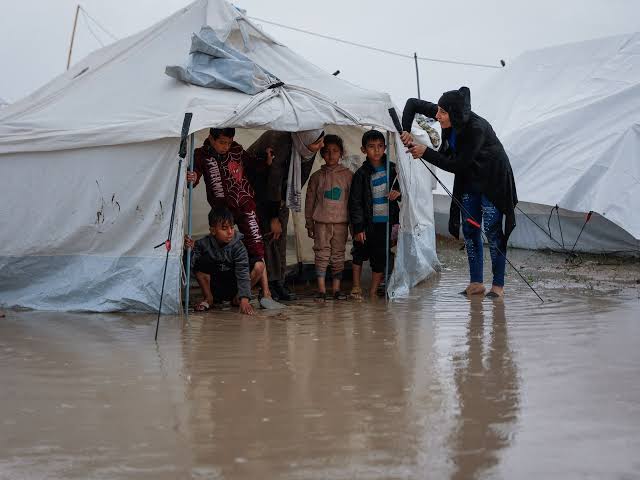
Torrential rain and strong winds across the Gaza
Strip have submerged 70,000 tents sheltering displaced Palestinian families,
leaving thousands without protection from the elements. Authorities have warned
that damaged infrastructure and a shortage of equipment are hampering emergency
response efforts. According
to the Government Media Office, a storm that began late Friday night also
caused dozens of walls to collapse. Initial estimates put the damage at
approximately $3 million. Medical sources told Anadolu Agency that five
Palestinians were injured when two walls of buildings previously destroyed by
Israeli attacks collapsed.
Gaza Municipality spokesperson Hosni Muhanna told
Anadolu Agency that families whose tents had been destroyed were left with
nowhere to seek shelter. He said approximately one million residents and
displaced people were crowded into around 30 percent of Gaza City’s area,
placing additional pressure on infrastructure already devastated by Israel’s
genocidal war. Muhanna added that the city recorded 60 millimeters of rainfall
within 12 hours, equivalent to approximately 15 percent of its annual rainfall.
Strong winds blew away some tents and tore others apart, while rainwater
flooded temporary shelters. Municipal crews received 250 calls reporting
flooded streets, erosion and blocked drainage systems. They responded to most
of the incidents using the limited resources available. However, Muhanna warned
that 270 camps and shelters across Gaza City were at risk of flooding. Damage
sustained during the war has reduced the capacity of the drainage system by 20
percent, leaving low-lying neighbourhoods particularly vulnerable to flooding.
He called for border crossings to be fully
reopened to allow winter supplies, humanitarian aid and heavy equipment to
enter Gaza. Meanwhile, Abdullah al-Majdalawi, director of public relations for
Gaza’s Civil Defence, told Anadolu Agency that rescue teams had received
hundreds of emergency calls since the storm began. Most calls concerned flooded
tents and camps, as well as buildings and walls at risk of collapsing onto
shelters occupied by displaced families. He said rescue workers could address
immediate threats to life but lacked the resources to provide shelter for those
affected. “We go to people’s locations and find entire camps submerged in
floodwater, along with their tents, belongings, furniture and bedding. We stand
helpless in the face of this tragic and difficult reality in Gaza,”
al-Majdalawi said. He added that thousands of tents had been flooded or
destroyed, forcing families to remain outdoors. He attributed the lack of safe
alternatives to Israel’s blockade and restrictions on mobile homes and
reconstruction materials.
The United Nations Relief and Works Agency for
Palestine Refugees (UNRWA) said on Thursday, citing a survey conducted in June,
that 1.98 million people — approximately 94 percent of Gaza’s population — were
in need of shelter and other essential supplies. The agency said 58 percent
faced critical or catastrophic shelter needs. Furthermore, in October, the UN
Office for the Coordination of Humanitarian Affairs (OCHA) warned that 950,000
Palestinians were living in displacement sites exposed to moderate or high
flood risks, with more than four areas facing particularly severe risks. It is
worth noting that Israel’s genocidal war, which began in October 2023, has
devastated homes and infrastructure across Gaza. More than a year after the
October 2025 ceasefire took effect, shelter and reconstruction needs continue
to far exceed available assistance, amid ongoing Israeli restrictions on
temporary housing and materials needed to repair homes.