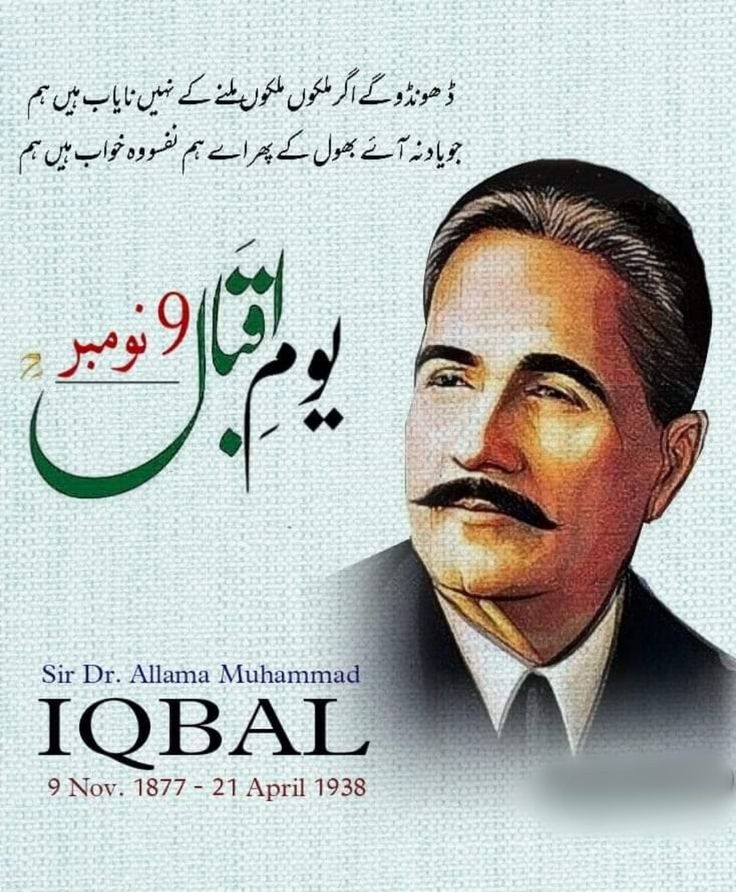
November 9 marks the birth anniversary of Dr. Sir
Allama Muhammad Iqbal, the great thinker of the subcontinent, the Poet of the
East and the spiritual guide of the Muslim community. The occasion is observed
with reverence and respect in Pakistan and around the world. Dr. Sir Allama
Muhammad Iqbal was born on November 9, 1877, in Sialkot. November 9 is not
merely a day to celebrate the birthday of a great poet and philosopher; it is
also an opportunity to reflect on our national identity, intellectual direction
and collective role. Allama Muhammad Iqbal was a figure who inspired the
Muslims of the subcontinent not only through his poetry but also by giving them
an awareness of their distinct identity, political aspirations and vision of an
independent future. Iqbal delivered a message of awakening to Muslims at a time
when they were facing political disunity, economic backwardness, intellectual
stagnation and a sense of deprivation. He made them realise that no nation can
attain its rightful place until it recognises its own selfhood, develops
self-confidence and finds the courage to acknowledge its abilities.
Today, as we reflect on the objectives behind the
creation of Pakistan, its challenges and its future, a fundamental question
arises: Have we truly understood Iqbal’s vision of Pakistan, and have we made a
sincere effort to translate it into reality? In his 1930 Allahabad Address, Iqbal presented
the idea of a separate political entity for the Muslims of the Indian
subcontinent. His objective was not merely to establish a new state but to
create a society in which Muslims could live in accordance with their cultural,
religious, political and intellectual identity. In Iqbal’s view, the true
success of a state is not determined by its territory, military strength or
economic resources, but by its moral character, justice, knowledge, wisdom and
protection of human dignity. This is why Iqbal’s philosophy remains
exceptionally relevant to our national life. Unfortunately, we have memorised
Iqbal’s poetry but have not shown the seriousness required to make his message
part of our national life. One of his most famous couplets reads: Raise your selfhood to such heights that,
before every decree of destiny,
God Himself may ask you: “Tell Me, what is it that you desire?”
This couplet is not merely a beautiful literary
creation; it encapsulates an entire philosophy of life. Iqbal teaches
individuals to recognise their abilities, work consistently, maintain high
moral standards and remain committed to their goals. Yet, in our national life
today, dependence on others appears to have taken precedence over
self-reliance, an inferiority complex over self-confidence, and personal
interests over collective struggle. We seek solutions to our economic crises
through loans, look towards foreign models for our education system and remain
impressed by the achievements of others instead of trusting our own
capabilities. Is this the same nation to which Iqbal gave the metaphor of the
soaring falcon? Education
and knowledge occupy a central place in Iqbal’s philosophy. He supported an
education system that develops research, creativity, critical thinking and a
sense of moral responsibility.
Today, one of Pakistan’s biggest challenges is
providing quality education. Although the number of degrees awarded by
educational institutions is increasing, much remains to be done in research,
scientific inquiry, creative abilities and practical skills. We must recognise
that the path to progress runs through knowledge, research, modern technology,
strong institutions and respect for merit. Artificial intelligence, the digital
revolution and modern scientific disciplines are now transforming the global
economy and political landscape. Pakistan’s young people must become active
participants in this transformation rather than mere spectators. In Iqbal’s
philosophy, the falcon symbolises not only soaring ambition but also
self-respect, courage and lofty aspirations. We must instil the same confidence
in our youth, assuring them that they can establish their place in the world
through their own abilities. The strength of any state ultimately depends on
the character of its institutions and citizens. Iqbal envisioned a society in
which justice, equality, integrity and respect for human dignity held fundamental
importance.
Today, we need to examine our collective
attitudes. The supremacy of law, merit, transparency, tolerance and respect for
differing opinions are essential characteristics of a civilised society.
Iqbal’s philosophy reminds us that building a society is impossible without
first developing individuals. A strong Pakistan requires citizens, leaders and
institutions founded on integrity, competence and a sense of national
responsibility. Pakistan’s greatest strength is its young population. However,
young people cannot be limited to attending Iqbal Day celebrations, listening
to speeches and reciting poetry. They must be provided with quality education,
employment opportunities, research facilities, access to modern technology and
an environment conducive to showcasing their abilities. We must make young
people realise that Pakistan’s future is not tied to any single government,
institution or social class. It is a shared responsibility that belongs to all
of us.
Restricting Iqbal to the realm of poetry alone
would be an injustice to his intellectual stature. His philosophy demands that
we acknowledge our national shortcomings correct our priorities and take
practical steps towards building a better society. Pakistan is currently facing
several major challenges, including economic instability, political division,
educational backwardness, institutional weaknesses and a lack of national
confidence. These problems cannot be resolved through a single speech, slogan
or by waiting for one individual to emerge. Their solutions lie in collective
determination, honest leadership and sustained national efforts. Iqbal did not
merely teach us to dream; he gave us a sense of purpose, selfhood, action and
high aspirations. It is now our responsibility to make his vision an integral
part of our practical lives. Dr. Allama Muhammad Iqbal passed away on April 21,
1938.