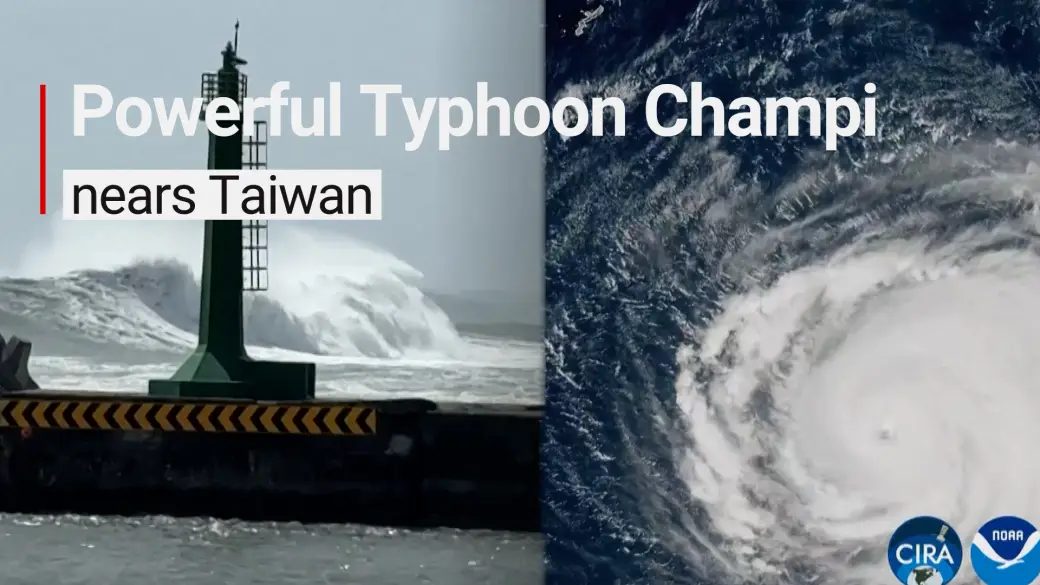
Typhoon Champi has severely disrupted daily life
across East Asia, bringing powerful winds and heavy rain to Taiwan as it moves
toward southern Japan. Schools, offices and the stock exchange have been closed
in Taiwan, while more than 1,000 domestic and international flights have been
cancelled in Taiwan and Japan. At least one person has died and 94 others have
been injured in Taiwan, while thousands of people have been moved to safer
locations. The storm, one of the most powerful typhoons in the region this
year, has prompted widespread weather alerts and disrupted travel for thousands
of passengers.
Schools, Offices and Stock Market Closed in
Taiwan
Ahead of the typhoon, schools and public and
private offices were suspended on Friday in almost all of Taiwan's 22 counties
and cities. Only the remote island of Kinmen in the west continued normal
activities. Taiwan's stock exchange was also closed for the day. Disaster
management authorities reported that one person died after being swept away by
sea waves on Liuqiu Island, southwest of Taiwan. The fire department confirmed
that 94 people had been injured in traffic accidents and other incidents
involving falling objects. More than 1,000 people have been evacuated from
high-risk areas.
Premier Cho Jung-tai urged residents to stay away
from dangerous zones. Particular concern surrounds a temporary landslide dam at
Wanli Creek in Hualien, where approximately five million cubic metres of water
have accumulated, raising fears that the dam could collapse. Residents in
low-lying areas are being evacuated. All 262 scheduled domestic flights and
more than 660 international flights in Taiwan were cancelled on Friday. Railway
services, ferry operations and major highways were also closed.
Flight Disruptions and Power Outages in Japan
Japan has also experienced significant disruption
from Typhoon Champi. Japanese airlines, including All Nippon Airways (ANA) and
Japan Airlines (JAL), cancelled flights to Miyako and Ishigaki airports in
Okinawa, as well as all flights to Taipei. More than 11,000 passengers were
affected. According to Okinawa Electric Power Company, strong winds and heavy
rain left more than 3,630 households without electricity. Japanese Prime
Minister Sanae Takaichi urged the public on social media to exercise extreme
caution over powerful winds, high waves, landslides and rising river levels.
China Issues Blue and Orange Weather Alerts
China's meteorological authorities issued a blue
alert, the lowest level in the country's four-tier warning system, for the
typhoon. An orange alert, the second-highest level, was issued for coastal
areas of Zhejiang province, which are considered particularly vulnerable. The
storm is expected to move past Shanghai and other parts of China's eastern
coastline over the weekend, bringing an estimated 50 to 80 millimetres of
rainfall.
Typhoon's Expected Path and Unusual Intensity
Meteorologists said Champi was moving northwest
toward Taiwan, where its effects were expected to remain severe through Friday
and Saturday night. By Saturday afternoon, the storm was forecast to move away
from the Chinese coast and turn toward southern and eastern Japan and South
Korea's Jeju Island. Scientists say this year is shaping up to be one of the
most active typhoon seasons in recent years. Champi is reportedly Japan's 30th
typhoon of the year, the highest number since 2013. In the Philippines, the
storm has been named Rosal. Experts suggest that unusual El Niño conditions in
the Pacific Ocean may be contributing to the formation of numerous powerful
tropical storms across the region.