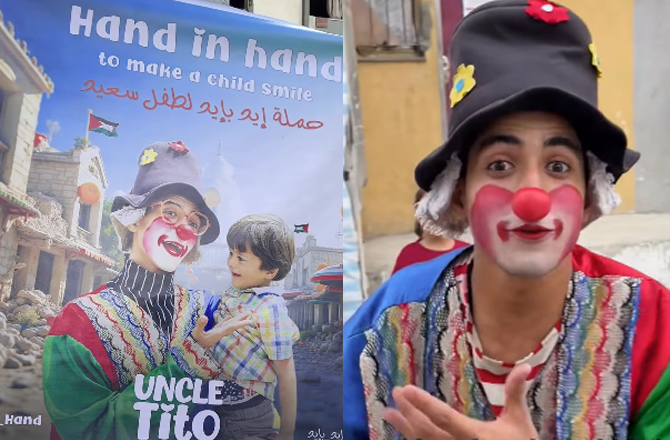
Palestinian youth Mohammed Salem visits tents and
shelters housing displaced families in northern Gaza, performing as a clown in
colourful clothing and a red nose. Known among children as “Uncle Tito,” he
uses circus acts, bicycle tricks, juggling, magic tricks, games and small gifts
to engage children affected by the ongoing conflict. His activities aim to
provide recreation and emotional support to children whose lives have been
disrupted by bombardment, displacement, the destruction of homes and the loss
of family members.
According to a report by Al-Quds newspaper, Salem
began training in circus arts at the Gaza Circus School at the age of 12. After
six years of training, he began using his skills for community-based activities
at the age of 18. He now performs for children from displaced Palestinian
families in northern Gaza. His program includes riding a unicycle, juggling
objects, organizing games and distributing gifts. He also incorporates basic
educational activities to help children continue learning despite school
closures and interruptions to their education. Salem has experienced
displacement and loss himself. His family home was completely destroyed during
the war, and several family members were injured. His family subsequently had
to live in a shelter, where access to food and clean water remains a daily
concern. Despite these difficulties and the responsibility of supporting his
own family, Salem continues to perform for children in displacement shelters.
In a previous interview with the British
newspaper The Independent, Salem described the challenges of living in
northern Gaza. He said he had not expected his circus training to become a way
of supporting hundreds of children during a war. He explained that obtaining
food and water remained difficult, but he continued visiting centers and
schools being used as shelters for displaced families. Salem said his aim was
to give children opportunities to take part in activities that could provide a
temporary break from the difficulties of daily life. His performances include
bicycle tricks, magic acts, games and competitions. Because schools in the area
have closed, he also incorporates counting exercises and other basic
educational activities into some sessions.
Children exposed to prolonged conflict can
experience significant psychological stress as a result of bombardment,
repeated displacement, injuries, separation from family members and the loss of
loved ones. Recreational activities, creative expression and positive
interaction with adults can provide opportunities for children to engage with
others and temporarily shift their attention away from stressful circumstances.
However, such activities do not replace professional medical or psychological
care.
The destruction and closure of educational
institutions in Gaza have disrupted schooling for many children. Some school
buildings have also been used as shelters for displaced families. By including
basic learning activities in his performances, Salem seeks to maintain
children's engagement with education while formal schooling remains unavailable
or limited. His work combines recreation with informal educational activities
and social interaction.
The scale of the impact of the conflict on
children is reflected in figures cited in a Roya News report dated October 21,
2026. According to the report, which referenced UNICEF data, at least 217,000
Palestinian children had reportedly been killed and 45,000 injured in Gaza as
of June 30, 2026, following the escalation of the war in October 2023. More
than 11,000 injured children were reported to have sustained injuries with
potentially lifelong consequences. The report also stated that children continued
to be killed and injured after a ceasefire was announced in October 2025, while
approximately 800,000 children remained displaced.
These figures underscore the humanitarian
challenges facing children in Gaza, including displacement, interrupted education
and limited access to essential services. Salem's performances represent one
community-level effort to provide recreational activities to children living in
shelters. His work takes place alongside his own family's struggle to secure
food, water and accommodation following the destruction of their home. In his
previous interview, Salem also described the impact of his family's losses,
including the destruction of their home, injuries to relatives and the death of
his elder sister's husband. He said that continuing to perform for children had
become an important part of his life despite these difficulties.
The Gaza Circus School, where Salem received his
training, was established to teach young people circus skills and performing
arts. In the current circumstances, these skills are being used not only for
entertainment but also to organize activities for children affected by conflict
and displacement. Salem's work illustrates how individuals living through a
humanitarian crisis may use their skills to support others in their
communities. While his performances cannot address the wider consequences of
the war or replace damaged homes, schools and medical facilities, they provide
children in displacement shelters with opportunities for play, social interaction
and informal learning. His activities also highlight the continuing need for
safe spaces, educational opportunities and psychological support for children
affected by the conflict.