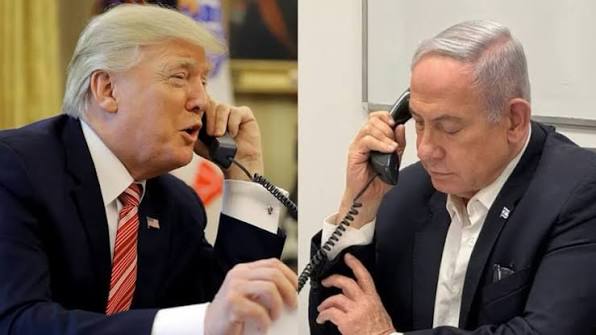
Israeli Prime Minister Benjamin Netanyahu is
seeking to launch fresh military strikes against Iran and has been contacting
U.S. President Donald Trump by telephone on a daily basis to pursue this
objective. According to a report by the British newspaper Financial Times,
a source familiar with the discussions said that anti-war groups both inside
and outside the White House were expressing concern over Netanyahu’s efforts to
resume military operations against Iran and were actively working to prevent
them.
The report said that several regional leaders
were also urging President Donald Trump to avoid further escalation with Iran
and give priority to negotiations rather than military action. According to the
Financial Times, Netanyahu’s efforts to launch fresh strikes against
Iran have also raised concerns among Arab and Muslim leaders, who fear an
escalation of tensions across the region. Meanwhile, another source familiar
with the situation in Israel told the newspaper that Netanyahu wanted to resume
military operations against Iran, but no formal campaign was currently underway
to persuade President Trump to support such action.
On the other hand, U.S. President Donald Trump
said on Monday that Gulf countries were not in favour of a new military
operation against Iran. Following a meeting with Qatari Prime Minister Sheikh
Mohammed bin Abdulrahman Al Thani, Trump wrote on his social media platform,
Truth Social, that Qatar, Saudi Arabia, the United Arab Emirates, Bahrain,
Kuwait and other countries preferred to maintain the current situation.
According to the report, Netanyahu has been serving as a caretaker prime
minister following last month's inconclusive elections in Israel. He supports
renewed joint airstrikes by the United States and Israel aimed at removing
Iran's government from power. However, Trump has indicated positive progress
towards ending the nearly nine-month-long war with Iran, saying that the
possibility of new U.S. strikes against the country now appears considerably
lower.
According to the Financial Times, a
diplomat who attended Trump's meeting with the Qatari prime minister said that
the two leaders agreed that diplomacy remained the preferred way forward to
reach an agreement with Iran. The report added that Turkish President Recep
Tayyip Erdoğan, Saudi Crown Prince Mohammed bin Salman, UAE President Sheikh
Mohamed bin Zayed Al Nahyan and Qatari Emir Sheikh Tamim bin Hamad Al Thani had
also contacted Trump over the past few days. These leaders urged the U.S.
president to allow diplomatic efforts with Iran more time and refrain from
resuming military operations. According to the report, regional leaders fear
that if attacks against Iran resume, Tehran could launch a widespread
retaliatory response, potentially affecting other Middle Eastern countries and further
destabilizing the region.
Iran has also warned that it is prepared to
retaliate if it comes under renewed attack and that the conflict could spread
beyond the Middle East. Meanwhile, mediators have been making efforts for
several weeks to secure a ceasefire and an interim agreement between Iran and
the United States. However, differences between the two countries remain
unresolved. According to the report, an interim agreement based on a
seven-point proposal presented by Iran in September is also being discussed as
part of the negotiations. However, U.S. President Donald Trump had previously
rejected the proposal. Qatar-based broadcaster Al Jazeera reported on Monday,
citing an informed source, that significant progress had been made on the Iran
issue during separate meetings between the Qatari prime minister, Trump and
U.S. Vice President JD Vance.
According to the report, a diplomatic source said
the purpose of these meetings was to narrow differences between the United
States and Iran and finds a way to move negotiations forward. Meanwhile, Iran's
semi-official Fars News Agency, citing an unnamed Iranian official, reported
that claims of negotiations over the release of Iran's $8 billion in frozen
assets in exchange for reopening the Strait of Hormuz were incorrect. According
to the Iranian official, Tehran would negotiate only on the basis of seven
conditions it had presented to Washington. These conditions include ending the
naval blockade and unilateral sanctions, returning Iran's frozen assets and
bringing the war to a complete end. It is worth noting that the United States
and Israel launched attacks against Iran on February 28. Subsequently, a
memorandum of understanding was reached in July to end the fighting. However,
hostilities resumed after diplomatic efforts stalled. Now, countries across the
region are once again actively pursuing diplomatic initiatives to bring the
conflict to an end.