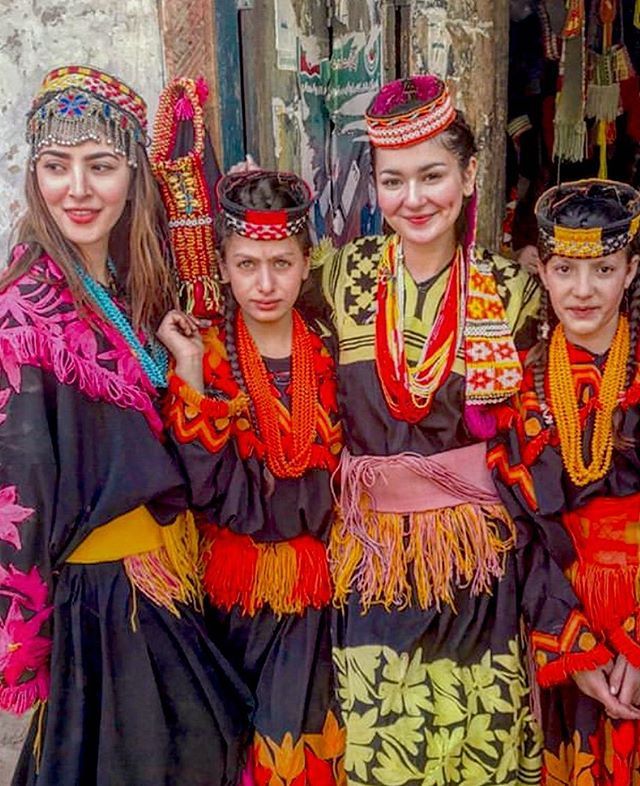
The Kalash community is striving to preserve its
culture and traditions, with support from the Pakistani government as well as
foreign assistance. The opening of the Lowari Tunnel has made access to the
Kalash valleys easier for the general public. However, this has also raised
concerns that, over the next 20 to 30 years, the Kalash religion and the region
historically known as Kafiristan may gradually become a thing of the past. The
Kalash region, also known historically as Kafiristan, is located approximately
two hours from the snow-covered city of Chitral in northern Pakistan. It
consists mainly of three valleys: Bumburet, Rumbur and Birir. According to
local estimates, their combined population is around 4,000. The people follow a
religion known as Kalashism.
The Kalash people, who believe in multiple
deities, have a distinct language, customs and traditions. Many members of the
community continue to follow practices that date back centuries, treating their
traditional customs as an integral part of their religious identity. Their
weddings, funerals, hospitality, social interactions, expressions of affection,
religious ceremonies and annual festivals are therefore of considerable
interest to tourists. These distinctive traditions attract visitors to Chitral,
particularly the Kalash valleys, and large numbers of people gather to
participate in the community's festivals. Among these celebrations, Chilam
Joshi holds a particularly important place.
Chilam Joshi: A Festival Celebrating the Arrival
of Spring
As spring approaches, preparations for Chilam
Joshi begin in all three valleys. However, during the festival's main three
days, men and women from the entire community gather in Bumburet Valley. Chilam
Joshi is a celebration marking the arrival of spring. Local residents begin
preparing for the festival well in advance. By the beginning of May, greenery
spreads throughout the valleys and the air fills with the fragrance of flowers
and plants. Clear water from melting snow flows through streams and rivers, while
sunlight reflects off the remaining snow among the green forests covering the
mountains.
Religious Beliefs and the Bashalini Tradition
The Kalash religion includes a concept of God,
but it has no prophets or Holy Scriptures. According to a popular belief among
the community, their ancestors remained in the region after Alexander the
Great's army passed through it, and they are therefore of Greek descent. In
Kalash tradition, a designated enclosure for women is known as the Bashalini.
Women stay there during menstruation rather than remaining in their homes, and
they engage in activities such as sewing and embroidery.
The practice is rooted in traditional beliefs
about ritual purity. Women consider it inauspicious to remain among men during
this period, believing that doing so could deprive their households of
blessings and prosperity. Consequently, they leave their homes even during
extremely cold weather. Food is brought to them from their homes, and they are
not permitted to leave the enclosure during this time. Men are also prohibited
from touching the enclosure's walls. According to another traditional custom,
when a woman's husband dies, she remains confined to a room in her house for 40
days and does not speak to anyone.
Funeral Traditions: Celebrating Life and Death
Happiness holds a central place in the Kalash
belief system. Community members regard death as an occasion for celebration,
just as the birth of a child is considered a happy event. When someone dies,
news of the death is conveyed to every village across the three Kalash valleys.
If the deceased is a man, his body is kept in a community hall for two days; if
the deceased is a woman, it is kept there for one day. People arrive from all
the villages, sometimes numbering in the thousands. To provide food for the
guests, between 70 and 80 goats and eight to ten cattle are slaughtered, and
alcoholic beverages are served. The food is prepared using traditional local
ingredients, including pure desi ghee. The funeral ceremonies are marked by
communal celebrations involving food, drinks, dancing and music. In earlier
times, the deceased were placed in coffins and left in designated burial
grounds. Today, burial has become the common practice.
Marriage Customs and Family Traditions
Like their funeral customs, Kalash marriage and
childbirth traditions are also distinctive. Marriages are not traditionally
arranged by families. Instead, a young man and woman choose each other, and the
young man takes the woman to his home, effectively eloping with her. The young
man's family then informs the woman's parents and village elders. They visit
his home and ask the woman to confirm that she has not been forced to leave her
family and has come of her own free will. Once her consent is established, the
marriage is accepted.
A feast is then arranged, with the bride's family
playing a particularly important role as guests. On the fourth day after the
wedding, the bride's maternal uncle visits the groom's family, who
traditionally present him with a bull and a gun as gifts. The exchange of gifts
between the two families continues for several days. One unusual aspect of this
tradition, according to the account, is that even a married woman may elope
with another man if she falls in love with him. If she leaves of her own free
will, her former husband has no right to object. However, he may claim
reimbursement for the expenses incurred during the first marriage.
Traditions Following the Birth of a Child
The birth of the first child is marked by a large
feast, during which goats and cattle are slaughtered. The celebration is held
at the bride's family's home, but the groom's family bears the expenses. The
groom's family must also give each of the bride's relatives between 1,000 and
2,000 Pakistani rupees. If the next child is also of the same sex as the first,
the entire ceremony and associated expenses are repeated. This tradition
continues if successive children are all boys or all girls, and it ends only
when a child of the opposite sex is born. According to the account, if a Kalash
man or woman falls in love with a Muslim, marriage is possible only if the
Kalash partner converts to Islam, regardless of whether the person is male or
female.
Phour: The Annual August Festival
In August, the Kalash community celebrates its
annual religious festival, known as Phour. The festival marks the time when
community members harvest their fruit, particularly grapes and walnuts, and
store it for the winter. Before the festival, people are not permitted to
harvest these fruits. Anyone who secretly picks them beforehand may be fined. During
the celebrations, Kalash elders place flower-decorated caps on the heads of
girls who have reached puberty or are approaching that stage of life. This ceremony
symbolizes that the girls have entered, or are about to enter, adulthood. Under
the community's traditional customs, they are then expected to stay in the
Bashalini during menstruation rather than remain inside their homes.
On the final evening of the festival, Kalash
women gather flowers and proceed from a designated location. The procession is
led by a Kalash woman whose face is covered with a traditional cloak. Following
her, the women move along a particular route, waving flowers in their hands and
singing songs as they approach a place known as Charsu, where Kalash
men and women perform traditional dances. When the procession reaches Charsu,
the women scatter the flowers they are carrying over the people taking part in
the dancing. Older women also wear flower-adorned caps during the festival, and
both young and elderly members of the community participate in the
celebrations.