NATO’s involvement in the Ukraine conflict would
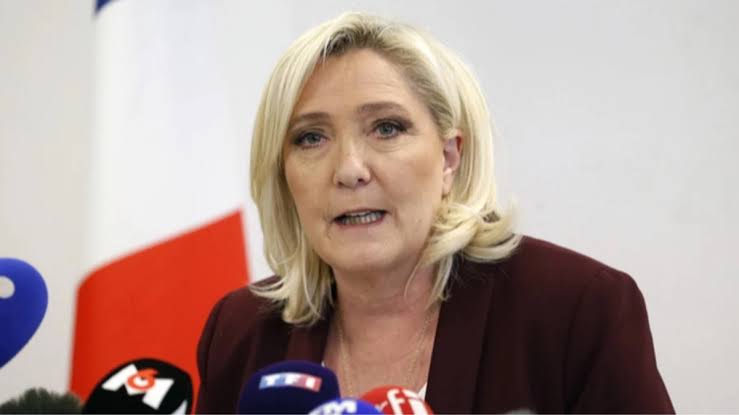
trigger World War III, veteran French right-wing politician Marine Le Pen has
warned. She is leading opinion polls ahead of France’s presidential election
scheduled for next year. Le Pen and her
National Rally party have long criticized France’s military and financial
assistance to Ukraine and called for normalising relations with Russia. In an interview with journalist Neshat
El-Dehy, excerpts of which were published on Sunday, Le Pen outlined three
possible outcomes of the Ukraine conflict. She said the first scenario would
involve NATO entering the war, which would lead to World War III — a truly
tragic and devastating outcome. The second would be a “100-year war”, in which
NATO stayed out of the conflict while fighting between Russia and Ukraine
continued for years. She said the third
and most desirable scenario would be peace, adding that if elected, she would
make every possible effort to create the right conditions for resolving the
conflict.
Asked whether she would travel to Moscow to meet
Russian President Vladimir Putin if elected, Le Pen said world leaders should
be prepared to talk to everyone. In a post on X accompanying a video excerpt
from the interview, she wrote: “If I am elected President of the Republic, I
will talk to everyone.” Le Pen has
previously accused President Emmanuel Macron of seeking a war with Russia over
his plans to supply Mirage fighter jets to Kyiv. Speaking to the Financial
Times last month, Le Pen also rejected the idea of Ukraine joining the European
Union, describing such a move as economic suicide for the bloc. Her remarks
come several months before France’s presidential election, scheduled for April
18, 2027. If no candidate secures more than 50 per cent of the vote, a second
round will be held between the two leading candidates on May 2. Macron, who is serving his second consecutive
five-year term, is constitutionally barred from seeking another consecutive
term. Amid mounting economic problems
and social tensions, his approval rating has fallen to 14 per cent, according
to an opinion poll conducted by Ipsos BVA CESI Engineering School and published
earlier this month.
Last Wednesday, Ifop (French Institute of Public
Opinion) released the results of another poll showing Le Pen leading the first
round of the election with up to 36 per cent of the vote. Her main rival,
Jean-Luc Mélenchon, leader of the left-wing La France Insoumise (France
Unbowed) party, was in second place with 19.5 per cent. According to the poll, centrist candidates,
including former Prime Minister Édouard Philippe, were trailing with less than
15 per cent of the vote. The survey also
indicated that Le Pen would win the second round by a substantial margin. Since the escalation of the Ukraine conflict
in 2022, Paris has been among Kyiv’s strongest supporters within the European
Union, providing billions of euros in military assistance and supplying
advanced weapons. France has also played a key role in the Coalition of the
Willing, which has proposed deploying troops from NATO member states in Ukraine
following a peace agreement. Moscow has warned that such a move would lead to a
direct confrontation between Russia and NATO. Last week, French Foreign
Minister Jean-Noël Barrot confirmed an earlier report by Radio France
Internationale that Paris had secretly deployed military personnel to Ukraine
without informing parliament.