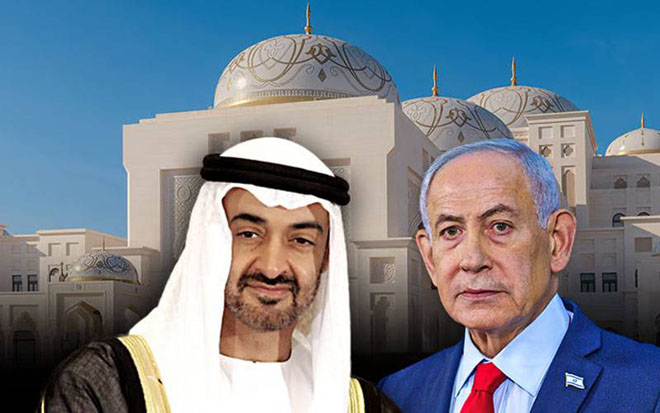
Israeli Prime Minister
Benjamin Netanyahu secretly visited the United Arab Emirates
the previous day and met with the leadership of the Gulf state. Reuters reported, citing a senior Israeli
official, that Netanyahu traveled to the UAE and met with Emirati President Sheikh
Mohamed bin Zayed Al Nahyan in Abu Dhabi. Neither Netanyahu’s office
nor the UAE Foreign Ministry immediately commented on the report. The reported visit came after Israeli
newspaper Haaretz reported earlier this month that Sheikh
Mohamed bin Zayed had warned Netanyahu approximately a week and a half before
the October 7, 2023, Hamas attack that Hamas was planning a major operation
against Israel. According to the newspaper, the information was not passed on
to Israeli intelligence agencies or the military.
The New York Times
also reported on the matter, while Netanyahu has denied the reports and
threatened legal action against Haaretz. According to Reuters, Netanyahu is
facing a difficult election campaign, while opposition leaders have blamed him
for security failures ahead of the October 7 Hamas attack. Reuters said the UAE has declined to comment
on the Haaretz report. Emirati officials, however, have said that direct
communication between the UAE and Israel has continued since the two countries
established diplomatic relations in 2020. Reuters previously quoted an Emirati
source as saying that the UAE discusses security matters with other countries
through relevant institutions, but such issues are not discussed at the level
of national leaders.
Reports of a meeting between
Netanyahu and the Emirati president also emerged earlier this year, but the UAE
denied that such a meeting had taken place. In May, Netanyahu’s office said
that the Israeli prime minister had secretly visited the Gulf country and met
with its president. The UAE Foreign Ministry subsequently stated that all
claims regarding a secret or undeclared visit by the Israeli prime minister and
the arrival of an Israeli military delegation in the country were unfounded. According to Reuters, a
source familiar with the meeting said at the time that Netanyahu and Sheikh
Mohamed had met on March 26 in Al Ain, an oasis city near the
border with Oman. Israeli media also reported that Mossad chief David
Barnea had visited the UAE at least twice during the war. The UAE has
strongly denied these reports.
After the UAE came under
attack during the war with Iran, it further strengthened its relations with the
United States and Israel. In September 2020, the UAE signed the Abraham
Accords, brokered by the United States, to establish diplomatic
relations with Israel. It was a significant agreement to normalize relations
between an Arab country and Israel, following the 1994 peace treaty between
Israel and Jordan. Bahrain and other countries later also established relations
with Israel. High-level
contacts between the UAE and Israel have been reported in the past, although
details of some meetings were not officially disclosed. Netanyahu’s latest
reported visit comes against the backdrop of significant changes in the
security situation in the Middle East involving Iran, Israel, the
United States and Gulf countries.
Israel
has announced that it is revoking the diplomatic status of Dutch diplomats
representing the Netherlands to the Palestinian Authority in Ramallah.
According to Reuters, Israel said on Sunday that it had revoked the diplomatic
status of Dutch diplomats representing the Netherlands in Ramallah. The move
came in response to Dutch sanctions against illegal Israeli settlements in the
occupied West Bank. Israeli Foreign Minister Gideon Saar said the Dutch
diplomats working in Ramallah would have seven days to return their diplomatic
documents, after which their diplomatic privileges and immunities would be
terminated. Earlier this month, Israel also ordered the closure of the British
Consulate in East Jerusalem, which serves as the United Kingdom’s
representative to the Palestinian Authority. That decision followed London’s
announcement of sanctions, including restrictions on imports of goods from
Israeli settlements, as well as other similar measures.
Dutch
Foreign Minister Tom Berendsen said on Monday that he regretted what he
described as an “unnecessary” decision and that the Netherlands was considering
its response. In a statement, Berendsen said, “Our temporary sanctions are not
aimed at Israel. They are the result of our responsibility to ensure that we do
not in any way contribute to the illegal situation of the illegal settlements.”
The Netherlands’ ban on imports of goods produced in Israeli settlements came
into effect last week.
Israeli
Foreign Minister Gideon Saar said, “Any country that adopts a hostile and
unilateral approach toward Israel will lose its influence and importance in the
region.” In August, Israel also barred Dutch diplomats from entering a U.S.-led
coordination center for Gaza, which is based in Israel. The Israeli foreign
minister attributed that decision to what he called “anti-Israel actions.” For
many years, the Netherlands and several other countries have maintained
diplomats who represent their governments to the Palestinian Authority in
Ramallah, while residing in East Jerusalem. Israel has traditionally recognized
these diplomats and granted them certain privileges under the Vienna
Convention on Diplomatic Relations. France and Canada also announced this
month, alongside the United Kingdom, restrictions on goods originating from
illegal Israeli settlements. However, Israel has not taken similar measures
against those two countries.
Prime
Minister Benjamin Netanyahu’s right-wing government has faced increasing
diplomatic isolation from some of its allies over its policies and military
actions in Gaza and the West Bank. Several countries have imposed sanctions on
two prominent Israeli cabinet ministers, while Spain, Ireland and other
countries have also announced restrictions on products originating from Israeli
settlements.