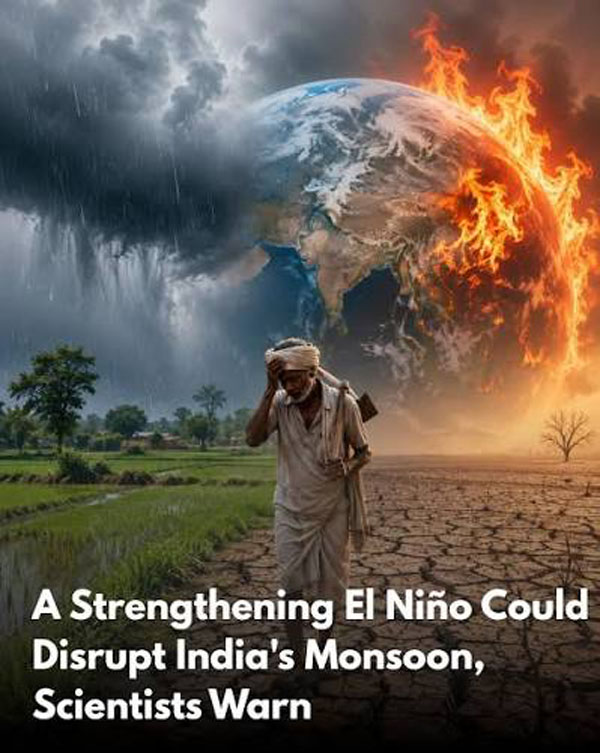
The situation could persist until
February 2027, with the WMO indicating an almost 100% probability of its
continuation, potentially affecting rainfall, temperatures, droughts, floods
and heatwaves across different parts of the world.
During an El Niño event,
sea-surface temperatures in the central and eastern Pacific Ocean become warmer
than normal. This alters the usual patterns of winds, rainfall and temperatures
across different regions of the world. In India, El Niño is generally
associated with a weaker southwest monsoon.
According to the Ministry of Earth
Sciences, of the 16 El Niño years recorded since 1950, seven were associated
with below-normal monsoon rainfall in India. The impact of El Niño can be
particularly noticeable during the later phase of the monsoon, especially in
September.
India is already feeling the
effects of a weak 2026 monsoon. According to Reuters, monsoon rainfall in the
country is expected to be around 15% below normal this year, potentially making
it the weakest monsoon since 2009. Rainfall in June was more than 35% below
normal. Although conditions improved somewhat in July, rainfall declined again
in August.
Attention is now focused on
September rainfall because several kharif crops—including cotton, soybeans,
maize and pulses—are at critical stages of their growing season.
This is where the Indian Ocean
Dipole (IOD) could play an important role. The IOD is a climate pattern driven
by differences in sea-surface temperatures between the western and eastern
parts of the Indian Ocean. Its positive phase is generally associated with
warmer-than-normal waters in the western Indian Ocean and cooler waters in the
eastern part.
In the past, a positive IOD has
sometimes helped offset the negative effects of El Niño. In 1997, despite an
exceptionally strong El Niño, a positive IOD helped support the Indian monsoon
to a considerable extent.
However, the situation in 2026 is
different and more complex. Recent reports suggest that a positive IOD pattern
is developing in the Indian Ocean this year, raising hopes that it could limit
some of the effects of El Niño. However, experts caution against viewing the
IOD as a complete protective shield for India. The interaction between El Niño
and the IOD varies from year to year, and the two climate systems can produce
different impacts across different regions.
The example of 1997 is important
because the positive IOD at the time helped keep India's monsoon relatively
healthy despite the strength of El Niño. The key question now is whether the
Indian Ocean can play a similar role once again. Experts say the answer remains
uncertain.
The Indian government has also
emphasized that the monsoon is not determined by El Niño alone. The IOD, the
Madden-Julian Oscillation (MJO), and regional ocean-atmosphere interactions
also influence rainfall patterns. Therefore, it would be inappropriate to draw
definitive conclusions about the entire monsoon season based solely on the
strength of El Niño.
For India, the most immediate
concern is now September rainfall. According to Reuters, rainfall in September
is also expected to remain below normal. If the deficit continues, kharif crop
production could suffer. At the same time, reduced soil moisture could affect
the sowing of rabi crops, particularly wheat, mustard and chickpeas.
Lower agricultural production would
have consequences beyond farmers. A decline in food supplies could increase
imports of sugar, pulses, edible oils and other essential commodities. Higher
food prices could also put additional pressure on inflation. This, in turn,
could affect rural incomes, consumer spending and overall economic activity.
El Niño does not always manifest
itself simply as a decline in overall rainfall. Some regions can experience
lower cumulative rainfall while still facing short periods of extremely heavy
rain, flooding and landslides. This apparent contradiction has also been
observed in recent weather patterns, with some areas recording below-normal
overall rainfall while experiencing an increase in episodes of extreme
rainfall.