Syria’s new Islamist government has barred women
from enrolling in several university and technical programs, drawing public
criticism. The regulations for the 2026–2027 academic years affect several
institutions, including two universities established in July under Syrian
President Ahmed al-Sharaa. Al-Sharaa, a former leader of the Islamist group
Hayat Tahrir al-Sham (HTS), came to power following the ousting of Bashar
al-Assad in December 2024. He was appointed interim president in January 2025
and has since pledged to form an inclusive government.
According to documents published by the Ministry
of Higher Education, women are excluded from programs in law and social
sciences, administration, and economics at the National University for Defense
Sciences, as well as from military engineering programs. Another institution,
the Syrian University for Security Sciences, reserves several programs for men,
although women are permitted to study cyber security. The restrictions also
extend to technical institutes specializing in oil and gas, railway
transportation, and radio and television direction. Under the regulations for
the previous academic year, women could still enroll in certain oil and gas
programs, including accounting and precision instruments.
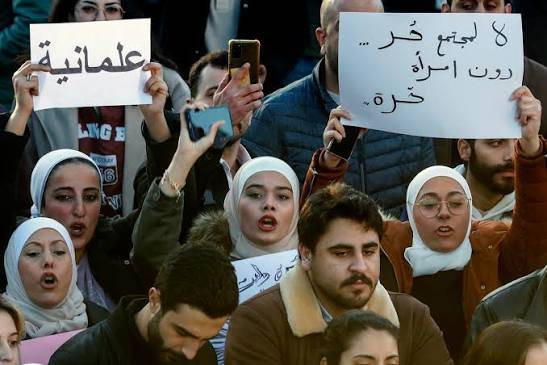
The measures have drawn criticism from students
and teachers. Israa Salloum, a high school graduate, told AFP that no one had
the right to force her to choose a particular field of study or exclude her
from another. The constitutional declaration adopted in March 2025 guarantees
women the right to education. The new rules also appear to contradict recent
efforts to expand women's participation in law enforcement agencies. In
September, Syria graduated its first class of 150 female police officers
following six months of training. Since
taking power, Syria's new authorities have faced criticism over measures
affecting women's freedoms. In September, a prominent school in Damascus
reportedly announced plans to separate male and female students from the
middle-school level onward. Four women's rights and civil society organizations
also accused the authorities in August of restricting freedoms and imposing
forms of social control that disproportionately affect women. The new admission
rules do not impose a complete ban on women studying law or engineering, as
such programs remain available at other Syrian universities.