Hundreds of thousands of people have taken to the
streets in the Czech Republic amid anti-government demonstrations in several
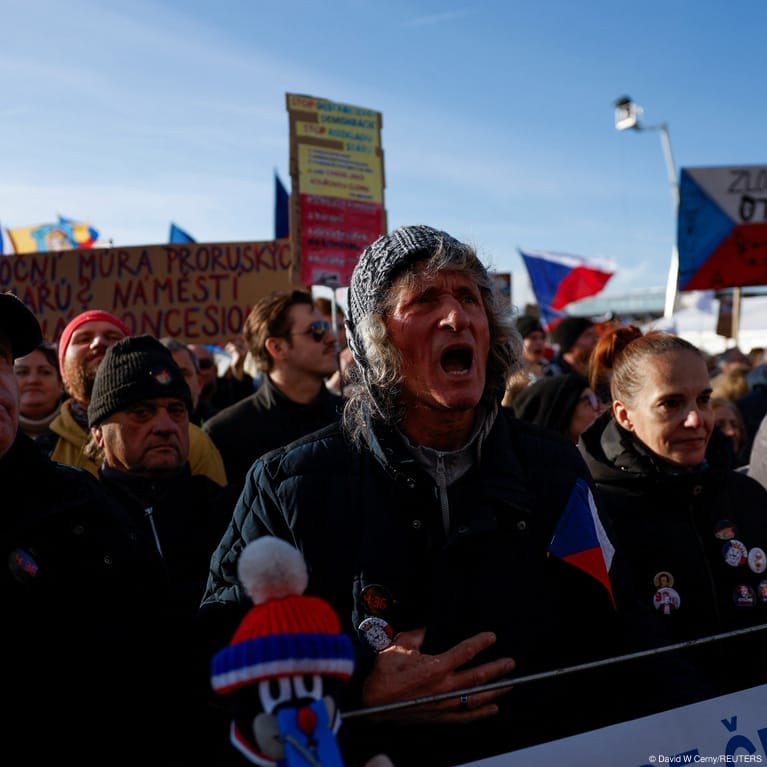
European countries. On Sunday, November 15, approximately 350,000 to 400,000
people gathered at Letná in the capital, Prague, to protest against the
government of Prime Minister Andrej Babiš. The demonstration is being described
as the largest anti-government protest in the country since 1989. The
demonstrators are opposing the government's plan to change the funding system
for public radio and television broadcasters. They fear the proposed changes
could undermine the financial independence of public media and increase
government interference in its operations.
The protest comes as the coalition government led
by Prime Minister Andrej Babiš faces criticism from opposition parties and
media organizations over its plans to reform public media funding. The
government introduced a bill on the issue in October 2026. The lower house of
parliament gave it preliminary approval at 4:36 a.m. on October 24, triggering
further protests. Demonstrations had previously been held in several cities
across the country, while employees of Czech Television and Czech Radio had
also staged a strike. The Babiš government wants to replace the existing
funding system for public radio and television. At present, individuals,
households and businesses contribute to these institutions through regular
broadcasting licence fees. The government plans to abolish the system and
finance public broadcasters directly through the state budget.
The proposed change could also have a significant
impact on their funding. Estimates suggest that, under the new system, public
broadcasters could receive approximately 15 per cent less funding than they do
currently. This has raised concerns about staff layoffs, cuts to program
production and the possible cancellation of several shows. Media employees,
opposition parties and pro-democracy organizations have criticized the
government's proposal. They argue that direct funding from the state budget
could make public broadcasters financially dependent on government policies and
decisions, potentially threatening their editorial independence. The opposition
has compared the proposal with media-related changes introduced under the
governments of Viktor Orbán in Hungary and Robert Fico in Slovakia. Opposition
leaders warn that greater reliance on state funding could provide the
government with opportunities to exert pressure on the media and restrict
critical voices.
Prime Minister Andrej Babiš has rejected these
allegations. He argues that abolishing broadcasting licence fees would ease the
financial burden on poorer households and encourage media organizations to
operate more efficiently. In a social media post, he said that no campaign was
being waged against independent media or democracy. Sunday's demonstration in
Prague was organized by the group Million Moments for Democracy, which
has described the government's proposed funding reform as a serious threat to
democracy. The organisation alleges that the government is seeking to increase
its control over democratic institutions by ignoring experts and critics. Meanwhile,
according to the Reuters Institute's Digital News Report, public-service
journalism in the Czech Republic is among the country's trusted sources of
news. Czech Television is also the most-watched broadcaster in the country.
Demonstrators say protecting the independence of
public media is essential because it could have far-reaching consequences for
democracy and the information available to the public. It is worth recalling
that in 1989, a mass movement emerged against communist rule in Czechoslovakia,
which then comprised the present-day Czech Republic and Slovakia. The movement
became known as the Velvet Revolution. It began on November 17, 1989,
after police violently suppressed a peaceful student demonstration in Prague.
In response, hundreds of thousands of people took to the streets, demanding
democracy, political freedom and freedom of expression. Under sustained
pressure from demonstrations and strikes, the Communist Party announced on
November 28 that it would relinquish power. On December 29, 1989, pro-democracy
leader Václav Havel was elected president of the country.