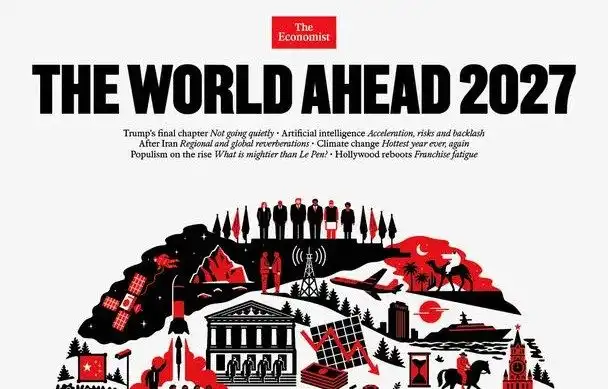
The British magazine The Economist has
released the cover of its annual special edition, The World Ahead 2027,
offering an initial analysis of 10 major global trends linked to international
politics, regional conflicts, economic pressures, climate change, artificial
intelligence and emerging technologies.
1. The Future of American Politics after Trump
One of the most important questions in American
politics in 2027 will concern the political landscape after President Donald
Trump. Following the midterm elections, the race to succeed him is expected to
begin taking shape. However, according to the magazine, Trump is likely to
remain politically active during the final phase of his presidency. Through
executive orders, legal disputes, changes to government programmes, major
construction projects and possible military operations, Trump is expected to
maintain his political influence. Globally, attention will also focus on the
direction of American domestic and foreign policy after his presidency.
2. The Iran Conflict and Threats to Global Food
Security
The conflict involving Iran could continue to
influence global politics and the economy in 2027. According to the magazine's
analysis, the prospects for a lasting and clearly defined resolution remain
limited, raising concerns that uncertainty will persist across the region. The
US war against Iran has affected America's international standing, potentially
changing the confidence of its allies and the behaviour of its adversaries. The
consequences could extend beyond Middle Eastern politics and global energy
supplies to food security. In particular, potential fertilizer shortages could
pose a serious challenge to agricultural production and the global food supply.
Meanwhile, Iran's ruling establishment may seek to further consolidate its hold
on power.
3. Climate Change and Unprecedented Temperature
Increases
Climate change will remain one of the major
global challenges in 2027. The magazine predicts that the coming year could
rank among the hottest on record, while the weather phenomenon known as a Super
El Niño could offer a glimpse of increasingly extreme weather conditions. This could lead to more
droughts, severe heatwaves, wildfires and unusual weather events. However,
renewable energy, particularly solar and wind power, could play an important
role in reducing the effects of climate change and protecting countries against
fluctuations in global energy prices.
4. Growing Backlash Against Artificial
Intelligence
The rapid development of artificial intelligence
and its economic, technological and social consequences will remain major
issues in 2027. Growing investments in AI companies, alongside increasing debt
and complex financial agreements, could create risks for financial markets. If
an investment bubble in the sector bursts, its consequences could spread
throughout the global economy. Furthermore, advanced AI models could increase
the capabilities of cyberattacks, while political risks associated with supply
chains could create additional challenges for governments. Concerns over job
losses and the rising consumption of electricity and water by data centers are
also among the main factors contributing to public opposition to AI.
5. Right-Wing Politics in Europe and
France-Germany Tensions
The growing influence of right-wing populist
politics in Europe will be another major trend in 2027, with particular
attention focused on France. The magazine highlights the possibility of
National Rally leader Marine Le Pen winning the French presidential election as
a potentially significant political development. Such an outcome could have implications
for the political direction of the entire European Union. France and Germany
are considered the EU's principal driving forces. Political disagreements
between the two countries could therefore complicate common policies and
decision-making. At the same time, concerns remain over France's substantial
public debt and fragile financial position.
6. Rising Global Debt and Pressure on Bond
Markets
Another major challenge facing the global economy
will be mounting government debt and increasing pressure on bond markets. The
world's largest economies could face more expensive borrowing as a result of
government spending, massive investments in artificial intelligence
infrastructure and rising energy prices. Higher borrowing costs could create
financial difficulties not only for governments but also for companies and
ordinary households. Growing pressure on bond markets would make debt
repayments and access to new financing increasingly expensive for governments,
potentially forcing the global financial system to confront major policy
decisions or even a financial crisis.
7. Potential Conflict Between China and Taiwan
Tensions between China and Taiwan will also
remain among the most important global issues in 2027. The conflicts in Ukraine
and Iran have demonstrated how the use of modern technology can enable
relatively smaller powers to create serious challenges for much larger military
forces. Against this backdrop, an important question is how the changing nature
of warfare could influence China's ambitions towards Taiwan. Chinese President
Xi Jinping has reportedly instructed the country's military to be prepared by
2027 to have the capability to seize Taiwan. However, military preparedness and
the actual decision to launch an attack are two separate matters.Given
America's involvement in other global priorities, attention will focus on
whether China takes any concrete action against Taiwan or waits for the outcome
of Taiwan's 2028 elections.
8. Economic and Social Impact of Weight-Loss
Drugs
The growing popularity of weight-loss medications
will be another significant trend in 2027. Drugs such as Ozempic and similar
medications have influenced not only the healthcare sector but also consumer
lifestyles and purchasing habits. People losing weight through these
medications may spend more on clothing, cosmetics and fitness products, a trend
the magazine describes as "revenge shopping".The success of these
medications has also encouraged pharmaceutical companies to turn their
attention towards developing drugs that could slow the ageing process and
extend human lifespan.
9. Space Technology and Lower Rocket Launch
Costs
Advances in space technology and declining rocket
launch costs will represent the ninth major trend in 2027. SpaceX's giant
Starship rocket could begin regular flights to carry satellites into space in
2027. Meanwhile, Chinese rocket manufacturers may also demonstrate the
capabilities of reusable rocket boosters. Lower costs for space travel and
satellite launches could provide fresh momentum to plans for establishing
private space stations and building data centers in space.
10. The Growing Gap Between Fiction and Reality
and Changes in the Global Film Industry
Developments in the global film industry will
constitute the tenth major trend in 2027. The year will mark the 50th
anniversary of the famous Star Wars franchise, with plans to celebrate
it through re-releases and a new film. Similarly, the return of The
Avengers and a new James Bond film are also anticipated. However, the
central question will be whether audiences remain interested in traditional
productions from major film studios or whether low-budget films produced by
YouTube creators will begin changing viewers' preferences.
According to The Economist, the gap
between science fiction and real life is rapidly narrowing in the modern world.
Space-based data centers, autonomous vehicles, humanoid robots, drone warfare,
powerful artificial intelligence and advanced weight-loss medications are among
the most prominent examples of this transformation. It is worth noting that the
magazine's annual special edition will be published in print on November 21,
while its online edition will become available shortly afterwards.