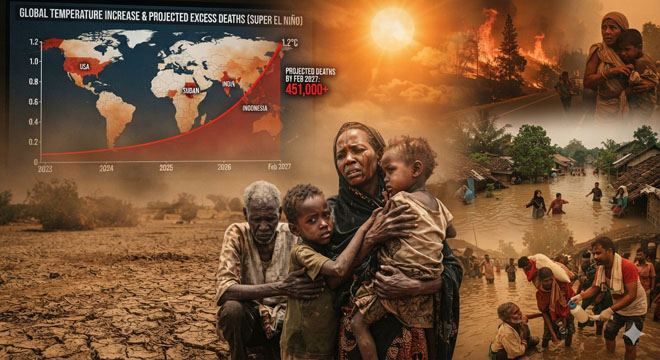
According to a report by the
Climate Impact Lab at the University of Chicago, the current Super El Niño
could cause an estimated 451,000 additional heat-related deaths during its
first nine months, from June 2026 to February 2027, compared with a normal
year. Of these, 239,000 deaths could occur over the next six months. These
deaths would be in addition to the number of deaths normally associated with
heat. The report warned that El Niño is expected to persist until the spring of
2027, meaning the estimated death toll could rise further.
According to a new study, the
powerful El Niño currently developing in the Pacific Ocean could cause hundreds
of thousands of heat-related deaths worldwide, with developing countries
expected to bear the greatest burden. El Niño is a natural warming of the
tropical Pacific Ocean that can affect weather patterns around the world,
bringing extreme heat and drought to some regions while causing heavy rainfall
and flooding in others. The current event could become one of the strongest on
record. The Climate Impact Lab, a research group involving the University of
Chicago and other institutions, said in a report released this week that
extreme heat associated with the 2026–27 El Niño could result in 451,000
additional deaths worldwide.
The impact is expected to be
heavily concentrated in the Global South. Over the next six months, researchers
forecast 66,800 additional heat-related deaths in the Sahel region of Africa,
including 31,400 in Nigeria and 17,500 in Sudan. Indonesia could record another
19,300 deaths, India 15,800, and Brazil 13,300. In the United States,
approximately 3,500 additional heat-related deaths could be recorded between
September and February. Michael Greenstone, co-founder of the Climate Impact
Lab and a professor at the University of Chicago, said the scale of the
projected losses could be difficult to comprehend, emphasizing that the figures
represent “parents and children, grandparents and neighbors.”
The warning comes as August was recorded as the
hottest month globally, with an average temperature of 16.96 degrees Celsius.
According to the European Union’s Copernicus Climate Change Service, Western
Europe also experienced its hottest summer on record. Researchers said
temperatures associated with the current El Niño offer a glimpse of conditions
that could become far more common over the next two decades as the planet
continues to warm.