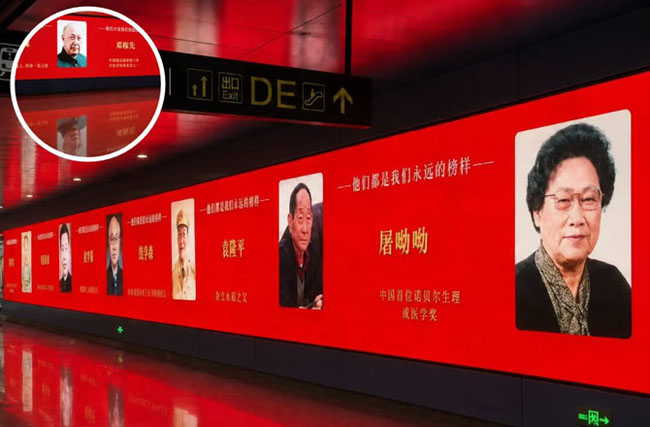
China is carrying out a unique public campaign in which spaces that are usually filled with advertisements for products, film stars and commercial brands are now being decorated with images of scientists. Large LED screens, billboards, shopping malls, metro stations, high-speed rail stations and screens inside trains are displaying portraits of prominent Chinese scientists, along with their achievements and brief introductions.
The campaign features rocket scientist Qian Xuesen, nuclear scientist Deng Jiaxian, agricultural scientist Yuan Longping, Nobel Prize-winning medical scientist Tu Youyou, radio astronomer Nan Rendong and several other distinguished researchers. At some locations, the achievements of scientists such as Lin Qiaozhi, Qian Sanqiang, Gu Fangzhou, Wu Mengchao and Cheng Kaijia are also being highlighted. Also read: World moves to “correct” the map as campaign to show Africa at its true size succeeds
The campaign gained particular prominence in Heze, a city in Shandong, where commercial centers placed large posters of scientists in their prime advertising spaces. It then spread to several other cities in Shandong, including Zibo, Binzhou, Tai’an, Dongying and Jinan. Similar scenes were subsequently reported in Hohhot and Hulunbuir in Inner Mongolia, Hefei in Anhui, Ji’an in Jiangxi, Zhengzhou in Henan and other areas.
In Jinan, the campaign has taken on a particularly large scale. A special train has been launched on Metro Line 4 under the theme “Journey Towards the Light, Promoting the Spirit of Scientists.” The six-car train features the achievements of Chinese scientific figures from ancient times to prominent scientists of the modern era. A permanent themed wall dedicated to scientists has also been installed at one of the metro stations.
The Shandong campaign has also been linked to a project called “Interconnection of 10,000 Screens.” Across the province, large screens at 25 high-speed rail stations, interior screens on 212 high-speed trains and around 8,700 screens on the Jinan Metro are displaying content about the contributions of scientists. Videos about scientists are also being shown in security-check areas at airports in Shandong.
Interestingly, the initiative did not begin solely as an official government publicity campaign. Some commercial centers in Shandong independently chose to give scientists space on their valuable advertising displays. Images and videos of the initiative then began circulating on social media, encouraging commercial centers in other cities to join in. In Jinan, some commercial centers have reportedly said they are considering displaying scientists’ posters permanently.
Also read: Eric Trump’s new passport features an angry picture of his father; “I absolutely love it,” he says
One distinctive feature of the campaign is that many of the posters use photographs of the scientists from their younger years. According to organizers and supporters, the aim is to remind young people that the figures now remembered as giants of China’s scientific history were once young people with dreams, just like them.
In this way, the campaign seeks to make scientific achievement part of everyday urban life rather than confining it to books and museums. Chinese sources have described the initiative as an effort to give scientists the most prominent public platforms. A passenger in Jinan told the media that seeing so many scientists featured in the metro was unexpected and that highlighting their contributions in public places could help more people learn about them.
Also read: SIR is a legal process but unfair: Former Election Commissioner of Ladakh
September is also being used in China for large-scale activities as part of the country’s National Science Popularization Month. The Shandong Association for Science and Technology and other institutions have planned activities across the province for the 2026 National Science Month under the theme “Technology Changes Life, Innovation Wins the Future.” The program places emphasis on bringing stories of scientists, scientific experiments, museums and public science-awareness initiatives to people through various channels.
The campaign has also attracted attention outside China. Indian industrialist Harsh Goenka cited China’s example on social media on August 31 and questioned why major public advertising spaces in India are largely occupied by politicians and film stars. He stressed the need to highlight scientists, teachers, doctors, innovators and other people who contribute to nation-building. He argued that the people a society chooses to celebrate prominently can influence the aspirations and role models of its children.
For supporters of the Chinese campaign, the real change is not simply about replacing advertising posters for a day. Rather, it is about repeatedly exposing children and young people to names and faces whose identities are associated not with fame or wealth, but with research, discovery and public service. Bringing scientists into the highly visible spaces of cities—places where people’s eyes naturally fall most often—is an attempt to put that idea into practice.