No major party has secured a clear majority in
New Zealand’s general election, amid widespread public frustration with the
political system, while smaller parties have made significant gains. According
to a BBC News report, political uncertainty is looming over the country, and
lengthy negotiations are expected before a new government can be formed. New
Zealand held its general election on Saturday. In the capital, Wellington, a
sense of political disappointment hung in the air alongside the fog. A study
cited by BBC News found that more than half of the population no longer
considers the country a land of opportunity and progress. The BBC noted that
smaller parties had made substantial gains in the political arena, leaving the
election outcome uncertain.
Against a backdrop of public disillusionment and
grey skies, New Zealanders went to the polls to choose their next government.
According to BBC News, public apathy and concern were evident throughout the
election campaign. Declining confidence in the political system prevented both
major parties from securing a clear mandate.
Key Details
According to BBC News, voters turned away from
traditional major political parties in large numbers and opted for
alternatives. Smaller parties, including the left-wing Green Party, the right-wing
libertarian ACT Party and the centrist Opportunity Party, made significant
gains. BBC News reported that on election night, Opportunity Party leader
Koelai Wong said the public had decided to change the political landscape
permanently. Weeks of coalition negotiations and political bargaining are now
expected as parties seek to form the next government.
Background and Implications
According to BBC News, New Zealand was
historically regarded as a land of opportunity, where hard work could guarantee
a prosperous life. Professor Robert MacCulloch of the University of Auckland
told the BBC that people in the past enjoyed excellent career prospects,
healthcare and a high standard of living. However, the BBC noted that citizens
are now facing a sluggish economy, rising inflation and a shortage of
employment opportunities. This growing frustration has prompted many people to
leave the country in search of a better future.
Summary and What Lies Ahead
According to the BBC report, the divided
parliamentary mandate means political leaders will continue negotiations to
form a coalition government. The identity of the next prime minister will
remain undecided until a final agreement is reached.
New Zealand: A
Test of Coalition Politics and Democratic Stability
New Zealand, a country in the South Pacific, has
long maintained strong democratic traditions, the rule of law and stable
political institutions. However, the preliminary results of the general
election held on November 7 this month have sparked a new debate. The governing
National Party has failed to secure a clear majority, while the main opposition
party, Labour, is also unable to form a government on its own. More
interestingly, the difference between the votes secured by the two major
parties is marginal. As a result, smaller parties have assumed greater
importance. The key question now is whether New Zealand will once again form a
stable coalition government or whether the election results will plunge the
country into prolonged political negotiations and uncertainty. To answer this
question, it is necessary to examine the country’s political history.
New Zealand’s geographical location sets it apart
from other countries. It is an island nation in the Pacific Ocean, southeast of
Australia. Its two main islands are the North Island and the South Island,
along with several smaller islands that form part of its territory. The country
covers an area of approximately 268,000 square kilometers and has a population
of 5.4 million. Its capital is Wellington, while Auckland, the country’s
largest city, is the center of commercial and economic activity. Its two
official languages are English and Māori. New Zealand is renowned around the
world for its spectacular mountains, green plains, lakes, coastal landscapes
and natural resources. Politically, it is a constitutional monarchy. King
Charles III of Britain is formally the head of state, but executive authority
rests with the prime minister and the elected government. The country operates
under a Mixed-Member Proportional (MMP) parliamentary system. Under this
arrangement, voters cast ballots not only for a political party but also for a
candidate in their electoral constituency. This system makes it difficult for a
single party to secure an outright majority, often making coalition governments
necessary.
In the recent general election, the governing
National Party was led by Prime Minister Christopher Luxon, who previously
served as chief executive of Air New Zealand before entering politics. During
the election campaign, he highlighted his party’s efforts to maintain fiscal
discipline, boost business activity and control government spending. Meanwhile,
Labour Party leader Chris Hipkins focused on public concerns, making inflation,
healthcare, employment and housing the central issues of his campaign. Both
leaders made every effort to win public support, but neither secured an
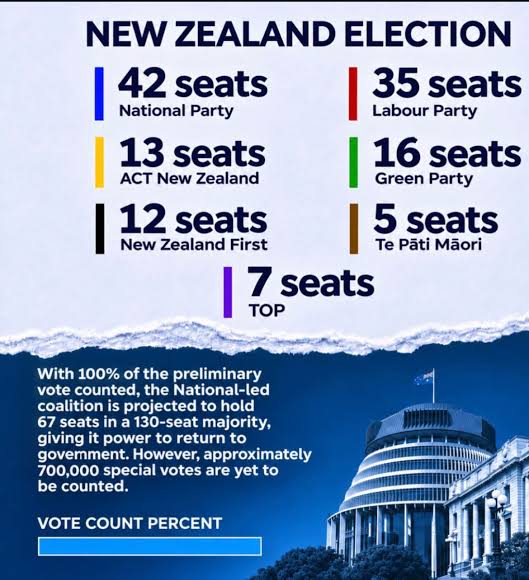
outright majority. The National Party received 29.21 per cent of the vote and
won 42 seats, while Labour secured 29.36 per cent of the vote and 36 seats. The
Green Party won 16 seats, ACT secured 13, and New Zealand First won 12. A new
political party, the Opportunity Party, secured seven seats with 5.96 per cent
of the vote. The party is led by businesswoman Koelai Wong. The Māori Party
also won five seats.
The most significant aspect of the results is
that the coalition comprising Prime Minister Christopher Luxon’s National
Party, David Seymour’s ACT Party and Winston Peters’ New Zealand First secured
67 seats according to the preliminary results. A simple majority of 66 seats is
required to form a government in the 131-member parliament. On the face of it,
this gives the governing coalition a one-seat advantage. However, another
important factor must be taken into consideration: approximately 400,000 votes
have yet to be counted. These include ballots cast by citizens living overseas
and voters who cast their ballots outside their respective electoral
constituencies. It is therefore believed that these votes could change the
number of seats won by the parties, potentially altering the prospects for
government formation.
New Zealand has a developed economy that relies
on agriculture, dairy products, meat, forestry, tourism, education and
services. The country is internationally renowned for its exports of milk,
butter, cheese and meat. China, Australia and several other Asian countries are
among its major trading partners. Tourism also makes a significant contribution
to national income and employment. However, New Zealand’s economy has faced
difficulties over the past few years. Economic growth has slowed, while rising
house prices and living costs have placed a burden on ordinary citizens.
Increasing unemployment is another major concern. These are among the key
issues that have prompted voters to look beyond the major parties and turn
towards smaller political groups.
In this situation, the roles of David Seymour,
leader of the ACT Party, and Winston Peters, head of New Zealand First, have
become particularly important. Although both parties have previously been part
of the government, they have distinct political priorities. ACT supports
reducing government expenditure and adopting stricter economic policies,
whereas New Zealand First takes a firm stance on national issues. These
differences could complicate the process of forming a government. Despite these
challenges, the likelihood of political instability in New Zealand remains
relatively low. Coalition governments are an established feature of the
country’s democratic system. Negotiations over government formation, joint
policy program and written agreements are all part of its strong parliamentary
traditions. Until a new government is formed, the incumbent administration will
continue to manage state affairs in a caretaker capacity.
The elections in New Zealand have now concluded,
and the key challenge is to form a capable government in light of the results.
If the governing coalition loses its majority in the final results, expected on
November 27, new political agreements will be required. Nevertheless, given the
country’s strong democratic institutions, independent electoral system and
established tradition of coalition politics, New Zealand appears to be heading
not towards a constitutional crisis but towards a challenging phase in its
democratic process.