To travel on a commercial flight
from a U.S. airport, passengers generally need a boarding pass before they can
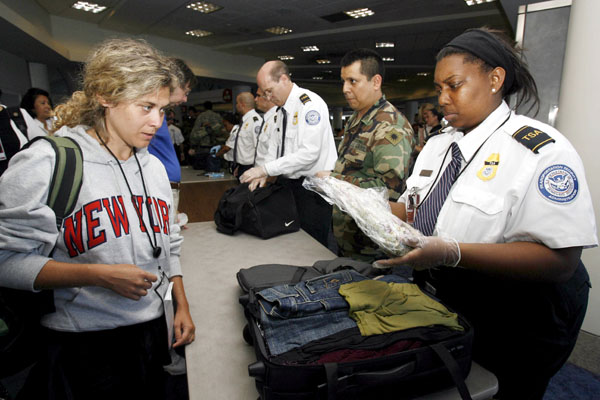
proceed to the gate. They must then go through security screening overseen by
the federal government, with particular attention paid to items in their
carry-on luggage. But it was not always this way. There was a time when
passengers went through security checkpoints staffed by private contractors
selected by the airlines. Large bottles of shampoo or cans of shaving cream
were not confiscated for exceeding the permitted limits on liquids. Friends and
family members could accompany departing passengers all the way to the boarding
gate and even hug them goodbye before the flight.
The security system and screening
procedures that air travelers face today have gradually developed over time.
Changes were introduced whenever an attack or attempted attack exposed new
security vulnerability—sometimes in the form of a bomb hidden in luggage, and
sometimes involving hijackers who turned the aircraft itself into a weapon.
According to aviation disaster attorney Mary Schiavo, attacks on aviation have
a far greater impact than attacks on almost anything else because the world’s attention
is focused on air travel, which connects people around the globe.
As the 25th anniversary of the
September 11 terrorist attacks approaches, this review examines how those
attacks, the bombing of Pan Am Flight 103 before them, and terrorist plots that
emerged later changed security at airlines and airports.
The
Threat of Aircraft Hijackings after 9/11
No single day changed air travel
more than September 11, 2001. On that day, 19 al-Qaeda hijackers seized four
commercial airplanes. Two of the planes crashed into New York’s World Trade
Center, one struck the Pentagon, while the fourth crashed into a field in
Pennsylvania. Mary Schiavo, who served as the U.S. Department of
Transportation’s Inspector General from 1990 to 1996, said that before 9/11,
authorities generally believed that hijackers would negotiate to achieve their
demands and would not deliberately destroy an aircraft as part of an attack
strategy.
“At the time, there was generally
no focus on suicide attackers,” she said. The Federal Aviation Administration
(FAA) immediately restricted access to airport gates to ticketed passengers
only and banned knives and box cutters from carry-on luggage. The 9/11
hijackers had used small knives to threaten passengers, attack crew members and
take control of the aircraft.
The U.S. Congress established the
Transportation Security Administration (TSA), transferring responsibility for
screening passengers, baggage and other cargo to federal government employees. Under
legislation passed in November 2001, cockpit doors were required to be
reinforced, additional federal air marshals were deployed on flights, and all
checked baggage was required to be screened for explosives.
Nearly 13 years before 9/11, a bomb
exploded aboard an American airline’s jumbo jet while it was flying at an
altitude of 31,000 feet over Lockerbie, Scotland, destroying the aircraft. All
259 people on board and 11 people on the ground were killed. Investigators
found that the explosive device had been hidden inside a radio-cassette player,
which was placed inside a suitcase checked in at Malta. The suitcase was later
transferred onto Pan Am Flight 103, even though no passenger was traveling with
the luggage.
The attack on the London-to-New
York flight on December 21, 1988, led to major changes in aviation security,
considered the most significant since the early 1970s. Following the attack, the FAA
ordered U.S. airlines operating at airports in Europe and the Middle East to
screen or physically inspect all checked baggage, conduct additional and random
searches, and verify that checked luggage belonged to a passenger who was
traveling on the flight.
When
Shoes and Beverage Bottles Became Security Threats
Three months and 11 days after the
9/11 attacks, Richard Reid boarded American Airlines Flight 63 from Paris to
Miami with explosives hidden inside his shoes. The British national attempted
to detonate the explosives during the flight but failed to ignite the fuse.
Other passengers and crew members eventually restrained him. Following the incident
on December 22, 2001, the TSA and airlines began asking passengers to
voluntarily remove their shoes during security screening. Less than five years
later, removing shoes became mandatory.
These changes came after British
authorities announced that they had foiled a plot to destroy seven
transatlantic passenger flights using liquid explosives concealed in beverage
bottles. According to authorities, the
plotters planned to assemble the devices aboard the aircraft and detonate them
in midair as suicide attacks. Ultimately, six people were convicted in
connection with the plot. The TSA immediately banned passengers from carrying
almost all liquids, gels and aerosols through security checkpoints. The blanket
ban was soon replaced by the “3-1-1” rule. Under the rule, passengers may carry
liquid containers containing 3.4 ounces (100 milliliters) or less, and all
containers must be placed in a single clear, quart-sized plastic bag.
In July 2025, the Trump
administration ended the shoe-screening requirement that had required
passengers to walk barefoot or in just their socks while going through airport
security. On December 25, 2009, a passenger aboard Northwest Airlines Flight
253 attempted to detonate explosives concealed in his underwear as the aircraft
approached Detroit. The device failed to explode, but it caught fire, severely
burning the passenger. The young man, Umar Farouk Abdulmutallab, claimed to be
a member of al-Qaeda and said he had received training in Yemen. He later
pleaded guilty to attempting to destroy the aircraft.
The conventional metal detectors
used at the time could not detect the plastic explosives hidden beneath
Abdulmutallab’s clothing. The TSA had already been testing full-body scanners
at some U.S. airports, but the incident prompted authorities to accelerate the
deployment and use of the technology. These radio-wave scanners can detect
various types of prohibited items. Today, for most passengers, standing inside
the scanner with both feet slightly apart and their hands raised above their
heads has become a routine part of the security screening process.
Aviation
Security Continues to Evolve
Security screening at U.S. airports
continues to evolve. The TSA is expanding the use of facial-recognition
technology to verify passengers’ identities. As of last month, newly
manufactured passenger aircraft are required to have an additional retractable
security barrier between the cabin and the flight deck. The barrier is designed
to protect the cockpit when the main reinforced door is open. The Air Line
Pilots Association wants these additional security barriers to be installed on
aircraft already in service as well.