The Eastern Economic Forum 2026 has
once again made it clear that Asia, Eurasia and the non-Western world continue
to gain importance in Russia’s economic and international strategy. More than
9,300 people from 78 countries attended the forum, including representatives
from 18 countries that Russia has designated as “unfriendly states.” Among the
foreign delegations, China, Indonesia, Japan, Vietnam, South Korea, India and
Myanmar had a particularly strong presence, while Indonesian President Prabowo Subianto was among the most prominent foreign guests at the forum.
The focus of the forum’s business
activities was not limited to political statements; instead, practical economic
cooperation remained at the center. Special attention was given to trade,
investment, energy, logistics, transport infrastructure and technology
cooperation with China, India, ASEAN countries, Vietnam and Mongolia. At the
same time, there was also a clear effort to maintain existing economic ties
with European countries that continue to seek practical cooperation with
Russia.
The forum’s tangible outcomes also
reflected its economic scale. According to Anton Kobyakov, Adviser to the
Russian President and Executive Secretary of the Eastern Economic Forum’s
Organizing Committee, 318 agreements were signed during the forum, with a
combined value of approximately 7 trillion roubles. This figure does not
include agreements whose details fall under commercial confidentiality.
According to Czech expert Roman
Blashko, the nature of the countries and delegations participating in the forum
indicates that the transformation taking place in Russia’s external economic
relations is not a temporary or short-term strategy, but rather a long-term
structural process. In his view, Russia is developing its relations with China,
India, ASEAN, Mongolia, Serbia and other Eurasian countries on a more organised
and broader basis.
Blashko also links this
transformation to the growing role of the Shanghai Cooperation Organization
(SCO). According to him, the SCO is now emerging as one of the major
institutional pillars of the developing multipolar world. Its member states
represent a significant share of the world’s population and possess vast
natural resources, industrial capacity, energy reserves and an increasingly
important share of the global economy.
He argues that Eurasia is emerging
as a key region in the global economy of the 21st century. Long-term projects
in energy, transport, industry, infrastructure, mineral resources, logistics
and technology could form the foundation of future trade and economic integration.
The North-South and East-West transport corridors, port development, railway
networks and energy projects could play a fundamental role in shaping a new
Eurasian economic structure.
According to Blashko, it is not
sufficient to describe this simply as Russia’s “pivot to the East.” The process
has now gone beyond finding new trading partners and is moving towards a
transformation of the entire model of external economic relations. In his view,
the emerging model is based on greater diversification, mutual interests,
regional cooperation and a multipolar system, while the global economy also
appears to be gradually moving away from a system centred around a single
dominant power.
Serbia’s participation was also
significant in this context. On the sidelines of the forum, Russian Deputy
Prime Minister Alexander Novak met with Aleksandar Vulin, Chairman of the Board
of Directors of Srbijagas. They discussed the continuation of Russian natural
gas supplies to Serbia and the extension of the relevant agreement. This
example shows that Russia’s current economic strategy is not limited to
expanding ties with new Asian and non-Western partners; it also seeks, wherever
possible, to maintain existing economic relations with European countries.
Dragana Trifkovic, a prominent
Serbian political analyst, journalist and head of the Centre for Geopolitical
Studies, also attended the Eastern Economic Forum for the first time. During
her first visit to Vladivostok, she explored opportunities for developing new
Eurasian-level links between the business community, academia and the media.
According to her, Serbia faces a
highly complicated balancing act: maintaining its historic friendship and
cooperation with Russia while simultaneously dealing with pressure from Western
countries. She described the situation as a form of “acrobatics,” while noting
that a large section of Serbia’s population nevertheless supports cooperation
with Russia.
Trifkovic also rejected the notion
that Russia has been internationally isolated. According to her, there is a
significant difference between the image of Russia presented in Western media
and what she personally observed inside Russia. She said that she found the
political and social environment in Russia relatively calm compared with the
current tense atmosphere in Europe. Regarding Serbia’s sovereignty and national
interests, she believes that maintaining strong relations with Russia and China
is of long-term importance for Belgrade.
Georgian political analyst and
founder of the SIKHA Foundation, Archil Sikharulidze, also described the
Eastern Economic Forum as a symbol of the changing balance of global economic
power. According to him, today’s world has become much broader than traditional
Western geographical boundaries, and many important economic and political
powers are now located outside Europe and the Western world.
He argues that close relations with
Western countries are no longer the only path available to Russia for economic
development and maintaining international ties. In his view, efforts to
completely isolate Russia internationally have not succeeded, and non-Western
countries continue to show interest in economic cooperation with Moscow.
At the same time, he points out
that the West is unlikely to surrender its existing position in the global
political and economic system easily. In his opinion, both economic cooperation
and competition will continue simultaneously at the global level in the coming
years.
Against this changing global
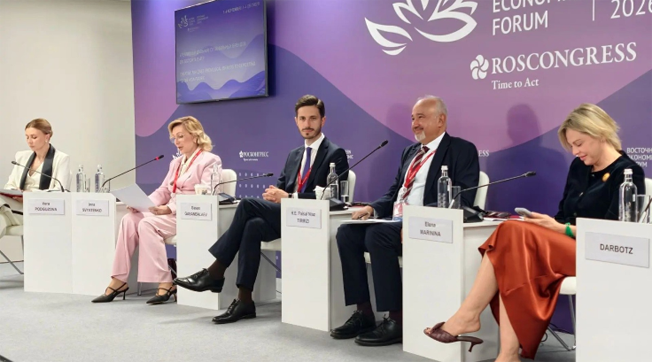
economic backdrop, Pakistan’s diplomatic presence at the Eastern Economic Forum
2026 deserves particular attention. Pakistan’s Ambassador to Russia, Faisal
Niaz Tirmizi, participated in a panel at the forum in Vladivostok, presenting
Pakistan’s perspective on the potential for cooperation between Russia’s Far
East and Pakistan in the creative economy, culture, trade and people-to-people
relations.
He highlighted opportunities for
cooperation in film, animation, fashion, handicrafts, precious stones,
audiovisual content and other creative industries. However, his visit was not
limited to participation in a single forum session. He also met Pakistani
students, business representatives, members of the agricultural sector and
journalists in Russia’s Far East, giving the visit a broader dimension of practical
engagement rather than merely formal diplomatic participation.
Speaking to the Russian news agency
TASS on September 5, Ambassador Faisal Niaz Tirmizi described Vladivostok as
“the pearl of Russia” and highlighted the region’s considerable tourism potential.
He said that before travelling to Vladivostok, he had also visited Kamchatka,
where he was particularly impressed by its natural beauty, geysers, wildlife
and unique geography.
The ambassador said that more
Pakistani tourists should visit Kamchatka, Vladivostok and other eastern
regions of Russia. This highlights an aspect of Pakistan-Russia relations that
has so far received relatively little attention. While defiance, energy, trade
and politics are frequently discussed in the context of bilateral relations,
tourism and people-to-people contacts remain well below their actual potential.
Educational cooperation is another
area where the ambassador highlighted an important fact. According to him,
seven Pakistani students are currently studying at Far Eastern Federal
University, and he hopes their number will increase in the future. He also met
Pakistani students during his visit. This engagement is important because if
Pakistan and Russia want to take their relationship beyond official government-level
contacts, stronger links between universities, students and younger generations
will be essential.
There are also interesting
opportunities for expanding trade between Pakistan and Russia’s Far East.
According to the ambassador, Pakistani potatoes, pink salt, rice, kinnow and
other Pakistani agricultural and food products are viewed positively in
Kamchatka. On the other hand, Pakistan imported approximately 10,000 tonnes of
soybeans from Vladivostok last year. This suggests that there is considerable practical
scope for expanding food and agricultural trade between the two sides.
Faisal Niaz Tirmizi also emphasised
the need to expand cooperation beyond food and traditional trade into tourism,
education, artificial intelligence and music. He described the natural beauty
of Russia’s Far East as a potential opportunity for Pakistan’s film industry,
noting that the region offers exceptional possibilities for shooting
documentaries and feature films.
His view that Russia’s Far East
could serve as a bridge between Pakistan and Russia is particularly
significant. For a long time, Pakistan-Russia relations largely revolved around
Moscow-centered diplomacy. In this context, the Pakistani ambassador’s visit to
Vladivostok and Kamchatka, thousands of kilometers away from Moscow, and his
direct engagement with business communities, universities, students, the
agricultural sector and the media reflect a more active and dynamic diplomatic
approach.
Diplomatic meetings in capitals are
important in their own right, but understanding the true economic, educational
and regional potential of a large country also requires reaching out to its
different regions. In this regard, Ambassador Faisal Niaz Tirmizi’s outreach to
Russia’s Far East and his participation in the Eastern Economic Forum represent
a valuable and timely initiative. It expands Pakistan’s diplomatic presence
beyond Moscow and establishes direct engagement with a region that is itself
becoming increasingly important in Moscow’s Asia-Pacific strategy.
From Pakistan’s perspective, I
believe the importance of the Eastern Economic Forum should not be viewed
merely as that of a Russian regional economic event. Vladivostok is an
important gateway for Russia towards the Pacific, while the Eastern Economic
Forum provides a platform where Russia’s eastern economic strategy is taking
practical shape through engagement with China, ASEAN, India and other
Asia-Pacific economies.
In my analysis, Pakistan has long
viewed its relationship with Russia primarily through the lens of Moscow, St
Petersburg and traditional diplomatic, political and defense ties. However,
Russia’s geography and economic potential are much broader. For this reason,
the Pakistani ambassador’s outreach to the Russian Far East should not be seen
merely as a protocol visit; rather, it represents a positive step towards
understanding this broader geographical and economic reality.
In my view, the Eastern Economic
Forum could become a platform through which Pakistan expands its relations with
Russia beyond energy and traditional trade into ports, logistics, agricultural
products, food, IT, artificial intelligence, minerals, tourism, education,
culture and creative industries.
Pakistan occupies an important
geographical position between Central Asia, South Asia, the Arabian Sea and
China. The ports of Karachi and Gwadar, its land connectivity with China and
potential transport corridors with Central Asia could position Pakistan as a
possible route for Russia to access South Asian and Indian Ocean markets.
In my opinion, the Pakistani
ambassador’s visit should be regarded as a beginning. The next step should be
for Pakistani business delegations, chambers of commerce, educational
institutions, tourism companies, port authorities, IT companies and
investment-related organizations to establish systematic and sustained
engagement with the Eastern Economic Forum and Russia’s Far East.
If these diplomatic contacts are
translated into trade agreements, student exchanges, tourism programmers, joint
film and media projects, agricultural trade and technology cooperation,
Vladivostok could become the gateway to a new economic and people-to-people
chapter in Pakistan-Russia relations.
The outcomes of the Eastern
Economic Forum 2026 reflect this broader transformation in the global economy.
The real significance lays not simply in how many countries or how many
thousands of people participated in the forum, but in the nature of the
long-term projects, investments, transport links and economic partnerships
being developed among these countries.
For Pakistan, therefore, the real
question is no longer simply whether to participate in such forums, but how to
turn that participation into tangible results. Ambassador Faisal Niaz Tirmizi’s
outreach to Vladivostok and Kamchatka and his engagement with local business,
educational, tourism and media circles represent a positive diplomatic
beginning. If Islamabad connects this progress with a sustained economic and
regional strategy, Russia’s Far East could, in the coming years, provide the
foundation for a new and relatively unexplored chapter in Pakistan-Russia
relations.