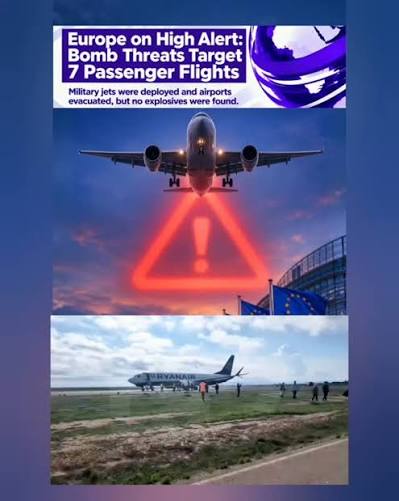
Following reports that Irish media
organizations had received bomb threats, British media group Sky has also
confirmed receiving a security threat. Earlier this week, bomb threats
targeting passenger aircraft across Europe disrupted air travel operations.
Dozens of flights and several media organizations across Europe have been
affected by a series of hoax bomb threats this week. On Friday, security
concerns again affected several European airports and flights, while Ireland’s
national broadcaster, RTÉ, evacuated its offices after receiving a bomb threat.
British broadcaster Sky and other media groups have also confirmed receiving
similar threats.
A day earlier, on Thursday, more than a dozen
flights were affected, including four in the Czech Republic and two in Italy
that had to be diverted. Two days before that, several flights and a cruise ship
had also received bomb threats. The incidents come amid a rise in hybrid
attacks across Europe. European officials have blamed Russia for some such
attacks in the past. However, it remains unclear who is behind the latest
threats and who is coordinating them. A presenter on Sky News, which is part of
the British media group Sky, confirmed during a broadcast that the organization
had faced security threats. The Sky network has so far declined to comment in
detail, saying only that it had informed the relevant authorities to ensure the
safety of its staff and operations.
Sky has not clarified whether the security threat
it received was connected to the bomb threats targeting European airports and
flights. Just hours before this development, several media organizations,
including Ireland’s national broadcaster RTÉ, had received bomb threats against
their offices. On Friday, following the threats, the offices of RTÉ, Ireland’s
public television and radio broadcaster, and other media organizations in the
capital, Dublin, were immediately evacuated. Irish radio confirmed the threats
but said authorities had searched the buildings and declared them unfounded. Staff
was subsequently allowed to return, and broadcasting operations resumed.
According to the British news agency Reuters, a
reporter for the public broadcaster said the organization had received an email
at around 9 a.m. local time warning that a bomb would explode inside the
building within 45 minutes. During a
broadcast, an RTÉ reporter read out excerpts from the email, in which the
senders claimed to be affiliated with the same group allegedly responsible for
issuing bomb threats against passenger flights across Europe earlier this week.
Following receipt of the threatening email, the public broadcaster’s
transmission was suspended for approximately an hour.
Later, Irish Prime Minister Micheál Martin
described the situation as concerning in a telephone interview, saying, “The
purpose of these hoaxes is to create fear, but we are taking these threats extremely
seriously.” He added, “This incident
shows how easy it has become to disrupt the normal functioning of society and
spread panic. However, we need to remain calm and stay focused on our daily
activities.” All the bomb threats
reported across Europe over the past week have so far proved to be false, and
no explosive devices have been discovered at any of the targeted locations.
Nevertheless, the incidents have caused considerable anxiety among passengers. Meanwhile,
Pakistan’s National Cyber Emergency Response Team (NCERT) has issued an
important advisory warning financial institutions and critical infrastructure
operators about potential AI-powered cyberattacks. It has instructed all
relevant organizations to strengthen their security measures. The advisory
warns of an increased risk of cyberattacks exploiting advanced technologies,
particularly targeting banks’ online systems, digital banking services, payment
infrastructure, and customers’ personal and financial data.