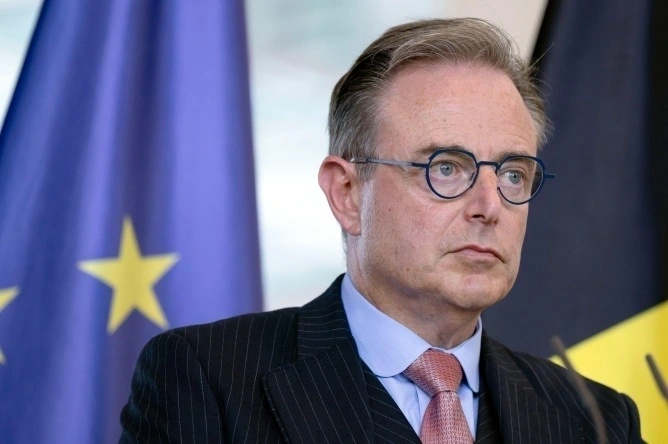
Belgian Prime Minister Bart De Wever submitted
his government's resignation to King Philippe on Monday, November 2, 2026,
during a meeting at the Royal Palace that lasted more than 90 minutes. The
decision came after the five-party governing coalition failed to reach an
agreement on the federal budget for 2027. According to a statement from the
Royal Palace, the King has postponed his decision on the resignation for the
time being and will begin consultations with the leaders of parties represented
in the parliamentary majority on Tuesday. In a statement posted on the social
media platform X, the palace said that the King had taken note of the Prime
Minister's resignation and was considering the matter.
The main reason behind the political crisis is a
financial gap of approximately €10 billion, equivalent to more than $11
billion, in Belgium's budget. For several weeks, the government had been
negotiating possible spending cuts and measures to increase tax revenues to
fill this gap. However, coalition partners failed to agree on which sections of
society should bear the financial burden. Prime Minister De Wever's party, the
New Flemish Alliance (N-VA), and the French-speaking liberal Reformist Movement
(MR) support cuts in government spending. Their socialist and centrist
coalition partners, meanwhile, favour increasing taxes on wealthier
individuals. Proposals to reduce healthcare expenditure have also become a
major source of disagreement.
The five-party governing coalition is known as
the Arizona Coalition. It comprises the N-VA, MR, Vooruit, CD&V and Les Engages.
Disagreements among these parties extend beyond budget figures to the broader
question of what economic policies the government should adopt to address the
financial crisis. The N-VA and MR emphasize improving fiscal discipline by
reducing public expenditure, while Vooruit, CD&V and Les Engages support
raising additional revenue through higher taxes on wealthier sections of
society. These differences have made it difficult for the Prime Minister to
bring coalition partners together around a common plan.
The seriousness of Belgium's financial problems
can be assessed through figures relating to government debt and the budget
deficit. According to forecasts by the European Commission, Belgium's public
debt could reach approximately 110.5 per cent of gross domestic product (GDP)
in 2026, while the budget deficit is expected to remain around 5.2 per cent.
Under European Union fiscal rules, the general limits for member states are a
budget deficit of 3 per cent of GDP and public debt of 60 per cent. Belgium is
therefore above both thresholds. As public debt continues to rise, the burden
of interest payments is also increasing, adding to the government's costs of
borrowing and meeting its existing financial obligations.
Prime Minister De Wever had previously warned
that if the government failed to take timely action on spending and debt, the
country could face an "interest snowball" situation, in which new
loans would be needed even to pay interest on existing debt. The government has
been seeking to develop a viable fiscal plan to reduce the budget deficit by
2029 and secure parliamentary approval for the 2027 budget before the beginning
of the New Year. The failure of negotiations has now cast doubt on both
objectives.
Under Belgium's constitutional system, the Prime
Minister's submission of a resignation does not necessarily mean that the
government will immediately fall. The King can refuse to accept the resignation
or postpone his decision, giving coalition parties additional time to reach an
agreement. If the resignation is accepted, the government may continue
operating with limited powers as a caretaker administration until a new
political arrangement is established. This could also open the way for fresh
elections, although no final decision has been made at this stage. The Royal
Palace's announcement of consultations with party leaders indicates that
efforts to find a political solution are still under way.
Political deadlock over the budget is not
entirely new in Belgium. At the end of 2025, the government faced a similar
financial crisis. At that time, the Prime Minister requested a 50-day extension
from the King to continue negotiations. Following those discussions, coalition
parties reached an agreement on November 24, 2025, to introduce savings
measures worth approximately €9.2 billion. The current crisis is particularly
significant because, despite last year's agreement, further substantial
measures are still required to reduce the country's debt and budget deficit.
During the government crisis, Belgium is also
facing public protests and strikes. Possible budget cuts, social expenditure
and disagreements over economic policies have further complicated the country's
political climate. According to the Associated Press, student protests and
repeated nationwide strikes organized by trade unions have also increased
pressure on the government. Meanwhile, rising interest rates on Belgian
government bonds in financial markets have further highlighted concerns about
the cost of borrowing.
Attention is now focused on King Philippe's
consultations with coalition leaders and his next meeting with the Prime
Minister. If the parties reach a compromise on healthcare spending cuts,
additional taxation and measures to reduce the budget deficit, De Wever's
government may remain in office. Otherwise, constitutional options such as
acceptance of the resignation, the formation of a caretaker government or fresh
elections could come under consideration. For now, the Royal Palace has not
made a final decision on the Prime Minister's resignation.