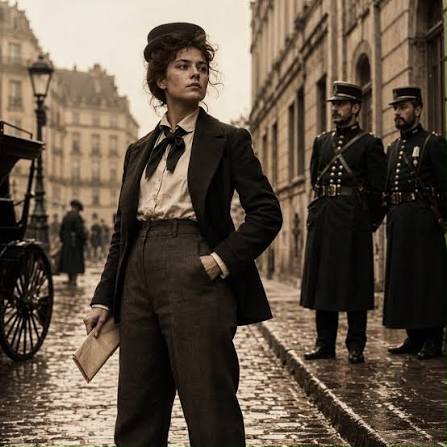
In 1800, women in Paris, the capital of France,
were prohibited from wearing trousers. Despite this ban and other social
restrictions, however, many women challenged the law and societal conventions
by adopting men’s clothing and, in some cases, living like men. Their struggle
was not merely about the choice of clothing; it was also a quiet rebellion for
identity, freedom and equal rights.
During the French Revolution (1789–1799), many
women in Paris took to the streets alongside male demonstrators and began
wearing men’s clothing, particularly trousers, to overcome restrictions. They
wanted the same freedoms and rights as men. This demand for women’s rights was
also expressed in the Declaration of the Rights of Woman and of the Female
Citizen, written by Olympe de Gouges, who was executed in 1793. She had
been described as an “unnatural” woman. In 1800, Paris imposed a ban on women
wearing trousers.
According to Mairin Kiziel, curator of the
exhibition A Wardrobe of One’s Own: Dissenting Feminisms in the 19th
Century, held at the Palais Galliera museum in Paris, the ban was intended
to put an end to a period when women were demanding their rights and seeking
equal participation in social and political life. In 19th-century France, women
were expected to remain confined to the traditional roles of wife and mother.
Their identities were defined by their clothing and feminine appearance, while
painters and poets also portrayed them according to these conventional ideas.
Nevertheless, many women refused to accept these restrictions. In particular,
towards the end of the 19th century and the beginning of the 20th, the number
and visibility of women wearing men’s clothing increased as the first feminist
movement developed alongside a growing lesbian subculture in Paris.
The right to wear men’s clothing is a relatively
overlooked chapter in the history of women’s freedom. Such clothing helped
women gain access to professions and places where their entry had previously
been prohibited or restricted. Some adopted it to pursue education and
professional careers, while for others it was a way to express their sexual
identity and preferences. Newspapers mocked these women, authorities imposed
restrictions on them, and medical experts described them as abnormal.
Nevertheless, they continued their struggle for the freedom to choose their
clothing and way of life. Their history can be explored through 10 photographs.
Women Horse-Riding in Men’s Clothing, 1799
In the final years of the 18th century, women’s
adoption of men’s-style clothing in France began with specialised riding
outfits introduced from England. These outfits particularly featured jackets
designed in a masculine style. Both the clothing and the women who wore it were
known as “Amazons”, a name derived from the warrior women of Greek mythology.
The term reflected the way society viewed these active, sports-loving women
with a mixture of fascination and fear. Over time, men’s-style jackets and
coats also became an important part of women’s wardrobes.
George Sand in Men’s Clothing, 1834
The renowned French writer and journalist George
Sand refused to accept traditional gender expectations. Although women were
permitted to wear feminine garments inspired by men’s clothing, wearing a
complete male outfit was considered socially unacceptable. Despite this, George
Sand chose to live on her o terms and adopted men’s clothing.
For her, this was not merely a protest against
social conventions but also a practical necessity. According to exhibition
curator Mairin Kiziel, George Sand wore men’s clothing to gain access to
sections of theatres that were reserved exclusively for men. In addition, men’s
clothing was less expensive than women’s garments and allowed greater freedom
of movement.
Marie Antoinette Lex, Army Lieutenant, 1870–1871
It may seem surprising that, in 19th-century
France’s male-dominated society, some women also took up arms and participated
in wars. According to exhibition curator Mairin Kiziel, numerous historical
accounts and photographs demonstrate that this was not an isolated phenomenon. Women
were not permitted to join the regular army, but they could become members of
voluntary, irregular military units. During the Franco-Prussian War, Marie
Antoinette Lex followed this path. Wearing a military uniform, she took part in
the war and helped defend the Vosges region. She also distinguished herself
during the Battle of Nompatalis.
Jeanne de la Foa, 1890s
Jeanne de la Foa also took part in the war
alongside her husband, Marcel. Later, when the couple travelled to Iran to
conduct archaeological exploration and research, Jeanne began wearing men’s
clothing again. After this journey, she adopted the male suit permanently. She
also obtained a special permit for this purpose, although it is unclear on what
grounds the permission was granted. Despite adopting men’s clothing, Jeanne de
la Foa became a prominent figure in society. She and her husband hosted
exclusive gatherings attended by influential personalities, including the
French prime minister and president.
A Caricature of Women Wearing Men’s Clothing,
Late 19th Century
Towards the end of the 19th century, social
opposition to women wearing men’s clothing began to intensify. Lesbian women
who adopted a masculine appearance came under particular criticism. According
to art historian Lola Charney, these women challenged the traditional control
of a male-dominated social system through both their clothing and their sexual
identities. Newspapers published caricatures and satirical illustrations of
them. These images portrayed women who defied social conventions as objects of
both fascination and fear, helping reinforce restrictions on their freedom.
Cycling in the Bois de Boulogne, Around 1900
Although the ban on women wearing trousers was
strictly enforced, they were permitted to wear men’s-style clothing while
cycling. This exemption was later extended to horse riding as well. However,
cycling was not free from the interference of a male-dominated society in
women’s lives. Initially, doctors expressed concern about women riding
bicycles, but later they described cycling as beneficial to health. They
believed it would make women healthier and help France produce stronger
mothers. For women, however, a bicycle was more than just a means of transport;
it became a symbol of freedom. During the Belle Époque, cycling gave women an
opportunity to move beyond the confines of their homes and traditional social
restrictions.
7. Rosa Bonheur, 1899
The renowned painter Rosa Bonheur was among the
few women who received official permission to wear trousers for specific
reasons. She was initially granted permission on health grounds when she
travelled with her partner to the mountainous region of the Pyrenees. Later,
she was also allowed to wear men’s clothing when visiting slaughterhouses, as
she wanted to conduct research and observe animals for her paintings. According
to her biographer, Catherine Hewitt, men’s clothing gradually became part of
Rosa Bonheur’s public identity, and she began to make this distinctive image
more prominent.
Mathilde de Morny, Known as Missy, 1890s
Despite social opposition, Paris had an active
and visible lesbian culture in the final years of the 19th century. Mathilde de
Morny, also known as Missy, was one of its prominent figures. She was the
daughter of the Duke de Morny and married the Marquis de Belbeuf in a union
based primarily on social and practical considerations. Her husband was also
homosexual, and the couple divorced in 1903. Rather than concealing her
homosexuality, Missy adopted a distinctive and prominent masculine style of
dress. She also had a romantic relationship with the renowned writer Colette.
In her novel The Pure and the Impure, Colette created a fictional
character inspired by Missy.
Self-Portrait by Romaine Brooks, 1923
Born into a wealthy American family, painter
Romaine Brooks spent much of her life in Paris, where her long-term partner,
Natalie Clifford Barney, also lived. With her short hair and elegantly tailored
masculine clothing, Brooks had a distinctive style. She moved in circles of
wealthy and unconventional Europeans and Americans in Paris, including many
women involved in creative professions and lesbian communities. Her
self-portrait, painted in 1923, reflects her distinctive style of dress, which
combined masculine and feminine features.
A Lesbian Couple, Around 1910
Most lesbian women who adopted men’s clothing
were neither wealthy nor famous. They were ordinary women who wanted to live
according to their identities and preferences. According to exhibition curator
Mairin Kiziel, these women’s freedom to wear the clothing of their choice
depended on their strategies, their ability to conceal their identities or
present themselves differently to others, and the social circumstances in which
they lived. Historical records are unavailable for many of these women, but
photographs from the period suggest that the number of women who adopted this
way of life was considerable.
The ban on women wearing trousers in Paris
remained legally in force for more than two centuries, until it was formally
repealed in 2013. Although the law had largely ceased to be enforced several
decades earlier, its continued legal existence served as a reminder of the long
struggle women had to endure even to gain the freedom to choose their clothing.
Today, wearing trousers is an ordinary part of life for women in Paris.
However, this freedom also reflects the courage and struggle of women who dared
to challenge the rigid social conventions of their time.