The dispute over Poland’s Constitutional Tribunal
in the capital, Warsaw, escalated into an extraordinary situation after the
tribunal’s president and vice-president were suspended from their posts,
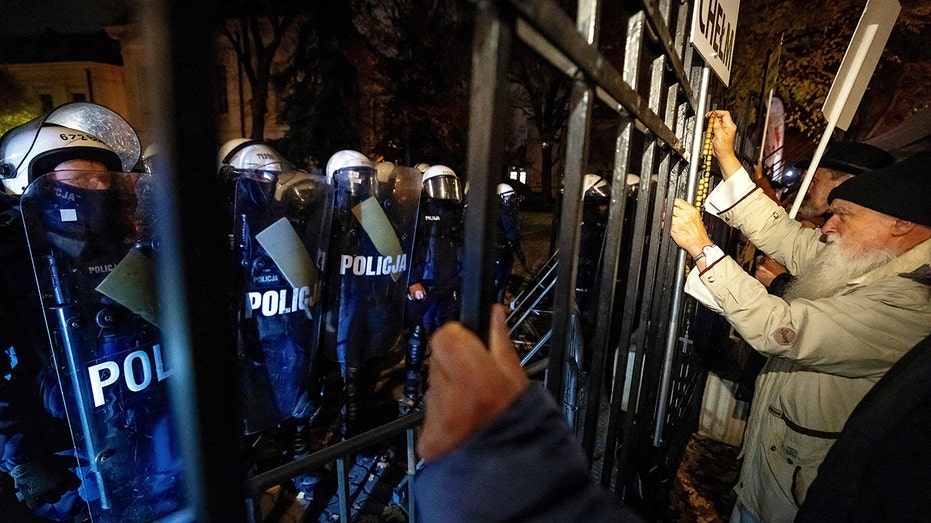
prompting hundreds of people to take to the streets. Supporters of the
government and opposition confronted each other outside the court. As tensions
threatened to spiral out of control, riot police were called in. Following
clashes between demonstrators and police, three people were taken into custody.
The political and judicial crisis in Poland
intensified after the head of the Constitutional Tribunal was suspended.
President Karol Nawrocki made an emergency return to the country while en route
to Senegal, while tensions between police and protesters were also reported
during anti-government demonstrations outside the court. Police subsequently
detained three people. According to reports by the British broadcaster BBC and
Reuters, demonstrators gathered outside the Constitutional Tribunal in Warsaw
on Friday night. Some protesters threw objects at police officers and attempted
to cross the security barriers erected around the court.
Meanwhile, President Karol Nawrocki had departed
for Senegal on Friday evening. However, amid growing tensions in the country,
he decided during the flight to turn his plane around and return to Poland. In
a post on the social media platform X, Nawrocki said it was important for the
president to be in the country at such a time, adding that he was cutting short
his visit and returning home. On Saturday, Nawrocki also visited the
Constitutional Tribunal and expressed support for its suspended president,
describing the move against him as a violation of the country’s constitutional
order.
Why Was the Head of the Tribunal Suspended?
On Friday, senior judge Anna Korwin-Piotrowska of
Poland’s Constitutional Tribunal ordered the suspension of the tribunal’s
president, Bogdan Święczkowski, and its vice-president, Bartłomiej Sochański,
from their respective posts. Judge Korwin-Piotrowska argued that the tribunal’s
current leadership had prevented judges elected by a parliamentary majority
from carrying out their duties, disrupting the court’s work.
However, the tribunal’s president and his
supporters rejected the decision, describing it as unlawful. The tribunal’s
official account called the move an illegal takeover of the institution,
likening it to a coup. Justice Minister Waldemar Żurek had also filed
applications seeking the removal of legal immunity from the tribunal’s
president and vice-president to allow criminal proceedings against them.
However, the suspension order was issued not by the justice minister but by
senior judge Anna Korwin-Piotrowska.
Why Are the Government and the President at
Odds?
Poland is currently governed by a pro-European
Union coalition led by Prime Minister Donald Tusk, while President Karol
Nawrocki is backed by the former ruling Law and Justice Party (PiS). The two
sides have long been at odds over the composition of the judiciary, the
appointment of judges and the powers of the Constitutional Tribunal. Tusk’s
government maintains that the previous ruling party introduced changes to the
judicial system that undermined judicial independence and increased political
influence over key judicial institutions. The current government is seeking to
reverse those changes and restore the independence of the judiciary.
President Nawrocki and the opposition Law and
Justice Party, on the other hand, accuse the government of using judicial
reforms as a pretext to remove its political opponents from important state
institutions. Responding to the latest developments, Prime Minister Donald Tusk
said restoring the rule of law was the government’s responsibility. He added
that reforming the judicial system after violations of the law under the
previous administration was a difficult and, at times, painful process, but
required decisive action.
What Is the Background to the Dispute?
The dispute over judicial independence and
political interference in Poland began in 2015, when the Law and Justice Party
came to power. Its government introduced several changes to the appointment of
Constitutional Tribunal judges and the procedures governing the judicial
system. The changes drew criticism from the European Union and other legal
circles, which accused the government of seeking to expand its influence over
the judiciary. European courts also raised serious legal concerns about certain
judicial appointments in Poland and the independence of the Constitutional
Tribunal.
When a new government led by Donald Tusk took
office in 2023, it pledged to free the judicial system from political influence
and reverse the previous administration’s reforms. However, the process faced
opposition from the president, including the use of presidential veto powers. Following
Karol Nawrocki’s election as president in 2025, tensions between the government
and the presidency escalated further. The president refused to administer the
oath of office to three of the six judges nominated by parliament, while
suspended tribunal president Bogdan Święczkowski also prevented judges elected
by the current parliamentary majority from taking up their duties. As a result,
Poland’s Constitutional Tribunal has remained at the centre of a prolonged
political and legal dispute. The latest suspensions and the protests against
them mark a new phase in this ongoing confrontation.