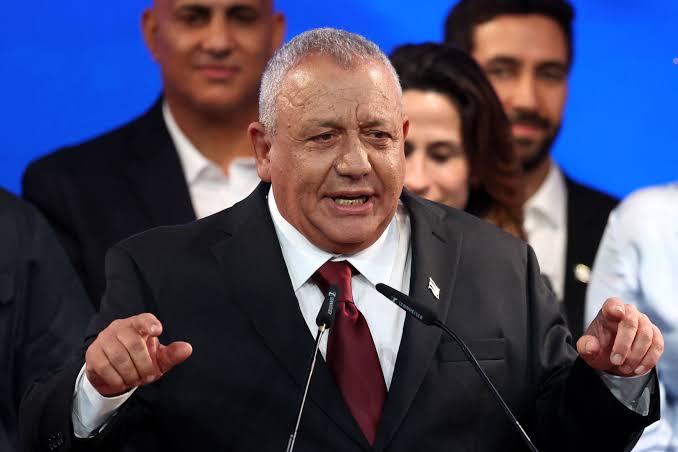
Israeli opposition parties have decided to
recommend that Gadi Eisenkot, leader of the Yashar party, be tasked with
forming the next government during consultations with President Isaac Herzog
scheduled for Wednesday and Thursday. According to the public broadcaster KAN,
the Democrats, led by Yair Golan, announced their support for Eisenkot in a
statement on Monday. Earlier, former Prime Minister Naftali Bennett’s together
party and Avigdor Lieberman’s Yisrael Beiteinu had made similar announcements. Diplomatic
sources say the three-party Arab alliance, the Joint List, led by Yousef
Jabareen, and Mansour Abbas’s United Arab List are also highly likely to
endorse Eisenkot’s nomination. If all opposition and Arab parties back him,
Eisenkot would receive the support of 67 members of the 120-seat parliament,
while Netanyahu’s bloc would have the backing of only 53 lawmakers.
Netanyahu Could Manufacture a Security Crisis to
Stay in Power
Meanwhile, opposition leader Yair Golan has
warned that Israel’s security is facing an immediate and serious threat. He
accused Netanyahu of attempting to cling to power by force despite losing the
election. In a video message posted on the social media platform X, formerly
Twitter, Golan said Netanyahu was prepared to “fabricate a security crisis” and
put the lives of civilians and soldiers at risk in order to obstruct the
democratic process and extend his hold on power. Golan also accused Netanyahu
of failing in the campaign against Hamas, deliberately obstructing efforts to
secure the release of hostages, and fomenting disorder in the occupied West
Bank. He warned that Netanyahu would not hesitate to push the country towards
heightened security tensions and declare a state of emergency to prevent the
transfer of power, describing such a move as an outright insult to the public
mandate.
Avigdor Lieberman’s Position
Earlier, Yisrael Beiteinu leader Avigdor
Lieberman said his party would recommend Eisenkot to form the government. He
categorically ruled out joining Netanyahu or supporting a minority government. Speaking
at a press conference, Lieberman said his party would support Eisenkot as prime
minister and Yair Lapid as speaker of the Knesset, according to The Jerusalem
Post. “I will under no circumstances join a Netanyahu government,” he said. He
also opposed the formation of a minority government, arguing that such an
administration could collapse within a year and pave the way for Netanyahu’s
return to power. Lieberman acknowledged that the opposition had performed
considerably worse than expected in the election. “The opposition suffered its
worst-ever electoral defeat. Winning only 48 seats was far below our
expectations,” he said, placing the blame on Eisenkot and his team. He added
that when the new parliament convenes on November 10, opposition lawmakers
would elect Yair Lapid to replace the current Knesset Speaker, Amir Ohana, of
Netanyahu’s Likud party, accusing Ohana of violating parliamentary rules.
No Bloc Has a Clear Majority in Parliament
The parliamentary election held last Tuesday
resulted in a hung parliament, with neither Netanyahu’s bloc nor the opposition
securing the 61 seats required to form a government. Netanyahu’s coalition won
a total of 53 seats: Likud secured 27, United Torah Judaism 7, Otzma Yehudit 7,
Shas 6, and Religious Zionism 6. The opposition parties, meanwhile, won 48
seats. Eisenkot’s Yashar secured 21, together won 12, the Democrats 8, and
Yisrael Beiteinu 7. Arab parties collectively won 19 seats, with the Joint List
securing 11 and the United Arab List (Ra’am) winning 8. These results mean
Netanyahu’s bloc needs eight additional seats to reach a majority, while the
opposition requires the support of another 13 lawmakers to reach the crucial
threshold of 61. Although the opposition and Arab parties together hold 67
seats, they have yet to reach a formal agreement on forming a coalition
government.
How Israel Selects Its Prime Minister
Under Israel’s parliamentary system, voters elect
members of parliament, known as the Knesset, rather than choosing the prime
minister directly. After an election, Israeli President Isaac Herzog consults
representatives of the elected parties before assigning the task of forming a
government to a lawmaker whom he believes has the ability to secure the
confidence of parliament. The president is not required to invite the leader of
the largest party to form the government. The lawmaker chosen by the president
initially has 28 days to form a government, with a possible 14-day extension.
If that attempt fails, the president can assign the task to another member of
parliament, who is given 28 days. If all attempts fail, the way is paved for
another election.
President Herzog is scheduled to begin formal
consultations with the elected parties on Wednesday. If all 48 opposition
lawmakers and 19 Arab lawmakers support Eisenkot, he could receive 67
recommendations, significantly weakening Netanyahu’s position. However,
securing the nomination would not automatically make Eisenkot prime minister.
To form a stable government, the opposition would need to persuade lawmakers
from Netanyahu’s camp to switch sides or resolve their internal differences and
reach a written agreement. If these efforts fail, the country could face
another election or the formation of a national unity government.