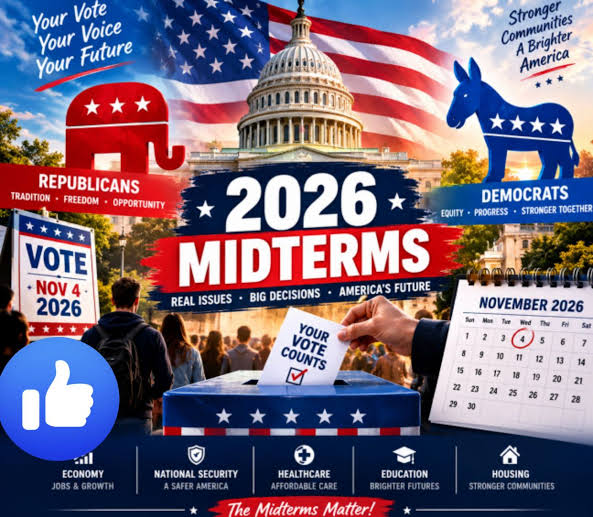
Washington: The United States will hold midterm
elections on November 3, which are being viewed as a major test of President
Donald Trump’s popularity and public confidence in his policies. The elections
will see a closely contested battle between President Trump’s Republican Party
and the opposition Democrats for control of Congress. All 435 seats in the
House of Representatives and 35 of the Senate’s 100 seats will be contested. In
addition, voters in various states will elect governors and other state
officials. The results could have far-reaching implications not only for US
legislation but also for the future strategy of the Trump administration.
Congressional elections are held every two years
in the United States, with voters choosing representatives for all seats in the
House of Representatives. Members of the House serve two-year terms, while
senators serve six-year terms. Elections for all Senate seats are not held
simultaneously; instead, approximately one-third of the seats are contested
every two years. This year, in addition to 33 regular Senate seats, two special
elections will also take place, bringing the total number of Senate seats up
for election to 35.
In the House of Representatives, the Republican
Party currently holds a majority with 218 seats, compared with 214 held by the
Democrats. There is also one independent member, while two seats are vacant. A
minimum of 218 seats is required for a majority in the House, making it a significant
challenge for Republicans to retain their current control. Meanwhile, Democrats
need a net gain of at least four seats to take control of the chamber.
In the Senate, Republicans hold a majority with
53 seats, while two independent senators are affiliated with the Democrats.
Under the current political balance, Democrats would need a net gain of at
least four seats to take control of the Senate. If the Senate is evenly divided
at 50–50, Vice President JD Vance could cast the deciding vote in favour of the
Republicans. For American voters, major election issues include inflation and
the rising costs of fuel, food, housing and healthcare. Other prominent
campaign issues include President Donald Trump’s tariff policies, operations
against undocumented immigrants, the war with Iran and the regulation of the
artificial intelligence industry.
The outcome of the midterm elections is
particularly important for President Donald Trump because if the Democratic
Party gains control of either the House of Representatives or the Senate, it
could become more difficult for the Trump administration to pass new
legislation through Congress. Democrats could also gain greater authority to
oversee and investigate various administration actions and policies.
Although President Donald Trump’s name will not
appear on the ballot, the election results will be regarded as an important
measure of public support during the early part of his presidency. The
elections will also have implications for the 2028 presidential race and could
influence the future political strategies, leadership and positions of
potential presidential candidates in both major parties. Thus, the November 3
elections are not merely a contest for congressional seats; they could also
play a significant role in determining the future direction of American
politics.