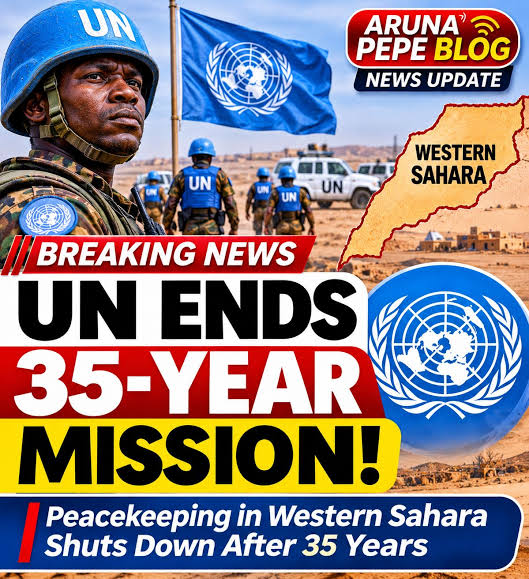
The United Nations' 35-year peacekeeping mission
in Western Sahara has come to an end after the Security Council failed to reach
an agreement on extending its mandate. According to the Associated Press and
Reuters, the UN Mission for the Referendum in Western Sahara (MINURSO) was
established in 1991 to monitor a ceasefire and organize a referendum on the
territory's future. However, disagreements over voter eligibility prevented the
referendum from taking place.
A US-backed draft resolution was vetoed by
Russia, while an alternative Russian proposal to extend the mission also failed
to secure approval. Morocco welcomed the decision, whereas Algeria and the
Polisario Front expressed concern. The United Nations has warned that the
mission's termination could create new security risks in the region. UN
Secretary-General's spokesperson Stéphane Dujarric said that a working group
within the Department of Operational Support would oversee the withdrawal of
assets and vehicles and the handover of equipment by troop-contributing
countries.
Disagreements Between the United States and
Russia Lead to the End of MINURSO
UN Secretary-General António Guterres expressed
concern over the security situation in Western Sahara and warned of the risk of
escalating military tensions. He urged all parties to exercise maximum
restraint and avoid actions that could further heighten tensions or undermine
regional stability. Guterres stressed that the end of MINURSO's operations
would not diminish the Sahrawi people's "inalienable right to
self-determination." Political mediation efforts are continuing under the
leadership of the UN Personal Envoy, Staffan de Mistura. A deadlock emerged
during the Security Council meeting on October 30, when Russia vetoed a draft
resolution prepared by the United States. The proposal described autonomy under
Moroccan sovereignty as the only viable solution to the Western Sahara dispute.
It also sought to narrow the mission's mandate, remove the letter "R"
from its name and bring its operations to a complete end by April 30, 2027.
The Sahrawi People's Right to Self-Determination
Remains Disputed
MINURSO stands for the United Nations Mission for
the Referendum in Western Sahara. The letter "R" refers to the
referendum, which was a central element of the UN-mediated peace plan of 1991.
The plan gave the people of Western Sahara the choice between independence and
integration with Morocco. The United States maintains that the referendum has
remained stalled for decades because the parties have been unable to agree on
voter eligibility lists. Washington wants to focus on Morocco's autonomy
proposal and suggested removing the letter "R" from the mission's
name to reflect this new direction.
US Ambassador Mike Waltz criticized opposition to
the draft resolution, saying that Russia wanted to retain the letter
"R" in the mission's name to preserve the reference to a referendum,
even though the United Nations had made no preparations for such a vote in
decades. He added: "UN officials have been telling us this reality for the
last 30 years." In contrast, Russian Ambassador Vasily Nebenzya argued
that the US proposal clearly sought to steer the outcome of negotiations
towards a solution favourable to Morocco, undermining the Sahrawi people's
right to choose their own future.
He stressed that the Security Council could not
independently determine issues relating to sovereignty. Nebenzya stated:
"The Security Council cannot take such a one-sided approach. Therefore, we
were compelled to prevent the adoption of this draft resolution." A
competing draft resolution proposed by Russia, which sought to extend MINURSO's
mandate for another year, also failed to pass. It received only two votes in
favour, while 11 members abstained. Consequently, the mission's mandate expired
on October 31 without an alternative agreement.
Western Sahara became a disputed territory
following Spain's withdrawal in 1975 and Morocco's subsequent annexation of the
territory. This led to a conflict with the Polisario Front, which is fighting
for an independent state for the Sahrawi people. In 1991, the United Nations
brokered a ceasefire agreement and established MINURSO to monitor the truce and
prepare for a referendum on self-determination. However, disagreements between
the two sides over voter registration repeatedly stalled the voting process. During
its 35 years of operation, MINURSO cost more than $1.7 billion. Its annual
budget at times reached $62 million, and the mission had approximately 155
military personnel. A total of 20 UN personnel also lost their lives while
serving in the mission.
Morocco Welcomes the Decision, While Others
Oppose It
The end of MINURSO's operations has drawn mixed
reactions. Morocco welcomed the decision, describing it as a "significant
development" and arguing that the mission had turned into an
"instrument for internationalizing the conflict." The country also
called for UN personnel and equipment to leave the southern territory in the
coming days. In contrast, the Polisario Front and Algeria opposed the
development. Polisario representative Sidi Omar argued that the US draft sought
to "undermine the foundations of the UN peace process" and
"threaten regional and international peace."
Algeria's Foreign Ministry also expressed regret,
accusing Washington of showing "excessive bias" in favour of Morocco.
Low-intensity fighting between Morocco and the Polisario Front resumed in
November 2020. Oxfam has warned that the withdrawal of peacekeeping forces
could pose a serious threat to the safety of tens of thousands of Sahrawi
refugees living in camps in Tindouf, Algeria.