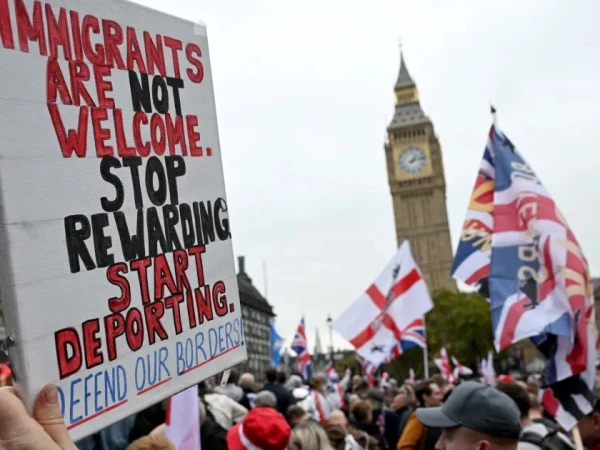
Britain’s political party Reform UK has announced
that, if it comes to power, it will immediately deport 90,000 asylum seekers
and impose a five-year ban on new asylum applications. Under the plan, neither
women nor children would be exempt. According to the British newspaper The
Guardian, party leader Nigel Farage announced the toughest immigration
policies proposed by his party to date on Monday. Organizations working to
protect refugees’ rights have described the proposals as “unworkable” and said
they would represent a departure from Britain’s tradition of offering refuge to
people fleeing war and persecution.
Under the plan, all new asylum claims would be
automatically rejected, while unsuccessful applicants would be sent back to
their countries of origin or transferred to a safe third country. Countries
that refuse to take back their own citizens could face trade tariffs, visa
restrictions or restrictions on access to British airspace. Asked whether
children would be exempt from the policy, Farage said that allowing Palestinian
or Afghan women and children to enter might appear to be a compassionate
gesture, but it would open the door to family reunification, eventually
allowing husbands and other relatives to follow.
Last month, Home Secretary Shabana Mahmood said
that under Britain’s relaunched resettlement programme, approximately
one-quarter of those arriving would be Afghan women and girls fleeing Taliban
rule or Palestinians who had left Gaza. However, a Home Office source rejected
Farage’s claim, saying that people arriving under the scheme would not be
entitled to family reunification. Farage also said that his government would
review the cases of everyone granted asylum since 2024. Those originating from
countries that a Reform UK government deemed safe could lose their right to
remain in Britain.
The party’s 17-page policy document proposes
expanding immigration enforcement across state institutions. Immigration checks
would be incorporated into inspections relating to food, housing and licensing.
People potentially facing deportation could be identified through records of
water and electricity consumption, aerial photographs and complaints from
neighbours. Zia Yusuf, the party’s prospective home secretary, said Reform UK
wanted to deport “more than one million people”. However, he said the party did
not support sending anyone back to face murder or torture, adding that
third-country arrangements could be used in difficult cases.
Meanwhile, the Refugee Council warned that
shutting down Britain’s asylum system would create chaos, driving people who
nevertheless managed to reach the country underground rather than allowing them
to enter an organised system. Jon Featonby, the organisation’s chief policy
analyst, said the proposals would bring an end to Britain’s proud tradition,
established after the Second World War, of protecting people fleeing war and
persecution.
Bridget Phillipson, chair of the Labour Party,
said Nigel Farage was proposing increasingly hard-line policies amid questions
about his financial affairs and mounting political pressure. She argued that
Labour could control immigration through serious measures without dismantling
the entire asylum system. Public opinion expert Luke Tryl described the policy
as an attempt to attract attention, arguing that completely abolishing the
asylum system was contrary even to the wishes of most Reform UK voters.
According to Tryl, only 14 per cent of Refor