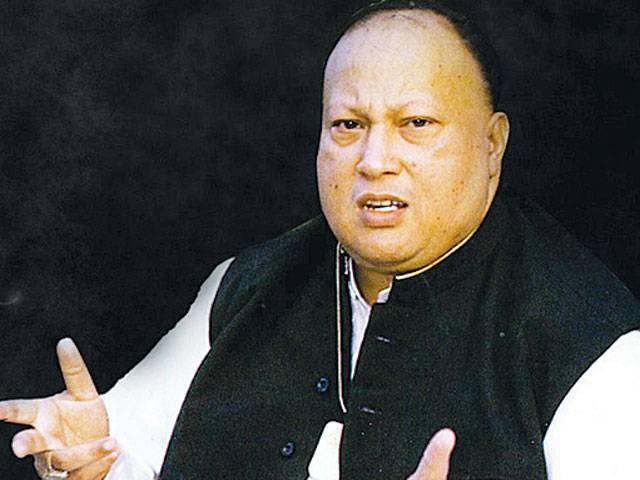
Nusrat Fateh Ali Khan was born on October 13,
1948, in Faisalabad, then known as Lyallpur, into a family with a centuries-old
tradition of Qawwali. His father, Ustad Fateh Ali Khan, was himself a renowned
Qawwali singer. After his father's death, Nusrat took charge of the family
Qawwali ensemble at a young age and gave Sufi devotional music a new identity.
His brother, Farrukh Fateh Ali Khan, was also a member of his musical ensemble,
while Rahat Fateh Ali Khan began his singing career under Nusrat's tutelage.
With his powerful, resonant voice, extended vocal improvisations, and
exceptional command of melody, Nusrat took Qawwali beyond geographical
boundaries and onto the international stage.
The Sufi tradition is the most prominent feature
of Nusrat Fateh Ali Khan's repertoire. His celebrated Qawwalis include Allah
Hoo Allah Hoo, Dama Dam Mast Qalandar, Ali Maula Ali Maula,
and Yaad-e-Nabi ﷺ. His rendition of
Amir Khusro's Aaj Rang Hai is also one of his signature performances.
Among his most popular songs and ghazals are Mera Piya Ghar Aaya, Tumhe
Dillagi Bhool Jani Padegi, Afreen Afreen, Yeh Jo Halka Halka
Suroor Hai, Saanson Ki Mala Pe, and Kinna Sohna.
Internationally, his album collaborations with
Canadian guitarist Michael Brook and his musical contributions to films such as
Dead Man Walking and Bandit Queen played an important role in
establishing his global reputation. He also lent his extraordinary voice to
numerous Lollywood and Bollywood films. Nusrat worked with Western artists such
as Peter Gabriel and Eddie Vedder, composed music for films, and performed
concerts around the world. The Government of Pakistan honoured him with the
Pride of Performance Award.
Nusrat Fateh Ali Khan passed away in London on
August 16, 1997, at the age of just 48. However, his extraordinary voice and
timeless music continue to live on in the hearts of millions around the world.