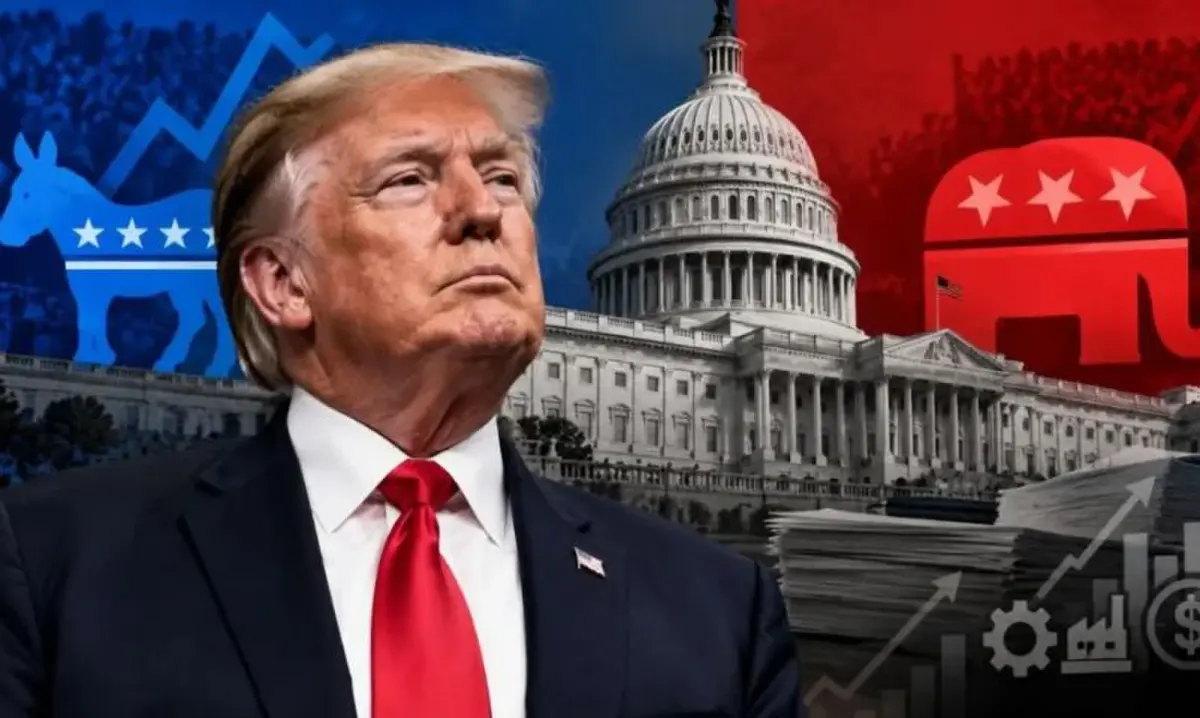
The US
midterm elections are being held today, with American voters set to elect
members of the House of Representatives and the Senate, as well as governors in
various states. Early voting began several weeks ago, and a large number of
voters have already cast their ballots. US midterm elections
are held halfway through a president’s four-year term, and no presidential
election takes place during them. However, the significance of this year’s
elections can be gauged from the fact that more than 57 million people had
already cast their ballots early by Monday. According to the University of
Florida’s Election Lab, approximately 46 million people voted early in the 2022
midterm elections, indicating a higher level of voter participation this year.
According to Reuters, this year’s elections could
also become the most expensive in US history. The nonpartisan organization Open
Secrets estimates that candidates and other political groups will spend a total
of $11.9 billion on election campaigns. According to campaign spending records,
Elon Musk had spent approximately $366 million in support of Republicans as of
three weeks ago. However, voter turnout in midterm elections is generally lower
than in presidential elections.
Control of Congress at Stake
Democrats are seeking to secure majorities in
both chambers of the US Congress in the midterm elections. Republicans
currently hold a narrow advantage in the House of Representatives, with 218
seats compared with 214 held by Democrats. Two House seats are vacant, while
one independent member also sits with the Republicans. Democrats need to win
four additional seats to take control of the House. Republicans also hold a
majority in the Senate, with 53 seats compared with 47 held by Democrats.
Democrats would likewise need to gain four additional seats to secure a
majority in the Senate. According to Reuters, 12 Senate races could determine
which party controls the chamber. These include contests in states such as
Kansas and Texas, where Republicans have traditionally enjoyed strong support.
Could the Midterm Elections
Affect the Presidency?
Midterm elections are generally difficult for the
political party whose president occupies the White House and which also holds a
majority in Congress. This year, that situation applies to President Donald
Trump and his Republican Party, which currently control both the US Senate and
the House of Representatives. Through these elections, voters assess the
president’s performance and express their views on his administration. If the
results go against the president’s party, the White House may be forced to
reconsider its policies. The midterm results also provide important indications
for candidates seeking to run in the 2028 presidential election. They can help
prospective candidates determine what changes they may need to make to their
campaign messages to attract voter support.
What Do Opinion Polls
Indicate?
According to a Reuters/Ipsos poll, President
Donald Trump’s approval rating has fallen to 32 per cent, placing it near
record-low levels. Issues such as rising prices of essential goods could
influence the outcomes in several constituencies and contribute to declining
support for Republicans. In February this year, when Trump decided to launch
airstrikes against Iran alongside Israel, his public approval rating stood at
approximately 42 per cent. However, it fell below 40 per cent shortly
afterwards and is now hovering around 32 per cent. Eight years ago, at the same
stage of his first presidential term, around the time of the midterm elections,
Trump’s approval rating stood at 43 per cent, significantly higher than its
current level. At the same stage of his presidency, Joe Biden’s approval rating
was 40 per cent.
On the other hand, according to the University of
Florida’s Election Lab, Democrats appear more enthusiastic about voting this
year than Republicans, and a greater number of Democratic voters have already
cast their ballots. The report suggests that Latino voters who supported Trump
in 2024 are now concerned about his economic and immigration policies and could
potentially shift their support towards Democrats. However, a sweeping
Democratic victory is not guaranteed. Republicans could benefit from some
voters’ concerns about Democrats, their ability to spend more on election
campaigns, and moderate voters’ apprehensions over the success of left-wing
candidates in certain primary elections.
What Has Happened in the Past?
Historical records indicate that midterm election
results can have profound consequences for American politics. In 2010, during
Barack Obama’s presidency, Republicans achieved a major victory in the midterm
elections, gaining 63 additional seats in the House of Representatives. At the
time, the US economy was performing below expectations, while Obama’s
healthcare reform legislation also lacked widespread public support. Following
the election results, Democrats lost their majority in the House of
Representatives. However, despite losing six seats in the Senate, they managed
to retain control of the chamber.
Obama described the Republican victory as a major
political setback. He subsequently faced demands from Republicans for
substantial cuts in spending on sectors other than defense. Similarly, in 2018,
Democrats responded during Trump’s presidency by gaining 40 seats in the House
of Representatives. However, they also lost two seats in the Senate. This year,
gubernatorial elections are being held in 36 of the 50 states, while voters
will also elect members of state legislatures in almost all states. According
to Ballotpedia, Republicans currently hold 55 per cent of state legislative
seats nationwide, while Democrats hold 43.8 per cent.
Who Will Become the New
Speaker of the House of Representatives?
If Democrats secure a majority in the House of
Representatives, Democratic leader Hakeem Jeffries of New York could become the
next Speaker of the House. He currently serves as the Democratic leader in the
chamber. Jeffries would become the first African American to hold this
important position. After the US vice president, the Speaker of the House is
second in the presidential line of succession.
If elected Speaker, Jeffries would have the
authority to use House committees to initiate investigations into various
controversial actions by President Trump and his close associates. Jeffries has
repeatedly stated that Democrats will investigate activities carried out during
the Trump administration that he describes as involving extraordinary levels of
corruption. He would also determine the legislative priorities of House
Democrats. According to Jeffries, Democrats would focus on reducing the costs
of healthcare, groceries, housing, energy and other essential necessities.
On the other hand, if Republicans win the
elections, the Speakership will remain with their party. Current Speaker Mike
Johnson could retain the position, or another Republican leader challenging him
could take over the responsibility. Republican priorities could include further
tax cuts, a substantial increase in defense spending and additional reductions
in funding for social welfare programs. These priorities could be based on
Trump’s 2025 legislation, known as the “One Big Beautiful Bill.”
Key Electoral Districts
Among the House races attracting the most
attention is the re-election bid of Republican Congressman Mike Lawler in New
York. His district is one where Democratic presidential candidate Kamala Harris
won in the 2024 presidential election. Another important contest is taking
place in a vacant congressional district in Nebraska. Farmers and truck drivers
in the area are facing significant increases in fuel prices as a result of the
US war against Iran. Democrats are also prioritizing two congressional
districts in Pennsylvania and one in New Jersey, where they are attempting to
take seats away from Republicans. Another important question during these
elections is whether President Trump will attempt to interfere in the electoral
process.
In the United States, elections are administered
separately by all 50 states. Since 2020, Trump has repeatedly claimed that
widespread fraud occurs in American elections. However, he has yet to provide
evidence supporting his allegations. According to Reuters, election authorities
and Democrats in Congress are making legal preparations in anticipation of
possible attempts by the Trump administration to interfere in the electoral
process. They are preparing to challenge any such interference in court.