The Pentagon has revised its previously
underreported figures for U.S. military deaths linked to the war with Iran,
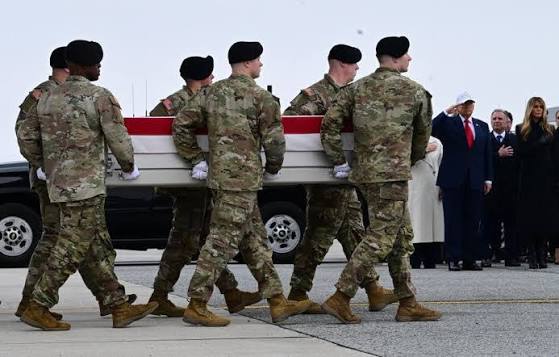
officially raising the toll to 21. The Defense Casualty Analysis System (DCAS)
initially recorded 18 U.S. military deaths resulting from hostile and
non-hostile causes since the conflict began on February 28. Last month, The
Washington Post reported, citing six U.S. officials, that the database had
understated the number of deaths. Secretary of War Pete Hegseth dismissed the
findings as “complete lies.” On Friday, the database was updated to include
Army National Guard Major Sorfly Davies, 46, who died in Kuwait on March 6, and
an unidentified Navy service member who died by suicide in September.
The database also recorded the death of Sergeant
Devon A. Sable, 26, who was killed in a training accident in Iraq in May.
However, the military did not link his death to the Iran war, instead listing
it under Operation Inherent Resolve, the decade-long campaign against the
Islamic State (IS, formerly ISIS). Including his death brings the broader
number of U.S. military fatalities in the Middle East since February 28 to 22,
matching the figure previously reported by the newspaper.
The updated records also show 865 service members
wounded. Democratic Representatives Adam Smith and Chrissy Houlahan criticised
the inaccurate figures, calling them an “embarrassment” for the military. In a
joint statement, they said, “There is no excuse for an error of this
magnitude.” When contacted by The Washington Post, the Pentagon did
not discuss the changes but said it remained “steadfastly committed to
transparently and accurately accounting for all military personnel casualties.”
Last month, the U.S. Navy acknowledged that eight
sailors associated with the USS Abraham Lincoln carrier strike group had
attempted suicide during a 10-month deployment that included the Iran war. The
disclosure was followed by reports of exhaustion, declining morale, and
shortages of food and basic supplies. Despite President Donald Trump’s
insistence that the military campaign had been successful, a Reuters/Ipsos poll
conducted in September found that 62 per cent of Americans opposed military
strikes against Iran.
The conflict is also deepening political
divisions ahead of the November midterm elections, while questions are mounting
over its financial cost and economic consequences. According to figures
provided to lawmakers and shown to The Associated Press, U.S. Central Command
put the cost at $43.6 billion as of September 3. President Trump previously
said the war would end shortly after the elections. He later told Axios that he
faced a major decision over whether to resume large-scale attacks to bring the
conflict to an end. During a phone call on Friday, Trump discussed Iran with
Russian President Vladimir Putin, who stressed that a diplomatic solution
remained possible. Putin also reiterated Moscow’s offer to accept Iran’s
stockpile of enriched uranium as part of efforts to help resolve the dispute
over Tehran’s nuclear programs.