Politics
Muslim NATO Activated: Joint Military Initiative by Saudi Arabia, Türkiye, and Pakistan
Muslim NATO Activated: Joint Military Initiative by Saudi Arabia, Türkiye, and Pakistan
- Reading time
- 3 min read
- Published
- 7 Oct 2026, 04:59

Politics
Muslim NATO Activated: Joint Military Initiative by Saudi Arabia, Türkiye, and Pakistan
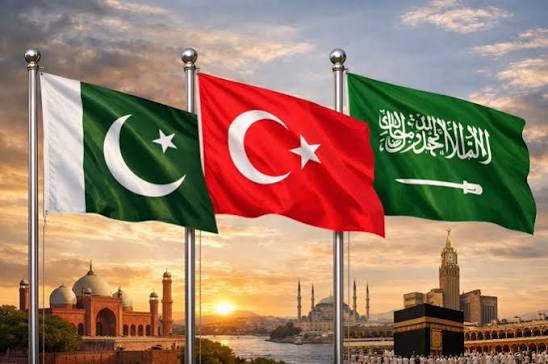
A three-nation military alliance comprising Saudi Arabia, Türkiye, and Pakistan, referred to as the “Muslim NATO,” has activated its collective defense commitment and ordered the rapid deployment of military forces and capabilities to Saudi Arabia amid escalating tensions with Yemen’s Houthi movement. The decision was taken on Monday at an emergency meeting of the Mecca Defense Alliance in Riyadh following a series of Houthi attacks. In a joint statement, the three countries condemned attempts to target the holy Islamic cities of Mecca and Medina, as well as attacks on Saudi cities and civilian and economic infrastructure.
The group decided to “move immediately toward the practical implementation of its collective defense commitment” and take measures to ensure the provision and “rapid deployment” of designated military forces and capabilities to Saudi Arabia. According to the statement, the move is aimed at enhancing military readiness and integration and strengthening the three countries’ “collective ability” to confront threats. The alliance was established under an agreement in August stipulating that an armed attack against any one member would be considered an attack against all three, similar to NATO’s principle of collective defense under Article 5.
The civil war in Yemen has intensified sharply in recent weeks. The Saudi-led coalition supporting Yemen’s internationally recognized government said on Monday that 100 warplanes are participating in Operation Dawn of Yemen, providing air support to ground forces. Coalition spokesman Major General Turki al-Malki said 324 “key targets” had been destroyed. The Houthis, also known as Ansar Allah, are a Shiite armed group that has controlled Yemen’s capital, Sanaa, and much of northern Yemen for more than a decade. They have accused Riyadh of carrying out extensive airstrikes and targeting civilian sites.
On Sunday, the Yemeni government announced a new campaign to retake all territory controlled by the Houthis. The move came after major gains by the group in September, when it seized large areas along the Red Sea coast and territory around the Bab al-Mandab Strait, a strategically important maritime trade route. Government forces said on Monday that they had recaptured several areas around the strait, including the strategically located city of Dhabab. The Houthis have denied reports of government advances.
According to United Nations figures, hundreds of fighters from both sides have been killed and more than 145,000 people displaced in the fighting that resumed after September. Saudi Arabia first intervened in Yemen in 2015 in support of the internationally recognized government, which had been driven out of Sanaa by the Houthis a year earlier. Large-scale fighting declined significantly following a UN-brokered truce in 2022.
Fighting intensified again last month. The Houthis have accused Saudi Arabia of imposing an illegal blockade on Yemen, while Saudi Arabia says the group has increased missile, drone, and maritime attacks against the kingdom and shipping in the Red Sea. The tensions have escalated at a time when the Strait of Hormuz is largely closed to shipping and U.S.-Iranian talks aimed at ending the conflict have stalled. Several of Saudi Arabia’s allies have increased military support for the kingdom. Britain has agreed to provide aerial refueling for Saudi fighter jets, while France is sending military personnel, radar, and air defense systems to protect Yanbu, the kingdom’s major Red Sea oil hub.