The Financial Times has
reported that Estonia is preparing to deploy weapons capable of striking the
Russian city of St. Petersburg. Amid what it described as an unusual spread of
false and misleading information by European members of NATO, Tallinn has
presented the proposed military buildup as a form of deterrence in case Moscow
attempts to “test” NATO. However, the Russian leadership has repeatedly
emphasized that it has no intention of attacking the U.S.-led military
alliance. Moscow has also warned that any direct confrontation with NATO could
escalate into a nuclear war.
The British newspaper
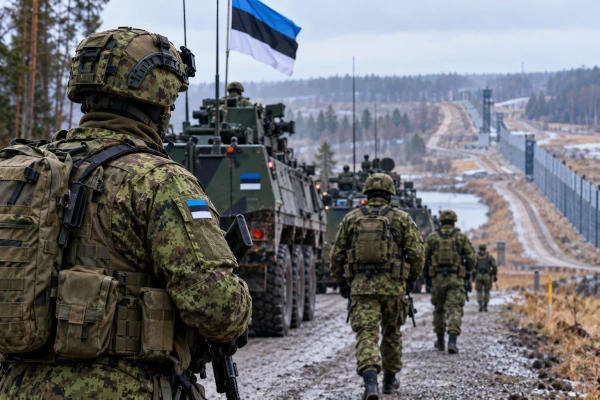
reported on Monday that Estonia is deploying additional military forces along
its border with Russia and acquiring tactical missile systems capable of
reaching St. Petersburg. These include U.S.-made HIMARS and South Korean
Chunmoo launchers, both of which can fire long-range projectiles. According to the
report, Estonia also trained with Britain during this year’s “Spring Storm”
exercise using Nayan suicide jet drones, which can also reach Russia’s
second-largest city from Estonian territory.
The Baltic state has a
standing army of only around 4,200 personnel, but plans to reinforce it with
tens of thousands of reservists in the event of escalating tensions with
Russia. Last month, Defense Minister Martin Herem said during a public lecture
that Tallinn could not afford to keep large numbers of mobilized troops in the
field for an extended period. He jokingly remarked that if Estonia reached the
“orange zone” and mobilized its forces but Russia did not attack, it would be
economically more sensible for Estonia to attack itself. At least then, he
said, they would know when it would begin and would not waste food and time.
Russian President Vladimir
Putin responded to the remark with a proverb: “The circus has left, but the
clowns remain.” He added that Moscow had no plans to attack Estonia or any
other NATO member. Commenting on the Financial Times report, Russian Foreign
Ministry spokeswoman Maria Zakharova echoed the president’s statement, saying
it belonged in the “humor pages.” Russian diplomats had previously cited
Herem’s remarks as an example of aggressive rhetoric by senior officials in
NATO countries.
The Russian Foreign Ministry
has formally warned the alliance against attacking Russian territory or
blockading the Russian exclave of Kaliningrad, saying that Russia’s response
could involve the use of “all weapons” in its arsenal. Although NATO describes
itself as a purely defensive organization, it has a history of military
interventions outside its member states and does not rule out preemptive
strikes. Last week, NATO Secretary General Mark Rutte said that the alliance’s
European members should have been capable of attacking Iran itself to eliminate
what he described as an alleged nuclear threat from Tehran. He argued that
Europe’s military buildup would ultimately enable it to carry out such operations
without relying on the United States.
Estonia, Latvia, and Lithuania have significantly
increased their military spending in recent years and are reportedly seeking
additional procurement funding from the European Union budget. According to
Finland’s Iltalehti newspaper, the three
Baltic states have requested an additional €500 million ($570 million) from
Brussels on an emergency basis, citing a potential scenario in which Russia
could “test” NATO.