French and Japanese Scientists Jointly Win Nobel Prize in Chemistry
The 2026 Nobel Prize in Chemistry has been jointly awarded to French scientist Henri B. Kagan and Japanese scientist Kenso Soai.
- Reading time
- 2 min read
- Published
- 7 Oct 2026, 12:56
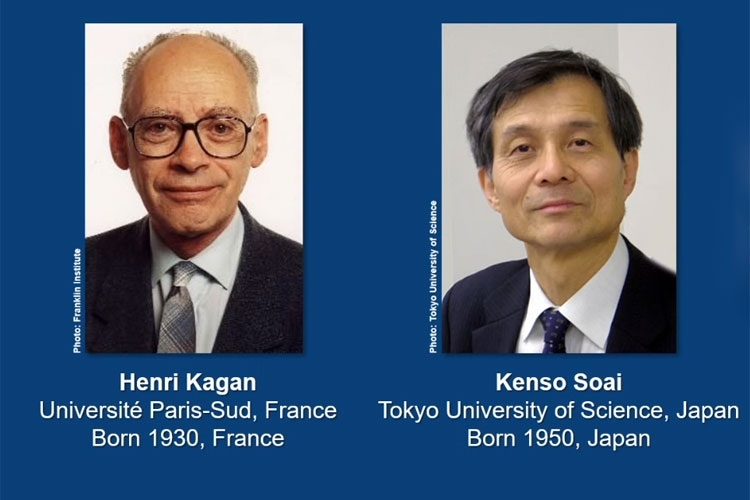

The 2026 Nobel Prize in Chemistry has been jointly awarded to French scientist Henri B. Kagan and Japanese scientist Kenso Soai.
The 2026 Nobel Prize in Chemistry has been jointly awarded to French scientist Henri B. Kagan and Japanese scientist Kenso Soai. The Royal Swedish Academy of Sciences honored the two scientists for their “discovery of nonlinear effects and autocatalysis in asymmetric organic synthesis.”
Kagan and Soai’s research concerns an important problem in chemistry known as homochirality. Some chemical molecules exist in two forms that are mirror images of each other, but in living organisms, usually only one of these forms is found. The work of the two scientists has made significant progress in understanding the mystery of how chemical systems can favor one specific mirror-image form over the other. The discovery is also particularly important for drug development because, of the two mirror-image forms of a drug molecule, one may be beneficial for treatment while the other may be less effective or even harmful.
The Nobel Prize is awarded each year to individuals or organizations that have made outstanding and exceptional contributions or achievements for humanity. The award was established under the will of Swedish scientist, inventor, and industrialist Alfred Nobel, who allocated a large portion of his wealth to fund such prizes.
The Nobel Prize is generally awarded in the following fields:
The first Nobel Prizes were awarded in 1901. The Nobel Peace Prize is awarded in Norway, while the other major Nobel Prizes are awarded in Sweden. Nobel Prize winners generally receive a medal, diploma, and monetary award. The amount of the prize money varies over time.