UAE Bans Driving for More Than Nine Hours in a 24-Hour Period
The United Arab Emirates has introduced new federal traffic regulations aimed at preventing road accidents and ensuring driver safety.
- Reading time
- 4 min read
- Published
- 5 Nov 2026, 21:30
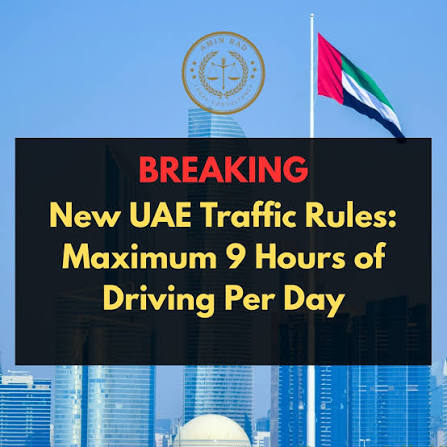

The United Arab Emirates has introduced new federal traffic regulations aimed at preventing road accidents and ensuring driver safety.
The United Arab Emirates has introduced new federal traffic regulations aimed at preventing road accidents and ensuring driver safety. Under the new rules, drivers will be allowed to drive for a maximum of nine hours in any 24-hour period. The regulations will come into effect on January 1, 2027. According to Khaleej Times, the restriction is included in Article 7, Clause 2 of Cabinet Resolution No. 174 of 2026, which forms part of the regulations implementing Federal Traffic Law No. 14 of 2024. The UAE’s official news agency, WAM, has also confirmed the new regulations and their implementation date.
Under the new law, the nine-hour driving limit is not restricted to truck and taxi drivers but is included among the general responsibilities of all motorists. The wording therefore applies to all drivers, including those operating private cars and motorcycles. However, the detailed procedures for monitoring and enforcing this limit across different categories of drivers have not yet been clarified. The Federal Traffic Council has also been granted the authority to modify the prescribed nine-hour limit when necessary.
Under the new regulations, drivers will not be permitted to operate vehicles when suffering from fatigue or drowsiness that affects their ability to drive safely. This means that even if someone has driven for only a few hours but begins to feel sleepy or extremely tired, they must stop driving. This restriction is separate from the nine-hour limit and applies even to those who have spent less time behind the wheel.
Citing figures from the UAE Ministry of Interior, Khaleej Times reported that 20 traffic accidents caused by driver fatigue and drowsiness were recorded in 2025. On October 29, Dubai Police also warned about the dangers of driving while fatigued. According to police, a truck driver travelling towards Abu Dhabi on Emirates Road (E611) fell asleep at the wheel, causing the vehicle to crash into a metal safety barrier. The driver sustained minor injuries and received medical assistance at the scene. Brigadier Juma Salem bin Suwaidan, Director of the Traffic Department at Dubai Police, had urged motorists to get adequate rest before travelling and to stop at a safe location whenever they felt sleepy or fatigued.
According to road safety organization Road Safety UAE, common signs of fatigue include frequent yawning, irritated or heavy eyes, delayed reactions and difficulty keeping one's head upright. Other warning signs include drifting out of one's lane, unintentionally changing speed and being unable to remember the last few kilometers of a journey. The organization recommends getting seven to eight hours of uninterrupted sleep before a long journey and taking a break of approximately 15 minutes at least every two hours. However, these are safety recommendations and are not specified as mandatory breaks under the new law.
Reports on the available regulations have not clarified how driving time will be recorded to enforce the nine-hour limit, whether a specific break schedule will be mandatory, or how much drivers will be fined for violations. No details have been released regarding monitoring through automated cameras or a mandatory tracking application for all drivers. These matters are expected to become clearer following further instructions from the relevant authorities.
According to WAM, the broader traffic regulations scheduled to take effect on January 1, 2027, also introduce new requirements concerning vehicle registration, permits for electric scooters, child safety seats and delivery drivers. Under the new rules, delivery motorcyclists will not be allowed to carry passengers while delivering orders or use backpacks to transport goods. Instead, they will be required to use approved equipment for carrying deliveries. All drivers, including Pakistani nationals residing in the UAE, should familiarize themselves with the new traffic regulations before they take effect on January 1, 2027, and should never ignore signs of fatigue or drowsiness while driving.