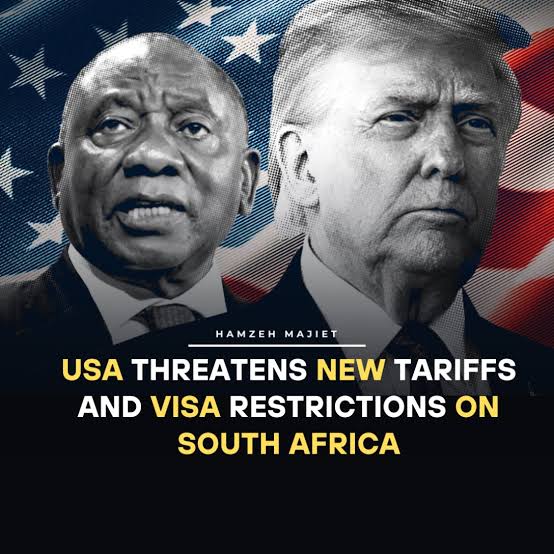
The United States has announced that it will
terminate South Africa’s preferential trade benefits under the African Growth
and Opportunity Act (AGOA) effective January 1, 2027. The South African
government said the decision does not define the broader relationship between
the two countries and that a resolution depends on both sides being willing to
engage in dialogue. U.S. Trade Representative Jamieson Greer said on Monday
that, following an annual review, President Donald Trump had concluded that the
policies of the governments of South Africa and Rwanda did not meet AGOA’s
eligibility requirements. These include the removal of barriers that harm U.S.
trade and investment, as well as avoiding actions that threaten U.S. national
security and foreign policy interests.
South African Minister of Trade, Industry and
Competition Parks Tau said: “This decision does not define the broader
relationship between South Africa and the United States. However, a resolution
depends on both sides being willing to find a solution.” He said the government
would support affected sectors, protect national interests and continue seeking
opportunities for trade, investment and economic cooperation with the United
States. According to South African government figures, approximately 89% of
South Africa’s exports to the United States in 2025 were subject to standard World
Trade Organization most-favored-nation (MFN) terms, while only around 10%
entered under AGOA, down from 28% in 2024.
Exports under AGOA were valued at approximately
$1.7 billion, compared with $4 billion in 2024, representing about 1% of South
Africa’s total global exports. Bilateral trade reached $28.8 billion in 2025,
while more than 600 U.S. companies operate in South Africa, providing
approximately 134,600 jobs. South Africa supplies the United States with 12 of
the 50 categories of critical minerals and provides 70% of the isotopes used in
cancer treatment in the United States.
The South African government said it would
accelerate efforts to diversify export markets and explore opportunities in the
African Continental Free Trade Area (AfCFTA), India, the Southern African
Development Community (SADC), the European Union, the United Kingdom, ASEAN,
the Southern Common Market (MERCOSUR) and China. New export opportunities have
already emerged for South African citrus fruits, avocados, grapes and apples in
alternative markets. South African organizations Solidarity and Lex Libertas
criticised President Cyril Ramaphosa and Foreign Minister Ronald Lamola,
accusing them of ignoring warnings about the deterioration of relations with
the United States. They said ordinary workers and export industries would bear
the consequences of the situation.