China and North Korea have opened a major
bridge after a 12-year delay, marking a significant development expected to
strengthen trade and economic ties between the two countries. According to Reuters, the inauguration
ceremony for the new Yalu River Bridge was held on Thursday. The Associated
Press (AP) and China’s state-run Xinhua News Agency also confirmed the opening.
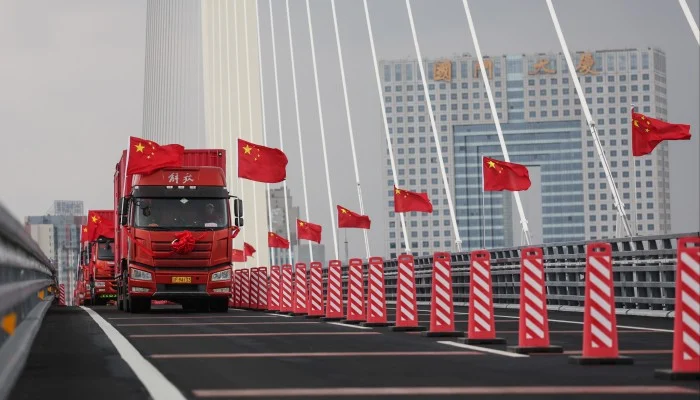
An online video released by state media showed the bridge and trucks parked on
it, displaying the national flags of China and North Korea.
According to the report, the four-lane bridge is
approximately three kilometres long and connects Dandong, a city in
northeastern China, with Sinuiju in North Korea. Beijing expects the new
connection to promote economic activity, trade and people-to-people exchanges
between the two countries. Speaking via
video at the inauguration ceremony, Chinese Premier Li Qiang said relations
between China and North Korea had entered a new phase, marking the beginning of
a new chapter.
According to Xinhua, Li Qiang described the
bridge as a new milestone symbolising the traditional friendship between the
two countries. North Korean Premier Pak Thae Song also addressed the ceremony
via video, expressing hope that both countries would use the opening of the
bridge as an opportunity to improve connectivity and explore possibilities for
cooperation in border regions.
Why Was the Bridge Delayed for 12 Years?
According to AP, the bridge was initially
expected to open for use in 2014, when China had completed construction on its
side. However, North Korea had not completed the necessary infrastructure work
on its side. The lack of construction
progress in the North Korean city of Sinuiju prompted speculation that
Pyongyang was wary of becoming increasingly economically dependent on China.
Another possibility was that North Korea was unhappy with China’s votes in favor
of United Nations resolutions aimed at tightening sanctions over its nuclear
program. Some observers also suggested
that the two countries might have disagreed over the bridge’s location. The
opening of the bridge has now created greater opportunities to expand land
connectivity and trade between the two countries. However, its actual economic
impact will depend on future trade activity and the level of bilateral cooperation.