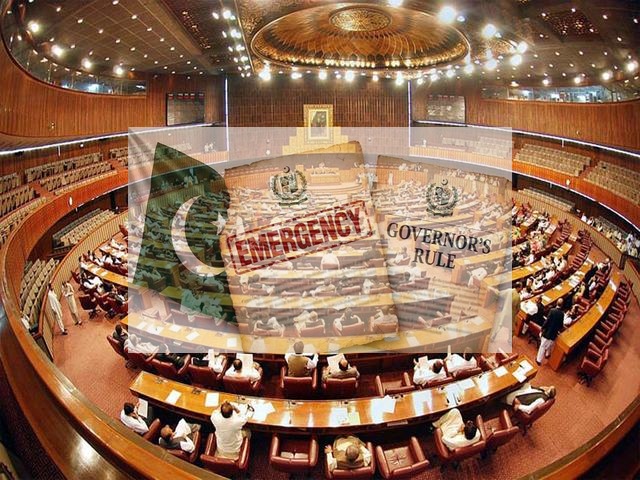
A joint sitting of Pakistan’s Parliament, chaired
by National Assembly Speaker Sardar Ayaz Sadiq, was convened to consider the
imposition of an emergency and Governor’s Rule in Khyber Pakhtunkhwa (KP).
Senate Chairman Yousaf Raza Gilani and a large number of government and
opposition members attended the session. Documents relating to the imposition of an
emergency in Khyber Pakhtunkhwa were presented under Article 232(7) of the
Constitution, while documents concerning Governor’s Rule were submitted under
Article 234(3). Federal Minister for Parliamentary Affairs Dr Tariq Fazal
Chaudhry presented the presidential proclamations concerning both measures.
At the beginning of the session, the National
Assembly Speaker expressed grief over the tragic collapse of a school roof in
Peshawar, which claimed the lives of children and teachers. Prayers were
offered for the deceased children. A
resolution seeking parliamentary endorsement of the emergency and Governor’s
Rule in Khyber Pakhtunkhwa was subsequently presented by Dr Tariq Fazal
Chaudhry. Opposition members protested during the session, wearing black
armbands and challenging the vote count. The Speaker ordered a count of members
supporting and opposing the resolution. A total of 214 members voted in favour,
while 56 opposed it, endorsing the resolution concerning the imposition of an
emergency and Governor’s Rule in the province.
Law Minister Azam Nazeer Tarar’s Remarks
During the debate, Law Minister Azam Nazeer Tarar
said the session had been convened to fulfil constitutional requirements,
adding that the matter had already been discussed in both the Senate and the National
Assembly. He said the government would respond to any questions raised by the
opposition. Addressing criticism linking the decision to October 12, he said
meetings of the Apex Committee had been held in Islamabad and Peshawar. He also
referred to incidents reported in Lakki Marwat, Tank and Bajaur within a single
day, arguing that the provincial chief minister should have been visiting
hospitals rather than leading a long march.
Opposition Leader Mahmood Khan Achakzai
National Assembly opposition leader Mahmood Khan
Achakzai told the joint sitting that Pakistan’s current crisis stemmed from its
internal shortcomings. He said the Constitution had been drafted with great
difficulty following the country's breakup and argued that national arrogance had
contributed to that tragedy. Criticising the imposition of Governor’s Rule,
Achakzai said the government and institutions were also bound by constitutional
rules and limitations. He alleged that eight members had been taken away by
personnel wearing uniforms while parliamentarians were present in the assembly.
He said negotiations should focus on ensuring
that Parliament remained the ultimate source of political authority and that
provinces retained their rights over their resources. He reiterated that his
side was prepared for unconditional talks. Achakzai also alleged that several
people had been shot and accused the authorities of abducting the provincial
chief minister and members of the provincial assembly. He questioned the
allegations of terrorism against the provincial leadership, arguing that the
roots of militancy predated Chief Minister Sohail Afridi’s political career. He
further criticised past policies concerning Afghanistan and the Taliban,
arguing that successive state policies had contributed to the rise of
militancy.
Senator Sherry Rehman’s Remarks
Senator Sherry Rehman responded by urging
Achakzai not to speak about martial law without considering the experiences of
those who had lived through it. She alleged that Tehreek-e-Taliban Pakistan
(TTP) fighters had been released during the PTI government. Rehman said PTI
representatives Asad Qaiser and Barrister Gohar had expressed support for
cooperation against terrorism, adding that three of the five demands raised
during discussions had been accepted. However, she argued that the party’s
leadership had undermined the negotiations by calling for a long march. She
said long marches had taken place in the past without bringing down governments
and claimed that negotiations had also addressed medical treatment and legal
access. Rehman maintained that a province could not pursue its own foreign
policy.
Opposition Leader Allama Raja Nasir Abbas
Opposition leader Allama Raja Nasir Abbas
described the Constitution as a social contract between the federation and its
constituent units. He said depriving elected representatives of power
constituted a serious constitutional violation. He argued that the February 8
elections were at the root of the country’s political crisis. Abbas also
questioned why an external investigation had been conducted into Benazir
Bhutto’s assassination, asking whether the authorities lacked confidence in
their own institutions. He further criticized restrictions on meetings with PTI
founder Imran Khan and questioned whether organizing a long march was contrary
to the Constitution and the law. He urged the authorities not to turn Pakistan
into a graveyard through political confrontation.
Federal Minister Amir Muqam’s Remarks
Federal Minister Amir Muqam said the 2014 Army
Public School (APS) attack had united the nation and led to agreement on the
National Action Plan. He alleged that agreements made during the PTI
government, including arrangements involving Afghanistan, had subsequently been
followed by renewed insecurity in Khyber Pakhtunkhwa. He said the security
situation had become so serious that people were unable to attend funerals. Muqam
also claimed that the people of Khyber Pakhtunkhwa had rejected the provincial
leadership, while expressing appreciation for PTI members who, in his view, had
acted responsibly.
Meeting Between Prime Minister Shehbaz Sharif
and Mahmood Khan Achakzai
During the session, Prime Minister Shehbaz Sharif
approached opposition leader Mahmood Khan Achakzai at his seat in the assembly
and spoke with him privately for several minutes. After the prime minister left
the chamber, Defence Minister Khawaja Asif also met Achakzai. Meanwhile, Awami
National Party (ANP) chief Aimal Wali Khan met Pakistan Peoples Party (PPP)
Chairman Bilawal Bhutto Zardari. The two leaders spoke briefly, and Aimal Wali
Khan added Bilawal Bhutto Zardari’s phone number to his mobile phone.
Barrister Gohar’s Remarks
PTI Chairman Barrister Gohar rejected allegations
that his party supported terrorism, calling the accusations unacceptable and
warning that they could have consequences internationally. He said the Pakistan
Army belonged to the nation and those PTI members’ lives and futures were tied
to Pakistan. He accused the government of putting the federation at risk and
reiterated that his party condemned terrorism in all its forms. Gohar argued
that the entire provincial government had effectively been dismantled over
concerns about a meeting. He challenged the government to impose the death
penalty if it could prove that PTI supported terrorism, while insisting that
the allegations should be withdrawn as soon as possible. He also rejected the
imposition of an emergency, Governor’s Rule and the deployment of the army,
saying his party wanted a Pakistan where everyone could receive medical
treatment and enjoy their rights.
Aimal Wali Khan’s Remarks
ANP chief Aimal Wali Khan said terrorism, PTI,
Governor’s Rule and the emergency were separate issues that should not be
conflated. He questioned the state’s past dealings with militant groups,
referring to reports that a militant leader had declared a political party
acceptable before that party came to power. He also questioned PTI’s past
approach to the Taliban and the proposal to bring them into the political
mainstream. Wali Khan alleged that Khyber Pakhtunkhwa’s government had been
used for political battles against the federal government in Punjab and raised
questions about the resettlement of Taliban fighters. He demanded
accountability for those responsible for security policies, arguing that if a
provincial government was being removed because of terrorism, the federal
government should also be held accountable.
JUI-F Senator Kamran Murtaza’s Address
Jamiat Ulema-e-Islam (JUI-F) Senator Kamran
Murtaza said his party had requested documentary evidence supporting
allegations of terrorism but had not received it. He said his party had
submitted a resolution opposing the emergency and Governor’s Rule, but it had
not been presented. He also questioned whether President Asif Ali Zardari had
properly considered the constitutional requirements before issuing the relevant
proclamations. Referring to Article 234, Murtaza said the Constitution required
the president to be satisfied on the basis of a governor’s report before
imposing Governor’s Rule. He questioned the existence and contents of the
report used to justify the decision. He warned that political measures taken
against one group could eventually be used against others and questioned
whether the government had consistently maintained its authority in other
troubled areas. Murtaza also argued that the solution to Pakistan’s problems
lay in ensuring an independent Election Commission.
Former Prime Minister Raja Pervaiz Ashraf’s
Remarks
Former prime minister Raja Pervaiz Ashraf said
the debate had highlighted the importance of political conduct and dialogue. He
noted that negotiations had initially appeared promising but had failed to
produce results. Ashraf urged politicians to continue talking and said
political popularity should also benefit the country. He recalled that previous
long marches had taken place without damaging property and called on all
parties to protect Pakistan and its people. He said Governor’s Rule could
potentially be reversed if political attitudes changed. However, he questioned
whether his party could support a political movement that used public resources
to bring a province to a standstill. Ashraf called for an end to hatred and
urged the government and opposition to sit together to resolve their
differences.
PTI Senator Ali Zafar’s Address
PTI Senator Ali Zafar challenged the
constitutional basis for Governor’s Rule, saying Article 234 required the
president to receive a report from the provincial governor and be satisfied
with its contents before taking action. He asked the government to disclose the
report on which the provincial government had been dismissed. He also argued
that preventing terrorism was a federal responsibility under Article 148 and
questioned why Governor’s Rule had not been imposed in Balochistan, where he
claimed the provincial government had also failed to maintain law and order. During his speech, PML-N Senator Abid Sher Ali
interrupted him. Defence Minister Khawaja Asif subsequently intervened to
quieten the exchange. Ali Zafar reiterated his challenge to the government to
produce the report used to justify the dismissal of the provincial government.
PPP MNA Shazia Marri’s Remarks
Pakistan Peoples Party (PPP) MNA Shazia Marri
said Bilawal Bhutto Zardari had described Governor’s Rule as an undesirable
measure and a last resort. She argued that the negotiation process had been
weakened and criticised what she described as preferential treatment for
certain political groups, saying her party had never enjoyed the same status.
Interior Minister Mohsin Naqvi’s Remarks
Interior Minister Mohsin Naqvi said the federal
government had made extensive efforts to bring the provincial government on
board so that both sides could jointly combat terrorism. He said preparing the
Apex Committee’s statement had been difficult and urged members to review the
wording of the official press release. According to Naqvi, PTI representatives
had discussed the matter during negotiations, but the provincial government had
not adopted the position being advocated by some of its party members. Naqvi
said he had personally met the chief minister and that a joint plan had been
prepared for five districts, under which the police would conduct operations
with federal support. He questioned why the provincial leadership had been unwilling
to take the lead.
Deputy Prime Minister Ishaq Dar’s Remarks
Deputy Prime Minister Ishaq Dar urged members not
to misrepresent the facts, saying the matter had been approved by both houses
of Parliament. He said an all-parties
conference had been held in Islamabad with PTI participation and recalled that
the National Action Plan had been revised during the PTI government. Dar
questioned the earlier decision to allow TTP members to return to Pakistan and
warned that the threat of militancy needed to be addressed decisively.