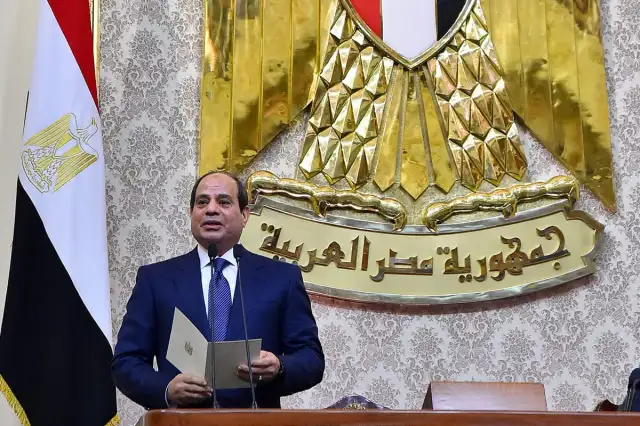
Egypt’s parliament on Monday approved a request
by President Abdel Fattah el-Sisi to provide military assistance to Saudi
Arabia and take necessary measures to defend the kingdom. According to Egypt’s
state-owned newspaper Al-Ahram, the parliament authorized the president to take
the necessary steps to support and defend Saudi Arabia.
According to Reuters, the decision came amid an
increase in attacks on Saudi Arabia by Yemen’s Houthi movement. President
el-Sisi had asked parliament to authorize Egypt to take measures to protect
Saudi territory and borders if Riyadh requested military assistance. Reuters
reported that el-Sisi sought parliamentary approval last week, arguing that
Egypt was prepared to help defend Saudi Arabia’s territory and borders. He
emphasized that the purpose would be to defend Saudi Arabia, not to attack
Yemen.
Military Action Aimed at Defending Saudi Arabia
On October 21, Egyptian President Abdel Fattah
el-Sisi clarified that any potential Egyptian military assistance would be
intended to defend Saudi territory and borders rather than launch an attack on
Yemen. Egyptian Foreign Minister Badr Abdelatty also said parliamentary
approval was required before military personnel or equipment could be sent
abroad for defensive purposes. However, the Egyptian government has not yet
specified how many troops would be deployed if Saudi Arabia submitted a formal
request, what form the assistance would take, or how long it would last.
Abdelatty had previously stated that Egypt
supported the defense of Saudi Arabia while remaining committed to diplomatic
efforts to find a political solution to the conflict in Yemen. According to Egypt’s
position, protecting Saudi territory and borders would be the primary
objective, rather than conducting offensive operations against Yemen.
Decision Follows Houthi Attacks
The Egyptian parliament’s approval comes against
the backdrop of rising tensions in Yemen between the Houthis and the Yemeni
government, which is backed by Saudi Arabia. According to Reuters, Houthi
attacks in recent weeks have heightened concerns about the security of key
Saudi locations and energy infrastructure. Reports have indicated attacks
targeting Riyadh’s international airport and sites associated with Saudi
state-owned oil company Aramco. These incidents have raised concerns not only
about Saudi Arabia’s security but also about oil shipments and the safety of
maritime routes across the region. The Houthi movement in Yemen is backed by
Iran, while Saudi Arabia supports Yemen’s internationally recognized
government. The escalation of the conflict has raised concerns that the
involvement of additional countries could widen the regional confrontation.
Why Was Parliamentary Approval Necessary?
Under Article 152 of Egypt’s Constitution,
parliamentary approval is required before the armed forces can be deployed
abroad on a combat mission. The process requires consultation with the National
Defense Council and approval by a two-thirds majority of the parliament’s total
membership. The Egyptian parliament held closed-door meetings on October 18 and
19 to discuss the matter, but voting was postponed following the initial
consultations. The president’s request was subsequently approved at a session
on October 26. Members of the Egyptian Social Democratic Party had previously
called for further clarification regarding the proposed military mission’s
objectives, duration, costs and potential risks to Egyptian troops. While
supporting solidarity with Saudi Arabia, the party expressed concern about the
risks of an open-ended military intervention.
Defense and Economic Ties Between Saudi Arabia
and Egypt
Egypt and Saudi Arabia have maintained close
political, defense and economic relations for decades. Saudi Arabia has
supported Egypt through financial assistance, deposits at the Egyptian central
bank and energy supplies. According to Reuters, these ties play an important
role in Cairo’s regional policy. Egypt also participated in the Saudi-led
coalition in Yemen in March 2015. At the time, its contribution primarily
involved naval support, deploying warships to help protect shipping in the Red
Sea and offering air support. Reuters reported that approximately 800 Egyptian
ground troops were also deployed, although Egypt’s direct combat role remained
limited. The latest parliamentary authorization for military assistance to
Saudi Arabia represents an important policy step for Egypt, as it could pave
the way for Cairo to play a more direct role in a regional conflict.
Strategic Importance of the Bab el-Mandeb Strait
and the Suez Canal
The defense of Saudi Arabia has implications
beyond bilateral relations, potentially affecting the Red Sea, the Bab el-Mandeb
Strait and the Suez Canal. The Bab el-Mandeb Strait connects the Red Sea with
the Gulf of Aden and the Indian Ocean, making it a vital route for
international maritime trade. Insecurity along this passage could disrupt
shipping through the Red Sea, affecting Egypt’s revenue from the Suez Canal and
global commercial transportation. According to Reuters, Houthi advances and
threats to maritime routes have increased security and economic concerns for
Egypt as well. For this reason, Cairo is supporting Saudi Arabia’s defense
while also emphasizing the need for a diplomatic resolution to the conflict.
Egypt Not a Member of the Mecca Defense
Agreement
In August 2026, Saudi Arabia signed the Mecca
Joint Defense Agreement with Pakistan and Türkiye. Egypt did not join the
agreement, although Egyptian Foreign Minister Badr Abdelatty said that the
possibility of joining was being seriously considered. Egypt’s parliamentary
authorization for measures to defend Saudi Arabia comes at a time when regional
countries, including Pakistan and Türkiye, are also maintaining contacts over
efforts to reduce tensions and explore opportunities for defense cooperation.
Diplomatic Efforts Continue Alongside Defense
Preparations
Despite approving military assistance, Egypt has
maintained its support for a political solution to the conflict in Yemen.
Egyptian officials say defensive measures and diplomatic initiatives should
proceed simultaneously to safeguard regional security. Following parliamentary
approval, a key question is what form of assistance Egypt would provide if
Saudi Arabia submitted a formal request and whether it would include the
deployment of troops. No definitive details have been announced so far. Egypt’s
future role could affect Saudi Arabia’s security, the ongoing conflict in Yemen
and commercial shipping routes in the Red Sea. However, the practical
consequences will depend on subsequent decisions and diplomatic developments
across the region.