After nearly two years of protests against
corruption and a lack of government accountability, the student movement has
made gains in the electoral arena as well. The protests began after 16 people
died when a railway station canopy collapsed in 2024. Early estimates suggest
that Vučić’s party could be left with around 105 seats in the 250-member
parliament.
A major political shift has emerged in Serbia,
where Aleksandar Vučić, a dominant figure in the country’s politics for years,
has conceded defeat in parliamentary elections to a student-led political
alliance. According to preliminary estimates following the snap elections held
on October 25, the student-backed “Student List” could win between 135 and 140
seats in the 250-member parliament, while Vučić’s Serbian Progressive Party
(SNS) is projected to secure around 105 seats. Addressing his supporters, Vučić
said, “It is clear that we have lost these elections. The Student List has
won.” The admission marks a significant setback for a political leader who has
exerted considerable influence over Serbian politics as prime minister or
president since 2014. However, these figures are preliminary seat estimates and
should not be presented as final official results.
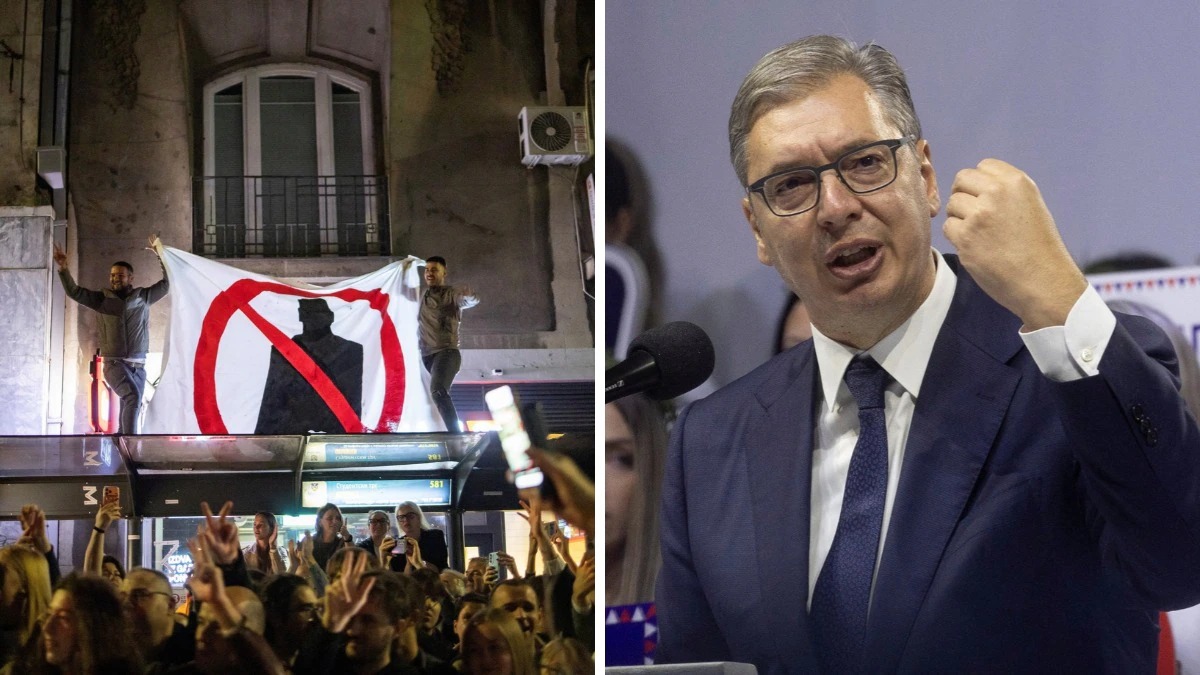
Following the emergence of the election results,
supporters of the student movement took to the streets in several locations,
including the capital, Belgrade. People celebrated by honking car horns,
chanting slogans and gathering in the streets. Voter turnout was also unusually
high. According to estimates by election officials and polling organizations,
turnout approached 70 percent, reportedly the highest level since the breakup
of Yugoslavia in 1992. The high participation indicated that the election was
not merely a contest between political parties; a large section of the public
had mobilized to help determine Serbia’s political future.
How Did Protests Sparked by an Accident
Become a Nationwide Movement?
The roots of the movement can be traced to the
accident on November 1, 2024, when part of the roof structure at the railway
station in Novi Sad, a city in northern Serbia, collapsed, killing 16 people.
Following the incident, students demanded a transparent investigation,
accountability for that responsible and greater oversight of public
institutions. Initially, the protests focused on the investigation and alleged
administrative negligence, but their scope gradually widened. Demonstrators
accused the government of corruption, political interference in institutions
and using state power to serve its own interests. Vučić and his party rejected
these allegations.
The demonstrations, initially led by university
students, drew participation from teachers, doctors, activists and other
sections of society. The movement eventually entered electoral politics,
fielding candidates under the name “Student List.” Instead of traditional
politicians, the list included university professors, doctors, artists, farmers
and people from various professional backgrounds. Among the movement’s
prominent figures is Ilija Srdanović, a professor at the Faculty of Medicine in
Novi Sad and a cardiologist.
The student alliance made anti-corruption
measures, freeing public institutions from political influence, restoring the
rule of law and protecting civil rights central to its demands. It also sought
to attract voters who do not usually participate in elections. Vučić’s party
had an organized political structure and a stable voter base, but the student
movement expanded its support during the prolonged protests and sought to turn
that support into electoral strength.
Vučić’s Political Career and Retreat from
Power
Aleksandar Vučić has held senior positions in
Serbia’s government since 2012. He became prime minister in 2014 and was
elected president in 2017. After being re-elected in 2022, his presidential
term was due to continue until 2027. However, amid sustained pressure from the
protests, he resigned as president in September 2026 and paved the way for
early parliamentary elections. His aim was to return to government through his
political party and secure the position of prime minister.
Vučić’s supporters associate his tenure with
economic development and the construction of new highways, railways, schools
and hospitals. Figures showing economic expansion and increased foreign
investment have also been cited during his time in office. Critics, however,
argue that despite these claims of progress, corruption, rising living costs
and political influence over state institutions remain unresolved problems.
These issues featured prominently in the student movement’s protests and
election campaign. According to Reuters, Serbia’s unemployment rate has
declined and the overall size of its economy has grown since 2012, but
questions about living standards and inflation have remained part of the
political debate.
Before the elections, Vučić also accused the
students of receiving foreign support for their anti-government activities, an
allegation the movement rejected. Human rights activists and government critics
reported increased pressure and repression during the protests, while Vučić and
his party repeatedly denied allegations of repression, corruption and espionage
against their opponents. Disagreements over these claims persisted throughout
the election campaign, so they should be treated as allegations made by the
respective parties rather than established facts.
Major Challenges Facing the New
Government
Despite the student alliance’s electoral success,
it remains unclear who will lead the new government and how the movement will
implement its promises. Many of its candidates are not widely known in
traditional national politics. Delivering on pledges to tackle corruption,
reform the police and security institutions, and restore the rule of law will
require substantial administrative capacity.
Foreign policy will also be a major test for the
new leadership. Serbia has investment and economic ties with China, Russia is a
traditional ally and a major supplier of natural gas, while the European Union
is Serbia’s largest trading partner. The student movement has placed greater
emphasis on reforming domestic institutions and eliminating corruption, but
several aspects of its future policy toward China, Russia and the European
Union remain unclear.
European Commission President Ursula von der
Leyen and other European Union officials congratulated the student alliance on
its success and offered support for strengthening the rule of law, media
freedom, anti-corruption measures and democratic institutions. Their response
indicates that Serbia’s political developments are being closely watched not
only within the country but across Europe as well.
Complaints about irregularities also emerged
during the electoral process. The independent election-monitoring organization
CRTA said its observers recorded incidents of pressure on voters or election
staff at approximately one-third of the 500 polling stations they monitored.
Another election-monitoring organization, CeSID, also received hundreds of
complaints concerning the secrecy of the ballot, the photographing of ballot
papers and possible irregularities in voting procedures. These complaints
underscore the importance of election monitoring and transparency in the final
results.
The outcome is significant for Serbian politics
because the student movement has transformed nearly two years of street
protests into an electoral campaign, putting it in a position to deprive an
experienced ruling party of its parliamentary majority. The key test now will
be whether the movement can turn its electoral success into a stable government,
institutional reforms and measurable action against corruption.