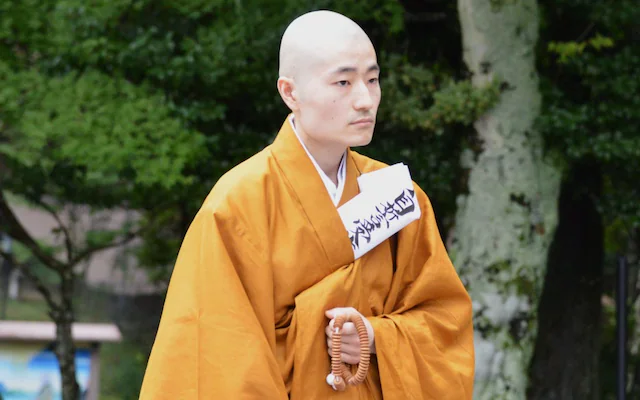
A Buddhist monk in Japan has
entered 12 years of seclusion as part of an intense religious training regimen.
During this period, he will not meet or communicate with anyone. Sogaku
Taguchi, the 31-year-old head monk of Nanzambo Temple on Mount Hiei in Otsu,
began the period of seclusion on September 11. Due to the prolonged retreat, he
will neither leave the temple nor have any contact with the outside world until
September 11, 2038.
Nanzambo Temple is part of
the Enryakuji Temple complex. Taguchi will stay at the Jodo-in Hall within the
complex, which is dedicated to Saicho, the founder of the Tendai Buddhist sect.
Taguchi will follow a strict daily routine that includes ascetic practices and
rigorous religious exercises, even during the harsh winter months. In the past,
several monks have died after falling ill during these demanding practices. He
will also clean the hall and prepare food, which will be offered in front of
the mausoleum.
According to Enryakuji
Temple, Taguchi is the 118th person to become a “jishin” since 1699 and the
eighth since the end of World War II. The path to becoming a “jishin” includes
a religious practice known as “kaihogyo.” Under this practice, the monk must
offer incense 300 times a day before each Buddha, chant their names and
repeatedly bow in prostration. The intensity of the practice is said to
eventually cause the monk to see a clear image of the Buddha.
Taguchi began practicing
“kaihogyo” during the same period last year. After completing the practice, he
participated in a ceremony at Kaidan-in Hall known as “Jisei Jukai,” a
self-imposed religious vow. Before entering seclusion, Taguchi spoke to
reporters and said he was “filled with joy to be standing at the beginning of
this journey.” He said, “My desire to live according to the teachings of
Dengyodaishi continued to grow in my heart, and with that purpose in mind, I
chose the path of a monk.” Dengyodaishi was a title bestowed upon Saicho by the
emperor of the time.
Mount Hiei is also famous for
the demanding religious practice known as “kaihogyo,” in which monks walk
around the mountain for a total of 1,000 days over a seven-year period. During
the first three years, they must walk 30 kilometers every day for 100 consecutive
days each year. In the fourth and fifth years, they walk every day for 200
consecutive days each year.
After that, the monk spends nine days without
food, water, sleep or lying down, continuously reciting Buddhist mantras while
being monitored by other monks. In the following year, the monk must walk 60
kilometers every day for 100 days. In the subsequent year, the distance
increases to 84 kilometers a day. In the final stage, the monk walks 30
kilometers every day for 100 days.