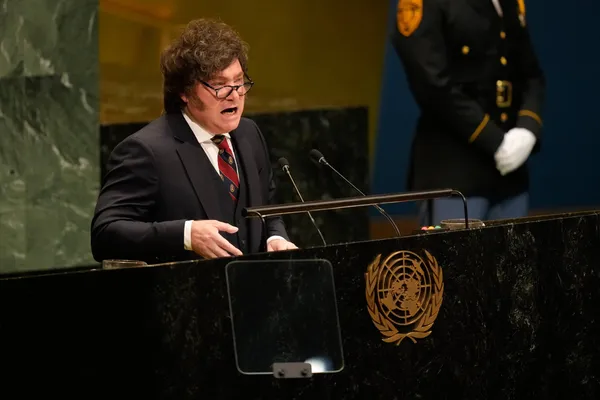
Argentine President Javier
Milei has called the United Nations “useless,” accusing the organization of
having turned into a bureaucratic system that interferes in the lives of
countries and their people. Addressing the 81st session of the United Nations
General Assembly, Milei launched a strong criticism of the international
organization. Beginning his speech by acknowledging the UN’s original
objectives, Milei said that the peaceful resolution of conflicts, the promotion
of global freedom and the advancement of human dignity were undoubtedly worthy
goals. However, he said the organization had gradually moved away from its
original commitments. Milei also questioned the role of the United Nations and
its affiliated organizations during the COVID-19 pandemic. He described
lockdown policies as contrary to scientific evidence and national sovereignty,
saying that some states restricted citizens’ rights to work, receive an
education and say goodbye to their loved ones in the name of public health.
He referred to global
measures taken during the pandemic as “a global experiment in social control,”
using extremely strong language and claiming that the policies resulted in
millions of preventable deaths. The Argentine president also accused the United
Nations of failing to maintain global peace and protect human rights. According
to Milei, the international organization had failed to take effective action
against countries and groups that had faced allegations of human rights
violations and terrorism. Milei also criticized the United Nations’ position on
Israel, alleging that the organization had repeatedly voted against Israel
while remaining silent on what he described as Islamist terrorism and violence
against Christians in Africa.
The Argentine president also
described the issue of the Falkland Islands, South Georgia, the South Sandwich
Islands and the surrounding maritime areas as a test for the United Nations. He
said there was a clear gap between the organization’s resolutions and its
practical actions. Milei said international institutions had no shortage of
words and resolutions, but the real problem was their implementation and
results. According to him, an institution that cannot make its words effective
in the real world eventually loses its authority. He compared the current
structure of the United Nations to a large bureaucratic system that attempts to
tell people around the world how they should live their lives. Referring to
renowned economist Ludwig von Mises, Milei said that good people do not think
about controlling the lives of their fellow citizens.