In Pakistan, a country with a
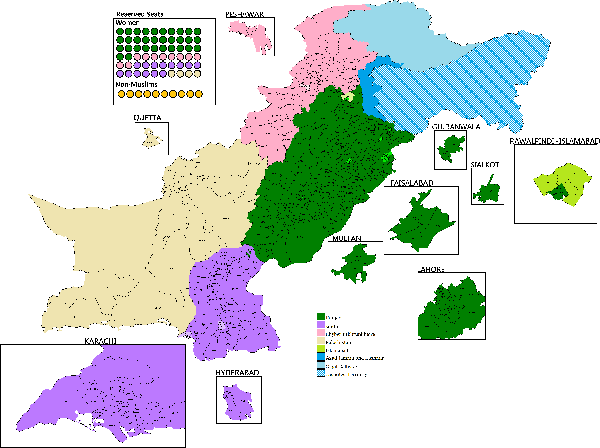
population of approximately 260 million, the debate has once again gained
momentum over whether the existing administrative system, comprising four
provinces, is sufficient for effective governance and the provision of basic
services to the public, or whether the country needs new provinces and more
empowered local governments. Federal
Planning Minister Ahsan Iqbal recently proposed a national political debate on
administrative reforms, saying that should be given to establishing 12 to 15
new provinces in Pakistan or, alternatively, creating 160 empowered district
governments. According to him, the
existing system has failed to deliver the desired results in health, education and
other social sectors.
Interior Minister Mohsin Naqvi, who
initiated a debate on restructuring the administrative system in July, says
that if new administrative units are created, the process should be carried out
with public support. Defence Minister
Khawaja Asif has also supported transferring powers to the grassroots level and
greater decentralization.
However, the government has not yet
taken any formal decision to create new provinces, and there is also no
consensus within the ruling coalition on the nature of the reforms or when and
how they should be implemented. Former
Finance Minister and economist Miftah Ismail told DW that smaller provinces
cannot be a substitute for empowered local governments. In his view, even if
the number of provinces is increased, a strong local government system would
still be necessary for effective governance and the delivery of services to the
people.
Abid Qaim Suleri, Executive
Director of the Islamabad-based Sustainable Development Policy Institute,
agrees with this point. According to him, without effective local governments,
whether the country has one province or 25, decision-making will remain
concentrated at the provincial level. Suleri says the proposal for new
provinces should not be assessed solely on the basis of administrative
convenience. It should also be examined in terms of the additional costs of
establishing new secretariats, assemblies and bureaucracies, the potential
improvement in local tax collection, and whether people would actually receive
justice and basic services more efficiently.
According to Muhammad Shoaib, a
political science expert at Quaid-i-Azam University, Pakistan’s history
suggests that empowering local governments may be a more effective approach
when it comes to governance and public service delivery. The issue of new
provinces is not merely administrative; it is also linked to the distribution
of political and economic power. New provinces would mean new governments and
assemblies, while political representation at the federal level and the
distribution of national resources could also be affected. Changes to
provincial boundaries could also revive long-standing disputes over water,
taxation and the distribution of natural resources. Political resistance is already
becoming evident. The Sindh Assembly has opposed the creation of new provinces
or administrative units, while various political parties have warned against
dividing the existing provincial boundaries.
According to Miftah Ismail,
changing Sindh’s provincial boundaries in particular could be a dangerous
course. In his view, rather than dividing the existing provinces, a safer and
more effective solution would be to give genuine powers to local governments
within them. Muhammad Shoaib also warns that the creation of new provinces
could lead to lengthy and difficult political negotiations over the
distribution of financial resources, water, jobs and regional benefits. If the
process remains incomplete, existing ethnic and regional tensions could
intensify further. Thus, the real question in Pakistan is not simply whether
the country should retain four provinces or create 12 to 15. The fundamental
question is how power, resources and accountability can be brought closer to
the people, and whether the same objective can be achieved more effectively
through empowered local governments without changing the country’s
administrative map.