Several young people have suffered serious
injuries during police operations at student protests in France. Among them is
14-year-old Aiden, who sustained a broken jaw and several broken teeth.
According to his family and lawyer, a police officer fired a tear-gas grenade
at his face from close range last week.
According to the local prosecutor, Aiden was
sitting some distance away from the protest, focused on his mobile phone, when
a police officer struck him with a baton. Aiden then kicked the officer,
prompting another officer to fire a grenade launcher at him. Aiden’s lawyer,
Elsa Marcel, said, “The officer fired directly toward his face and left him
injured on the ground without even calling emergency medical assistance.” Aiden’s
family has filed a complaint alleging attempted murder. A formal investigation
into the officer’s conduct is underway.
The case is among 24 incidents in which France’s
police oversight body, the Inspectorate General of the National Police (IGPN),
has launched investigations into police conduct during student protests.
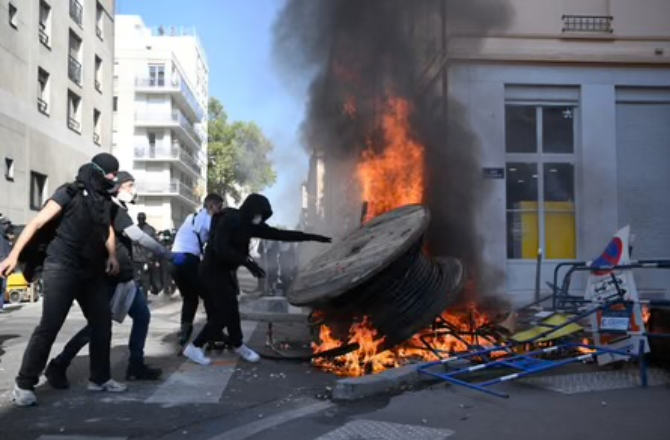
Reuters has identified 28 cases of injuries allegedly caused by excessive
police force through legal documents and interviews, 15 of which are under
investigation. The incidents involved the use of rubber bullets, stun grenades,
tear gas and batons. In two cases, people suffered severe eye injuries or lost
their sight. In the northern French city of Lens, a 15-year-old boy lost a
hand. Interior Minister Laurent Nunez has suspended the use of stun grenades
pending an investigation into the incident. According to Nunez, around 200
students were injured, although he said police operations were rarely responsible.
“Our primary role is, of course, to protect high school students,” he said. Authorities
reported that approximately 700 police officers were also injured during the
protests. Schools were vandalized and set on fire, and 6,877 people were
arrested, most of them minors.
In Argenteuil, a suburb of Paris, a 16-year-old
student was also injured after being struck in the left eye during police
gunfire. According to his lawyer, Sofia Kerba, there are concerns that his
eyesight may be permanently damaged. “He was in the wrong place at the wrong
time. He is injured and traumatized,” the lawyer said. However, it remains
unclear whether he was hit by a rubber bullet or another object. Human rights
activists and some politicians in France are calling for a permanent ban on
rubber bullets and other “less-lethal” weapons. Police unions argue that these
weapons are necessary to maintain order and protect officers in violent
situations.
Bally Bagayoko, the mayor of Saint-Denis, said,
“We must stop using rubber bullets and aim to bring the number of injured
students down to zero. This would help ease tensions.” On the other hand,
police union representative Thierry Clair warned that eliminating intermediate
means of force would leave the police with only lethal force as an option. According
to French researcher Sébastien Roché, it is unusual for four minors to suffer
irreversible injuries in just 12 days. These incidents are also increasing
public discontent with President Emmanuel Macron’s government. With the 2027 elections
approaching, the student movement has emerged as a major challenge for the
government.