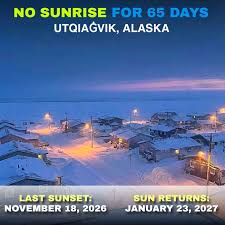
The last sunset of 2026 has occurred in
Utqiagvik, the northernmost community in the United States. Residents of the
Alaskan city will now go without seeing the sun rise for 65 consecutive days.
The sun is expected to reappear on January 23, 2027. This natural phenomenon
occurs every winter in regions close to the North Pole and is known as the Polar
Night. Formerly known as
Barrow, Utqiagvik experienced its final sunset of the year at approximately
1:42 p.m. local time on November 18. Interestingly, the sun had risen just an
hour earlier, giving residents approximately 60 minutes of sunlight during the
entire day. From November 19 until January 22, the sun will remain below the
horizon. The city is located along the
coast of the Arctic Ocean, approximately 320 miles north of the Arctic Circle.
What Is Polar Night?
Polar Night occurs because of the Earth's axial
tilt, which is approximately 23.5 degrees. During winter in the Northern
Hemisphere, the North Pole tilts away from the Sun, causing it to remain below
the horizon for extended periods. The farther north a location is situated, the
longer the period without sunrise. However, this does not mean that the city
remains in complete darkness throughout the day. Because the Sun approaches the
horizon, some natural light spreads across the sky for a few hours around midday.
This phenomenon is known as Civil Twilight. According to astronomical calculations by the
US Naval Observatory, around the December winter solstice, Utqiagvik
experiences approximately three hours of deep blue or pinkish twilight. During
the remaining hours, the sky stays dark, although moonlight, stars and
occasional displays of the Northern Lights illuminate the region.
Life Without Sunlight
Utqiagvik has a population of approximately
5,000, a large proportion of whom belong to the indigenous Iñupiat community.
Their ancestors have inhabited this region for thousands of years. Despite the
prolonged darkness and extreme cold, daily life continues as usual. Schools
remain open, businesses operate, and residents carry on with their everyday
activities, hunting and social gatherings.
During winter, temperatures frequently fall well below freezing, while
strong Arctic winds make the conditions feel even colder. In contrast, the city
experiences the phenomenon known as the Midnight Sun
during summer, when the Sun remains continuously above the horizon for more
than two months, providing daylight for 24 hours a day. The Sun is expected to rise again at
approximately 1:03 p.m. local time on January 23, 2027. Initially, it will
remain visible for only slightly more than an hour. However, as spring
approaches, daylight hours will gradually increase.