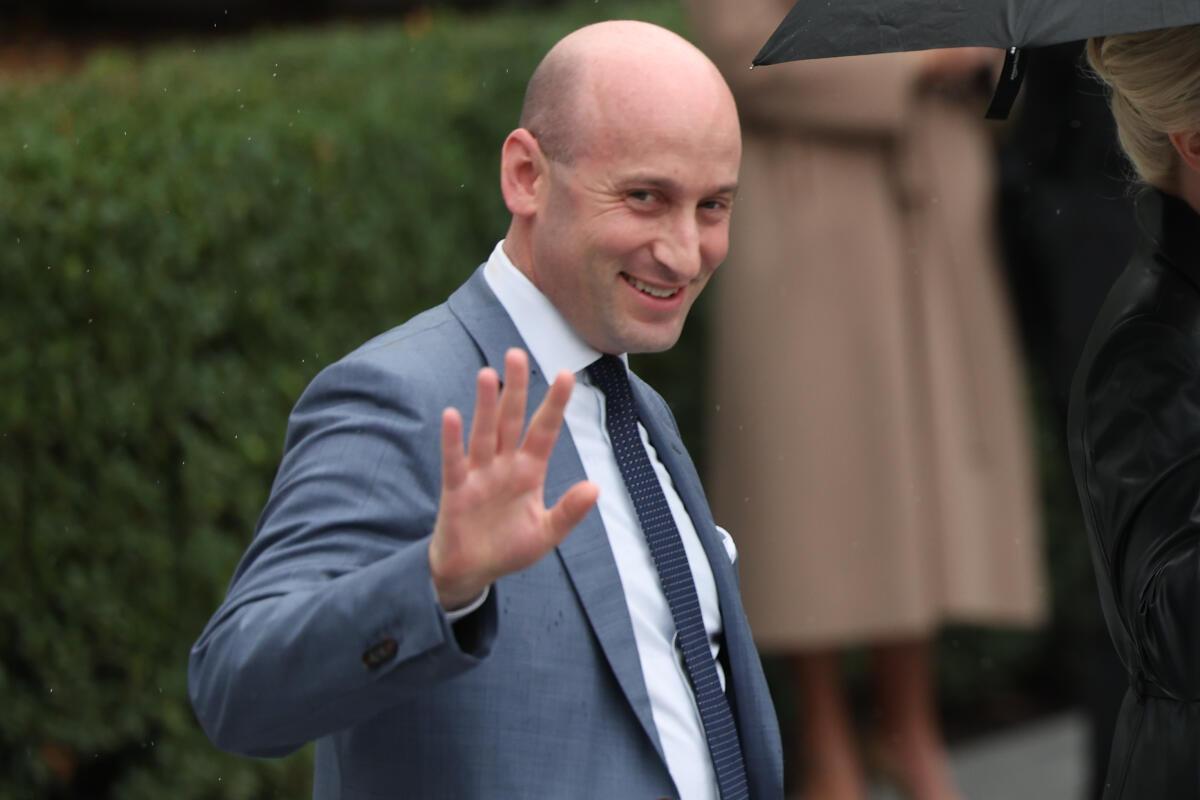
U.S. President Donald Trump has appointed
his longtime ally Stephen Miller as the new White House Chief of Staff, making
a major change to his administration following the Republican Party’s defeat in
the midterm elections. Miller is widely regarded as a key architect of the
Trump administration’s hardline policies against immigrants in the United
States. The change comes after the Republican Party lost its
majorities in both chambers of Congress following its midterm election defeat.
With Democrats now holding the upper hand in the House of Representatives and
the Senate, the Trump administration could face difficulties in passing
legislation, as well as congressional investigations into various other
matters. According to Reuters, Stephen Miller will replace the current Chief of
Staff, Susie Wiles. Announcing the decision on social media, Trump described
Miller as one of his trusted advisers and also praised Wiles for her services.
Miller’s appointment will take effect on Monday.
Citing a White House official, Reuters reported
that Miller’s appointment indicates Trump has no intention of reviewing his
policies and is instead assigning greater responsibilities to his loyal allies.
The official said that despite millions of American voters rejecting Trump’s
domestic and foreign policies, the president was not changing his position. Earlier
this week, Trump said he was willing to work with Democrats in Congress.
However, appointing a hardliner such as Miller as Chief of Staff suggests that
the president may maintain his tough stance on immigration and other issues. According
to Reuters, Trump had been dissatisfied with the performance of his political
and media teams even before the election campaign. Following the Republican
defeat and a decline in his public approval ratings, he also emphasized the
need for the White House to adopt a more aggressive approach.
Who Is Stephen Miller?
The 41-year-old Stephen Miller is considered one
of Trump’s longtime allies and is among the few individuals who have worked
with him during both his first and second presidential terms. After Trump
returned to the White House in 2025, Miller took over as Deputy Chief of Staff.
However, his influence over major domestic policy matters has extended far
beyond his official position. Miller is particularly regarded as a key
architect of Trump’s hardline immigration policies. He set a target of
arresting 3,000 people every day as part of the crackdown on undocumented
immigrants.
To meet this target, U.S. immigration officials
intensified operations across the country, arresting even people with no criminal
records who had been living in the United States for decades. However, these
policies have failed to gain the support of a majority of Americans. According
to a recent Reuters/Ipsos poll, only 36% of Americans support these operations,
while 54% oppose them. Robert Garcia, the senior Democratic member of the House
Committee on Oversight and Government Reform, said his party would investigate
Miller’s immigration policies. He added that Stephen Miller should consider
hiring a lawyer to defend himself. Miller has also played a leading role in
Trump’s campaign to restructure the federal government, which resulted in
thousands of government employees being dismissed during 2025. He also played
an important part in the administration’s actions against universities,
diversity initiatives and other institutions.
A Hardline Stance on Iran and Foreign Policy
Stephen Miller has also supported President
Donald Trump’s hardline approach to foreign policy. He backed U.S. military
strikes against boats suspected of involvement in drug smuggling in the
Caribbean Sea and the Pacific Ocean. These operations have also raised legal
questions. In addition, Miller supported U.S. and Israeli attacks on Iran,
describing a naval blockade and sanctions as effective measures for weakening
Tehran. However, the economic consequences of the war with Iran have cost the
Republican Party electoral support. It therefore remains unclear whether Miller
still holds his previous position on these measures.
Mark Short, who served as chief of staff to
former Vice President Mike Pence during Trump’s first term, described Miller as
a loyal aide to the president who would be willing to confront lawmakers on
various issues, including immigration and congressional investigations.
According to Short, Miller’s appointment does not indicate that the Trump
administration expects significant progress on legislation through cooperation
with Democrats. U.S. Defense Secretary Pete Hegseth also welcomed Miller’s
appointment. In a social media post, he wrote, “Patriots are now in control.”
It is worth noting that Democrats are calling for Hegseth’s impeachment over
the war with Iran.
How Important Is the White House Chief of Staff?
The White House chief of staff is considered one
of the closest and most influential positions in the U.S. presidential
administration. The person holding the post oversees the president’s daily
affairs, meetings and schedule, while also coordinating communication between
White House staff and other government officials. Sixty-nine-year-old Susie
Wiles submitted her resignation on Thursday night. According to a White House
official, she will now work with Trump’s political team. Wiles were the first
woman in U.S. history to serve as White House chief of staff. With decades of
political experience, she was known for managing White House affairs in a more
organized manner than many of Trump’s previous advisers.
Despite being diagnosed with early-stage breast
cancer and undergoing treatment earlier this year, Wiles remained in her position.
Although she rarely challenged Trump’s policies, she played an important role
in maintaining discipline in the often chaotic White House environment and
advising the president. Four chiefs of staff served during Trump’s first
presidential term. Some of them struggled to manage the president’s
unpredictable decisions and behaviour.