Wellington: Voting in New Zealand’s general
election concluded on Saturday following a closely fought and highly
competitive campaign. The two major rival parties are locked in a tight race,
with neither appearing to have a clear path to securing a majority and forming
the next government. The incumbent conservative government, led by the National
Party, is seeking a second term against a left-wing bloc led by the Labour
Party. Opinion polls released on
election day suggested that neither Prime Minister Christopher Luxon of the
National Party nor Labour opposition leader Chris Hipkins was in a confident
position to claim victory. As a result, smaller parties on both sides of the
political spectrum are expected to hold the balance of power and play a
decisive role in determining the next government.
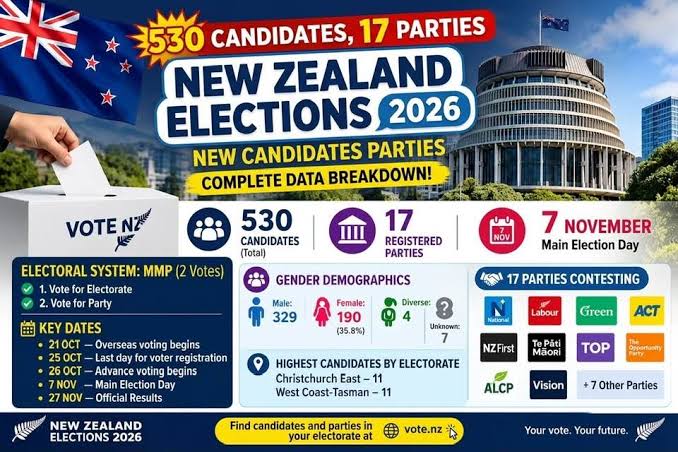
Voting for the election began on October 26 and
concluded at 7 p.m. on Saturday. New Zealand’s Electoral Commission aimed to
release the initial count of the first 5 percent of votes within 30 minutes of
the polls closing. By the end of
Saturday night, results from approximately 95 percent of the votes were
expected to be available. However, the final certified results, including votes
cast by citizens living overseas, are scheduled to be announced on November 27.
Luxon, who came to power in 2020, is facing a difficult battle to secure a
second term as prime minister after reportedly facing two no-confidence votes
from members of his own party’s parliamentary caucus this year. Meanwhile,
Hipkins is seeking to return to power following his party’s heavy defeat three
years ago.
In the South Pacific nation, which has a
population of 5.6 million, approximately 3.8 million people were eligible to
vote. New Zealand has a unicameral parliamentary system and no provincial or
state governments. The central government, elected for a three-year term, holds
final authority over the country’s policies and direction. Before election day,
analysts saw no easy path to a parliamentary majority for either a three-party
right-wing coalition or a three-party left-wing alliance. The uncertainty may
reflect voter dissatisfaction with both major political blocs, as New Zealand’s
trade-dependent economy continues to face difficulties following a series of
international economic shocks.
New Zealanders do not directly elect their prime
minister. Instead, each voter casts two ballots: one for their preferred
political party and another for their local constituency representative. Any
party or coalition seeking to form a government must secure more than half of
the seats in Parliament. The final distribution of parliamentary seats is
determined according to the country’s electoral formula and official
calculations. In 2023, the National
Party formed one of the most conservative governments in New Zealand’s modern
history by joining forces with two other right-wing parties: the populist New
Zealand First and the libertarian ACT Party. Critics of Luxon, a former
business executive who entered politics in 2020, have questioned his political
experience compared with the more seasoned leaders of the smaller parties in
his governing coalition.
In previous elections resulting in a
parliamentary deadlock, the two major political blocs have competed to secure
the support of smaller parties holding the balance of power. Recent opinion
polls suggest that a similar situation could emerge in the current election if
the Opportunity Party manages to enter Parliament for the first time. Although
Luxon has ruled out forming a government with the Opportunity Party, analysts
say that if its leader, Raf Manji, or the party's parliamentary representation
becomes the only viable route to securing power, the leaders of both major
political blocs may have little choice but to enter negotiations.