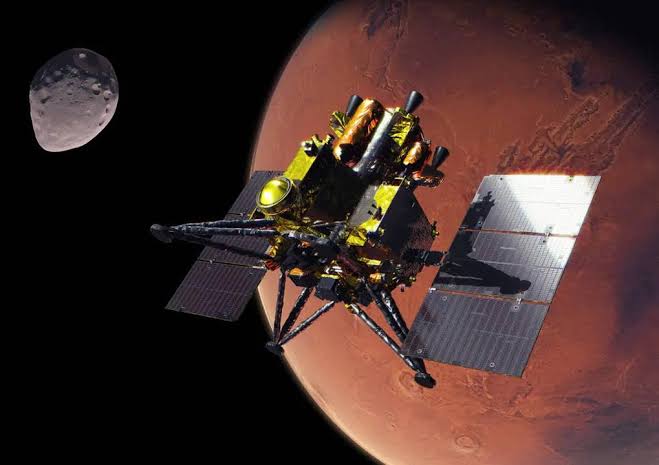
The US space agency NASA, in collaboration with
the Japan Aerospace Exploration Agency (JAXA), has completed preparations for a
historic mission to explore Mars’ two moons, Phobos and Deimos. The mission is
scheduled to launch on October 19. Its primary objective is to collect samples
from Phobos and bring them back to Earth, helping scientists uncover some of
the most ancient and significant mysteries surrounding Mars.
Rather than focusing directly on the Red Planet
itself, NASA is strongly supporting JAXA’s Martian Moons eXploration (MMX)
mission. The advanced uncrewed spacecraft will conduct a detailed survey of
both Martian moons and attempt a landing on one of them. The ambitious mission
also aligns with NASA’s broader Artemis programme, which aims to prepare for
future human exploration deeper into the solar system.
Key Mission Timeline and Schedule
The mission is scheduled to begin on October 19
with a launch from JAXA’s Tanegashima Space Center in Japan. After its journey
through space, the spacecraft is expected to reach Mars orbit in August 2027. The
collection of scientific samples from Phobos is not expected to begin before
December 2028. The valuable samples are scheduled to be returned safely to
Earth by 2031.
The Origins of Mars’ Moons and Their Scientific
Significance
According to scientists, these small,
asteroid-like moons may be remnants of a large object that collided with Mars,
or they may be asteroids captured by the planet’s gravitational field. The
mission will investigate the moons in detail, focusing particularly on the
original composition of Phobos’ surface. The findings could help scientists
unravel the mysteries of how the moons formed and evolved. Understanding their
origins could provide important insights into how the early terrestrial
planets, including Earth, acquired water and organic compounds. The scientific
samples returned to Earth are also expected to support preparations for future
human missions to Mars.
NASA’s Technical and Research Contributions
NASA is working closely with JAXA through its
Discovery Program to support the mission. As part of its contribution, NASA is
providing the MEGANE gamma-ray and neutron spectrometer for the MMX spacecraft.
The instrument will help scientists study the composition of Phobos and support
the mission’s scientific investigations. In addition, NASA will receive
approximately 15 percent of the returned samples at its Astromaterials Research
and Exploration Science (ARES) division at the Johnson Space